Physiotherapy Approaches Compared
A guide to the main schools of physiotherapy for back pain — MDT, manual therapy, exercise-based, and pain neuroscience — and the evidence behind each.
Why There Are So Many Approaches
Physiotherapy for back pain is not one thing. It is a profession that encompasses multiple schools of thought, sometimes with quite different theories about what causes pain and what resolves it. This is not a failure of the field — it reflects genuine complexity. Back pain is heterogeneous: the mechanisms underlying a disc herniation in a 28-year-old are different from chronic pain in a 55-year-old who has been deconditioned for years. Different approaches suit different presentations. Understanding the main schools helps you evaluate what you're receiving.
Mechanical Diagnosis and Therapy (McKenzie Method)
Developed by Robin McKenzie, MDT is built around the concept of directional preference — the idea that patients with disc-related pain tend to have a direction of movement that reduces or centralizes symptoms (moves pain from the leg toward the spine), and a direction that peripheralizes pain (moves it further down the limb).
The assessment involves repeated end-range loading in flexion and extension. If extension reliably centralizes your pain, you are a responder to extension loading. McKenzie practitioners use this to guide exercise prescription.
The evidence is strongest for disc-related symptoms with radiculopathy. A 2017 systematic review found centralization during the McKenzie assessment is a valid prognostic marker — patients who centralize tend to do significantly better. MDT also performs well for rapid screening and mechanical classification.
Its limitation is that not everyone has a clear directional preference, and the assessment requires a trained practitioner to perform correctly.
Centralization — where leg or referred pain moves back toward the spine during repeated movements — is one of the strongest favorable prognostic signs in disc-related back pain. If this happens during your physio assessment, it strongly suggests your pain will respond to that direction of loading.
Manual Therapy: Maitland and Mulligan
Maitland mobilisation uses graded oscillatory movements applied to spinal joints — from small, pain-free movements at the limits of range (Grades I–II) to larger movements into resistance and end-range (Grades III–IV). The theory is that controlled mechanical input normalizes joint movement and reduces pain.
Mulligan's Sustained Natural Apophyseal Glides (SNAGs) apply a sustained accessory glide to a spinal joint while the patient actively moves, with the goal of producing pain-free movement.
The evidence for manual therapy is consistent but modest: short-term benefit for acute low back pain, reduction in pain and disability in the first few weeks. Effect sizes are small to moderate. Long-term benefit compared to other active treatments is less clear — manual therapy does not appear to produce superior outcomes at 6–12 months.
Manual therapy is best viewed as a tool to restore movement and reduce acute pain so that exercise can begin — not as a standalone long-term treatment.
Exercise-Based Physiotherapy
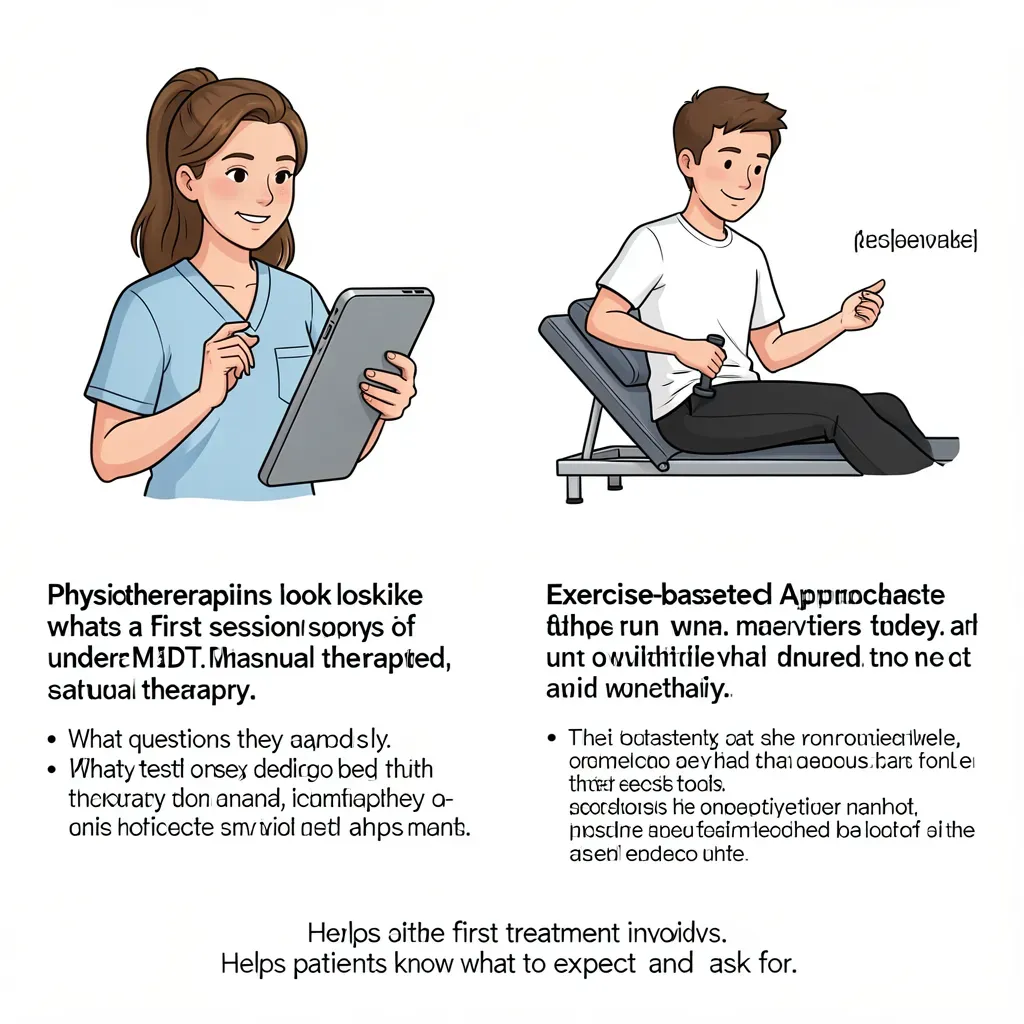
Exercise-based approaches have the strongest long-term evidence of any physiotherapy intervention for back pain. The McGill approach (developed by Stuart McGill) prioritizes spinal stability, focusing on reducing spinal load and building endurance in the stabilizing musculature — the "Big Three" (curl-up, side bridge, bird-dog) are its foundation.
More broadly, structured exercise programmes — including motor control exercises (targeting deep stabilizers like the multifidus and transverse abdominis), progressive strength training, and aerobic conditioning — consistently outperform passive treatments at 6 and 12 months in randomized trials.
The key insight from the evidence is that the specific type of exercise matters less than doing it consistently. Pilates, yoga, general strength training, and motor control exercise all show benefit. Adherence is the strongest predictor of outcome.
Pain Neuroscience Education
Pain Neuroscience Education (PNE) is an approach that teaches patients the biology of pain — how central sensitization works, why pain does not equal damage, and how the nervous system can amplify signals. The goal is to reduce fear-avoidance behaviors, which are among the strongest predictors of chronic pain and disability.
The evidence for PNE combined with exercise is strong for chronic low back pain. A 2019 Cochrane review found education that includes neuroscience concepts outperforms biomedical education alone for chronic spinal pain. PNE alone (without exercise) is less effective.
Dry Needling
Dry needling involves inserting fine needles into trigger points — hyperirritable spots within muscle tissue. It is distinct from acupuncture in its theoretical framework (trigger point theory vs meridian theory) though the practical techniques overlap.
The evidence is moderate: short-term reduction in pain and improvement in pressure pain threshold, particularly for myofascial pain. Effect sizes are similar to manual therapy. It is unlikely to be the primary driver of recovery but may help as an adjunct.
Watch out for physiotherapists who rely predominantly on passive treatments — massage, ultrasound, dry needling, manual therapy — session after session without progressing to an active exercise programme. Passive treatments have a role, but a physio who sees you for 20+ sessions without building your own capacity is not moving you toward independence.
How to Evaluate Your Treatment
Your treatment is working if: your pain is trending down over weeks (not necessarily every session), your function is improving, you are doing more and tolerating more, and you are learning skills you can apply yourself. It is not working if: you feel temporarily better after sessions but return to baseline immediately, you have been attending for 3+ months without measurable progress, or your physiotherapist has not explained the rationale for what they're doing.
A good physiotherapist will set clear goals with you at the start, measure progress against them, and have a discharge plan from day one. You are not meant to need physiotherapy indefinitely.
In Review
- MDT (McKenzie method) has strong evidence for disc-related symptoms; centralization during assessment is a favorable prognostic sign
- Manual therapy (Maitland, Mulligan) shows genuine short-term benefit but limited long-term advantage over other active approaches
- Exercise-based physiotherapy has the strongest long-term evidence; specific exercise type matters less than consistent adherence
- Pain Neuroscience Education is highly effective for chronic pain, especially when combined with exercise
- Dry needling has moderate evidence as an adjunct for myofascial pain — not a primary treatment
- Red flag in practice: predominantly passive treatment without progression to active exercise
- You should be developing independent skills, not increasing dependence on a practitioner