Cycling for Performance With Back Pain
For serious cyclists who won't give up the sport — how to optimize bike fit for spinal health, manage lumbar flexion, and periodize around back pain.
The Cyclist's Dilemma
Cycling is simultaneously one of the most back-friendly cardiovascular activities in terms of spinal compression — the unloaded seated position removes body weight from the lumbar spine — and one of the most predictable causes of chronic lumbar discomfort through sustained, non-negotiable flexion. For hours at a time, the lumbar spine sits in a flexed, posteriorly tilted position. Disc hydration decreases, posterior spinal musculature fatigues in its lengthened state, and the sustained position becomes its own loading pattern distinct from compression or rotation.
The serious cyclist who develops back pain faces a particular challenge: their training volume is high, their identity is bound up in the sport, and the advice they typically receive — "ride less, raise the bars, switch to a recumbent" — often feels like a capitulation to injury rather than a management of it. This article is written for that cyclist. The goal is not to get you off the bike. It is to help you understand the mechanical variables you can control, what the evidence actually supports, and how to build the physical capacity that allows continued high-level cycling.
Lumbar Flexion: The Core Problem
In an aggressive road cycling position, the lumbar spine is held in approximately 15 to 30 degrees of lumbar flexion throughout the ride. On a time trial (TT) bike, this can reach 35 to 45 degrees of continuous lumbar flexion. On a relaxed upright bike, lumbar flexion is minimal — closer to neutral.
The problem is not lumbar flexion itself. Lumbar flexion is a normal spinal movement and the spine tolerates it well in short bursts. The problem is sustained lumbar flexion that persists without variation for hours. This sustained position:
- Progressively loads the posterior disc annulus, which is least tolerant of sustained stretch
- Creates sustained lengthening of the posterior lumbar ligaments and thoracolumbar fascia, reducing their passive stabilizing contribution
- Fatigues the erector spinae and multifidus in their lengthened position — a type of contraction that is less efficient and has lower endurance than contraction at neutral or shortened length
- Produces a pattern of posterior pelvic tilt that, over years of high-volume riding, can become habitual even off the bike
The cyclist's morning back stiffness — particularly the difficulty straightening up or extending after getting out of bed — is a recognizable clinical picture. The disc hydration that occurs during the night (discs absorb fluid during unloaded horizontal rest) is followed by the extension loading of standing upright, and a spine that spent the previous day in sustained flexion is not ready for that transition.
The intradiscal pressure research of Nachemson, and the more recent in vivo studies of disc mechanics, consistently show that sustained flexion under moderate load (which is essentially what cycling does) increases posterior annular stress progressively over time. This is not irreversible damage in most cases — disc tissue adapts and recovery overnight is substantial — but it does explain why disc-related presentations are common in high-volume cyclists, and why interventions that reduce sustained flexion duration are the most mechanically justified.
Bike Fit as Primary Intervention
If you have back pain and you ride a bike, bike fit is not a luxury or a performance optimization — it is a clinical intervention. The relationship between bike fit parameters and lumbar loading is well established and the adjustments are controllable. Before considering any other intervention — exercises, manual therapy, medication — optimizing the bike fit is the logical first step.
The primary fit variables affecting lumbar mechanics:
Handlebar height and reach. These two variables together determine the degree of trunk flexion required to ride in position. Higher bars and shorter reach create a more upright position and less lumbar flexion. Lower bars and longer reach create the aerodynamic position at the cost of increased lumbar flexion. For a rider with back pain, the question is not which is faster — it is what the minimum lumbar flexion requirement is that still permits comfortable, sustained riding.
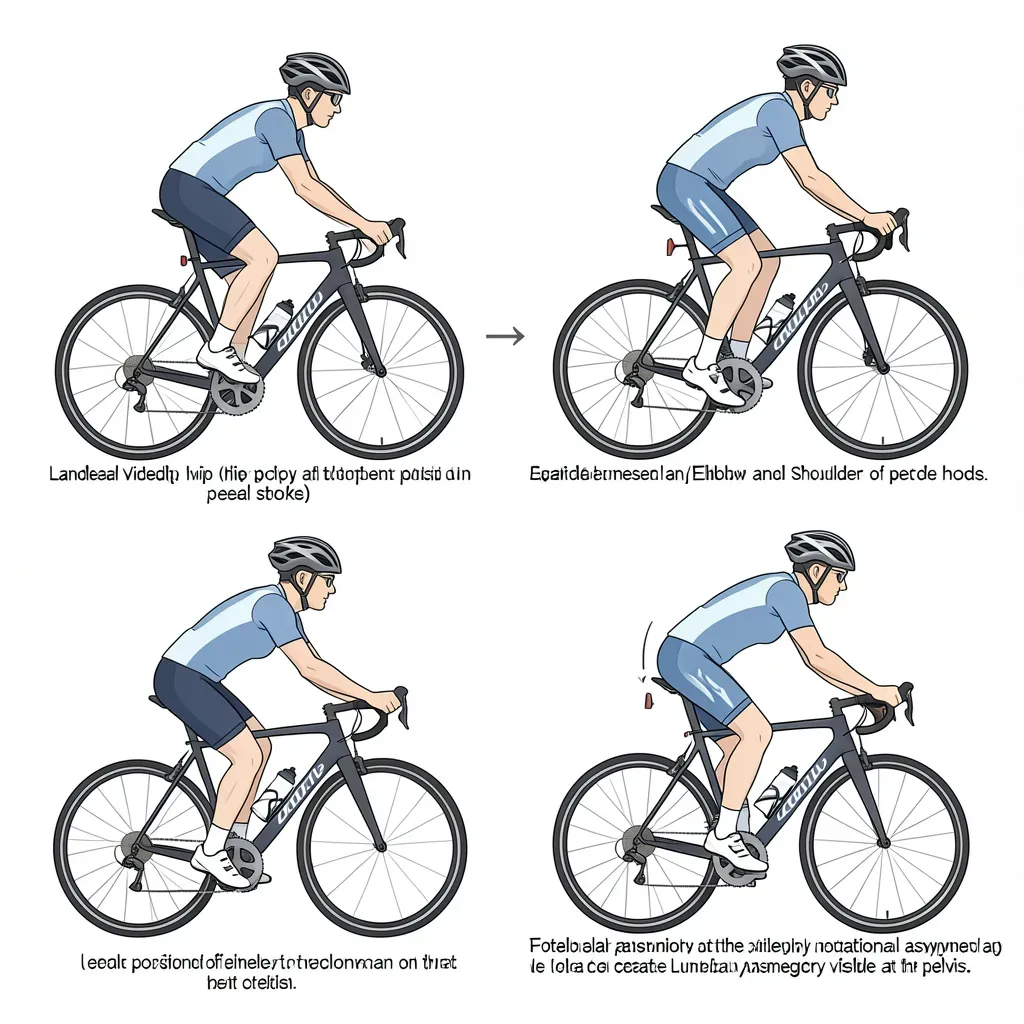
Saddle height. Saddle height is primarily a knee and hip optimization, but it has a secondary lumbar effect through its influence on pelvic position. A saddle that is too high causes the pelvis to rock side to side at the bottom of the pedal stroke, creating lateral lumbar movement and asymmetric loading. A saddle that is too low creates excessive knee flexion and pushes the hips into posterior tilt, increasing lumbar flexion. Both extremes are relevant. The standard functional test — observing the pelvis from behind during pedaling and confirming no lateral rock — is a practical screen.
Saddle fore-aft position. Moving the saddle forward places the pelvis in anterior tilt (reducing lumbar flexion), while moving it back increases posterior pelvic tilt. This is less influential than bar height and saddle height but worth considering as a fine adjustment once the primary variables are set.
Cleat position. Poorly aligned cleats create asymmetric force application through the pedal stroke, which drives compensatory pelvic rotation and asymmetric lumbar loading. This is often the last thing bike fitters check and the first thing overlooked when riders self-adjust their setup.
A bike fit performed by a physiotherapist with specific cycling competence — rather than a generalist bike fitter — integrates clinical assessment of hip mobility, lumbar range, and movement dysfunction into the fit process. The standard position of "what fits on the bike" and the clinical position of "what is appropriate for this spine" are not always the same, and resolving the difference requires someone who understands both. If you are experiencing back pain on the bike, this is the most cost-effective single intervention available.
Road vs. TT Position: The Risk Differential
The time trial position — an aerodynamic posture achieved through a forward lean onto aero bars, with the elbows supported and the torso near-horizontal — creates the most sustained lumbar flexion of any cycling discipline. TT riders routinely spend 20 to 60 minutes in a position that is mechanically close to a sustained, loaded lumbar flexion test.
This position produces specific outcomes. TT specialists have higher rates of lumbar disc pathology than road cyclists. The forced hip flexion of the TT position — with the saddle often higher, the reach longer, and the trunk lower than a road position — creates maximum posterior pelvic tilt and maximum lumbar flexion simultaneously. For a rider with disc pathology, this position is likely to provoke or sustain symptoms.
Gravel cycling, by contrast, tends to produce a less aggressive position. Gravel bikes are typically ridden with a higher handlebar stack, shorter top tube, and more compliance in the frame, producing a position that is 10 to 15 degrees more upright than a comparable road racing position. The variable terrain also means the rider is constantly making micro-adjustments, standing on descents, and varying their position in ways that reduce the sustained-posture loading of road riding. For a cyclist with back pain who wants to maintain outdoor riding volume, gravel is often a more appropriate short-to-medium-term option than road racing.
Track cycling introduces different considerations: the fixed-gear format means the legs are always connected to the pedal stroke, preventing the coast-and-recover breaks of road riding. Sprint events are brief and explosive, with lumbar loads from the explosive power output rather than sustained flexion. Endurance track events share the sustained-flexion profile of road cycling.
Core Endurance for Cycling Posture
The lumbar spine's ability to maintain a controlled position in a flexed, sustained load is determined primarily by the endurance capacity of the local stabilizing musculature — specifically the multifidus, deep erector spinae fascicles, and deep abdominals. This is core endurance, not core strength, and it is a distinct physiological quality that is trained differently from maximal strength.
A strong core in the sense of a high-load isometric contraction is not what protects the cycling spine. What protects it is the ability to maintain low-level, sustained activation of the stabilizers for hours — the endurance quality. A cyclist with excellent deadlift strength and poor McGill side-plank endurance is not well protected. A cyclist with moderate maximal strength and excellent low-level endurance capacity is.
The training implications are direct. The exercises most relevant for cycling back pain are time-based endurance work:
McGill side plank holds: Sustained isometric lateral stabilization, targeting quadratus lumborum and the lateral abdominal wall. A clinically meaningful benchmark is maintaining the side plank for 60 to 90 seconds on both sides. Build duration progressively, adding 10 seconds per week.
Bird-dog: The slow, deliberate bird-dog — extending one arm and the opposite leg from quadruped position and holding for 8-10 seconds before returning — trains the deep stabilizers in a pattern that directly translates to the stabilization demand of cycling. Not fast repetitions; slow, deliberate, sustained holds.
Pallof press: Anti-rotation core work using a resistance band or cable, building the capacity to resist rotation under load. This addresses the rotational demand of out-of-saddle climbing.
Plank variations: Standard plank, plank with shoulder tap, and plank with leg lift — all focusing on duration and quality of position rather than maximal hold time. Three sets of 30-45 seconds builds useful capacity.
These exercises should be performed on non-riding days or after riding, not before. Pre-ride core fatigue reduces the endurance capacity available during the ride itself.
When to Raise the Bars vs. When to Build Capacity
This is the practical decision point for most performance cyclists: does the solution lie in adjusting the bike (accepting a less aggressive position) or in building the physical capacity to tolerate the position you want to ride in?
The honest answer is that both are often required, and the sequence matters. Raising the bars during the acute phase of a back pain flare is appropriate — it immediately reduces the provocative load and allows riding to continue. Staying in a raised-bar position indefinitely because core endurance has not been rebuilt is a missed opportunity. The goal should be to use the modified position as a foundation for rebuilding capacity, then progressively returning toward your preferred position as that capacity develops.
A reasonable framework:
Acute phase (first 2-4 weeks): Raise bars, shorten rides, avoid climbing out of saddle. Focus is symptom management and maintaining the habit of riding.
Rehabilitation phase (weeks 4-12): Maintain modified position while deliberately adding core endurance training off the bike. Gradually increase ride duration. Begin adding brief out-of-saddle segments.
Return to performance phase (weeks 12+): Progressively lower bars in 5mm increments every 2-3 weeks as core endurance benchmarks are met. Increase ride intensity. Full training load resumes when the target position is achieved without symptom provocation over three or more rides at progressive intensity.
The cyclist who bypasses the rehabilitation phase and simply raises their bars permanently has managed the symptom without addressing the capacity deficit. They will experience the same problem again under the same demands.
High training volume is not a contraindication to recovery for most lumbar presentations. The cardiovascular fitness maintained through cycling is beneficial for recovery, and the activity itself keeps the spine loaded (lightly) rather than resting it into deconditioning. Reducing volume temporarily during acute phases is appropriate; extended complete rest from cycling is rarely necessary and not generally evidence-supported for non-specific lumbar pain.
Periodizing Around Back Pain
Performance cyclists think in training cycles. The same framework applies to managing back pain: acute, sub-acute, and maintenance phases each require different approaches, and integrating this into an annual training plan is both possible and useful.
Base training phases — high volume, low intensity — are an appropriate time to address bike fit and build core endurance. The lower intensity means the position can be slightly compromised without significant performance penalty, and the volume builds the endurance base simultaneously.
High-intensity training blocks, when internal motivation to ride in the most aggressive position is strongest, are also when back pain is most likely to recur if capacity has not been built. Building the core endurance phase into the base period specifically to prepare for the high-intensity period is intelligent periodization.
Race seasons involve a trade-off the individual athlete must make explicitly: maximum performance position versus spinal comfort. For many athletes, a position that is 1-2% less aerodynamic but that allows complete, high-quality training and racing without pain interruption is the higher-performance choice when considered across a full season.
In Review
- Cycling creates sustained lumbar flexion rather than high compressive load — the chronic nature of the position, not the magnitude, is the primary risk
- Bike fit is a clinical intervention with direct mechanical effects on lumbar loading — handlebar height, saddle height, fore-aft position, and cleat alignment are all adjustable and relevant
- TT positions produce the highest lumbar flexion of any cycling discipline; gravel cycling produces the most spine-friendly position with natural position variation
- Core endurance — specifically the capacity to maintain low-level stabilizer activation for extended periods — is the physical quality most relevant for cycling back pain
- Time-based exercises (side plank holds, bird-dog with holds, Pallof press) build the endurance quality that protects the cycling spine
- The intervention sequence matters: raise bars acutely, build core endurance during rehabilitation, progressively return to target position as capacity improves
- High training volume can often continue with position modification — complete cycling rest is rarely necessary or supported for non-specific lumbar presentations
- Integrating core endurance training into base training periods as preparation for high-intensity blocks is intelligent periodization for the cyclist with a back pain history