Tracking Your Progress
Objective measures and a simple logging system to tell whether you're improving — so you can make smart decisions, not emotional ones.
Why Your Pain Score Is Lying to You
The standard question in clinical settings is: "Rate your pain from 0 to 10." It feels objective. It isn't.
Pain ratings are acutely sensitive to sleep quality, stress level, barometric pressure, hydration, mood, how the question is asked, and what you were doing an hour before. Two people with identical tissue damage routinely give pain scores that differ by 4 or 5 points. The same person gives different scores on different days for reasons entirely unrelated to their tissue state.
More importantly: pain is a lagging indicator of progress. Tissue capacity improves weeks before pain reliably reflects that improvement. People whose healing is well underway often cannot tell — because pain fluctuates wildly on a daily basis while the underlying trend is upward.
Making decisions based on today's pain score is like navigating by looking one foot in front of your shoes. You need to look at the road.
The most dangerous application of pain scoring is the "good day" mistake: feeling well and dramatically increasing activity, followed by a multi-day flare. A single good day does not reflect capacity — it reflects that pain is currently low. Capacity is measured over weeks, not moments.
What Actually Measures Progress
Functional measures cut through the noise. These are things you can do, time, and count — things that don't shift with your mood.
Big 3 Hold Times
The most direct measure of spine stability capacity. Track:
- Bird-dog: Hold time per side at current difficulty level
- Modified curl-up: Hold time
- Side plank: Hold time per side
Record these weekly, not daily. You are looking for hold times that increase or difficulty levels that progress over a 2–4 week window. Don't chase daily improvements — connective tissue adaptation is too slow for that to be meaningful.
Walking Metrics
Walking is the backbone of the recovery program and provides the clearest functional signal:
- Walking duration: How long can you walk continuously before symptom onset?
- Walking distance: How far?
- Post-walk response: What is your pain level the morning after a walk?
A person who could walk 5 minutes in week 1 and now walks 25 minutes in week 8 is demonstrably improving — regardless of what their pain score says on any given day.
Pain-Free Windows
Track the duration and frequency of pain-free periods across the day. Ask:
- How many hours today was I at 0/10?
- Was there a period this morning before I loaded the spine where I was pain-free?
- Did I have any 2-hour block today without needing to change position?
Early in recovery, pain-free windows may be measured in minutes. Progress looks like: 10-minute windows → 30-minute windows → 2-hour windows → most of the day pain-free. This trajectory is meaningful even when daily pain scores appear static.
The Task List
Maintain a simple list of tasks that have been off-limits due to pain, and track which ones you can now do. Examples:
- Put on socks without sitting
- Carry a bag of groceries to the car
- Sit through a 90-minute dinner
- Bend to load the dishwasher without wincing
- Get in and out of the car without pain
- Lift a child or grandchild
When you cross items off this list, you are improving — even on weeks when your pain score has not changed. The tasks are the point. Pain score is not.
Write your task list at the beginning of your recovery and revisit it every two weeks. It provides both a measurement of progress and a reminder of why you are doing this work. Reviewing a list where half the items are crossed off is more motivating than any pain score could be.
The Daily Log Structure
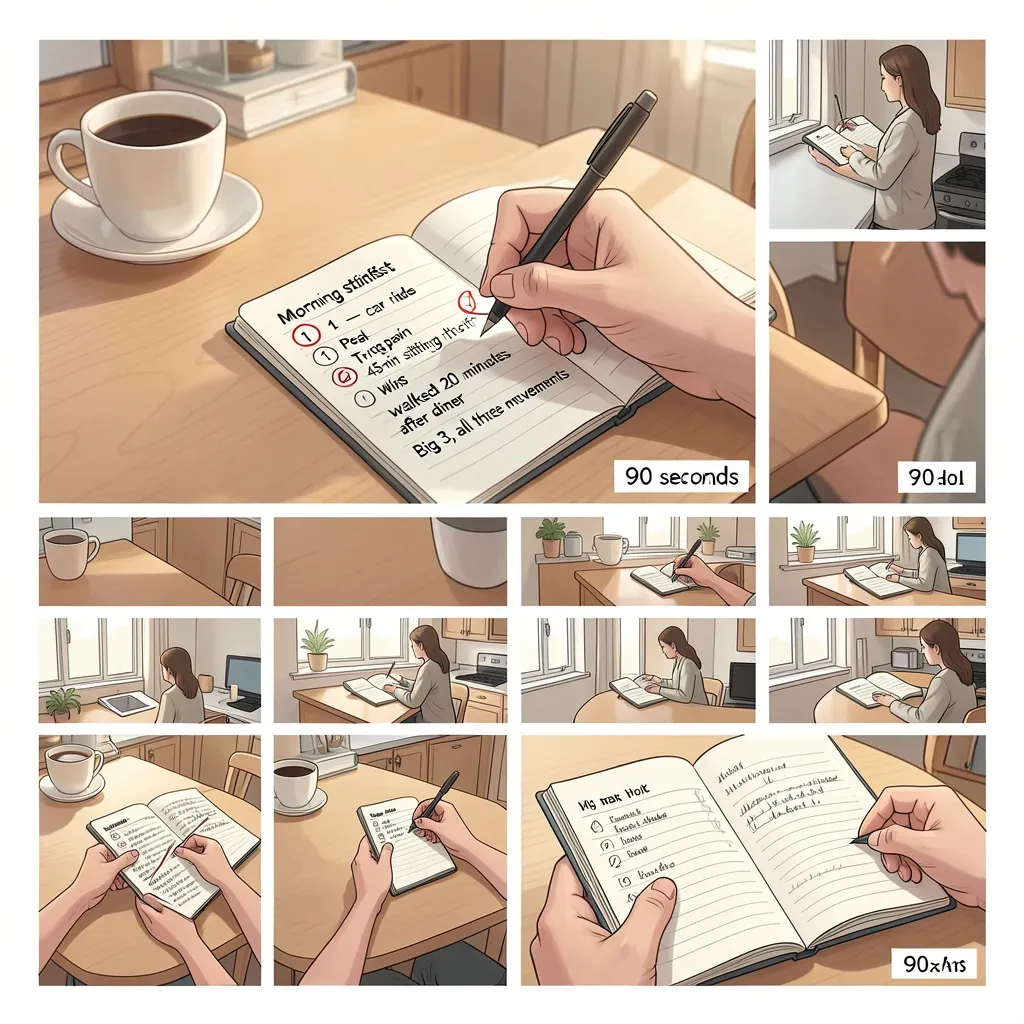
Keep the daily log simple enough that you will actually do it. A log you write for three days and abandon is worthless. A log that takes 90 seconds and you maintain for months is enormously valuable.
Recommended daily log fields:
Morning stiffness (0–3): How stiff were you when you woke up, before you got moving?
- 0 = none
- 1 = mild, resolved within 5 minutes of moving
- 2 = moderate, took 15–20 minutes to ease
- 3 = severe, limited what I could do this morning
Peak pain today (0–10): The highest pain experienced today, and what triggered it.
Pain triggers: One sentence. "Sitting in the car for 45 minutes." "Loaded the dishwasher without thinking." "Nothing identifiable." Even noting that there was no identifiable trigger is useful data.
Wins: One sentence. "Walked 18 minutes." "Slept through the night." "Tied my shoes standing up." This is not optional — the wins log counteracts the negativity bias that chronic pain creates and helps you see improvement that your pain memory would otherwise erase.
Exercise completed: What you did, duration, any notable responses.
The Weekly Review
The weekly review is where the daily data becomes useful. Set aside 10 minutes at the end of each week for this process:
- Average morning stiffness: Is the weekly average lower than last week's?
- Walking duration: What was the longest continuous walk this week vs. last week?
- Pain-free window peak: What was the longest pain-free block this week?
- Task list: Any new items crossed off?
- Trigger patterns: Did any trigger appear three or more times? That's a target for next week.
You are not looking for daily improvement. You are looking for weekly trends. If two consecutive weeks show no improvement across any of these measures, something needs to change. If three consecutive weeks show regression, you have an unresolved mechanical problem that needs attention.
Weekly review transforms a journal from a diary into a tool. Without the review step, you are collecting data and not using it. The 10-minute weekly review is where patterns emerge that are invisible day-to-day — and where you make the adjustments that keep recovery moving forward.
Good Days, Bad Days, and Trends
Understanding Bad Days
A bad day during recovery is not evidence that you haven't improved. It is evidence that the recovery process involves variance.
The factors that produce bad days are well-documented: poor sleep, high stress, cold/damp weather, a minor overload from the previous day, a hormonal shift. None of these represent structural regression. They are noise in the signal.
The mistake is responding to bad days with either panic (dramatically reducing all activity) or denial (pushing through and paying for it the next three days). The correct response is: identify whether there is a specific cause, address it if possible, maintain your baseline activity level, and move on.
Understanding Good Days
Good days are equally dangerous as data points. A good day triggers the impulse to catch up — to do all the things that have been restricted, or to test the limits of recovered capacity. This is how most setbacks happen.
A good day means: your symptoms are low today. It does not mean your capacity has increased. Continue the program at the current level. The gains from a good day are locked in over weeks, not borrowed forward.
Reading the Trend
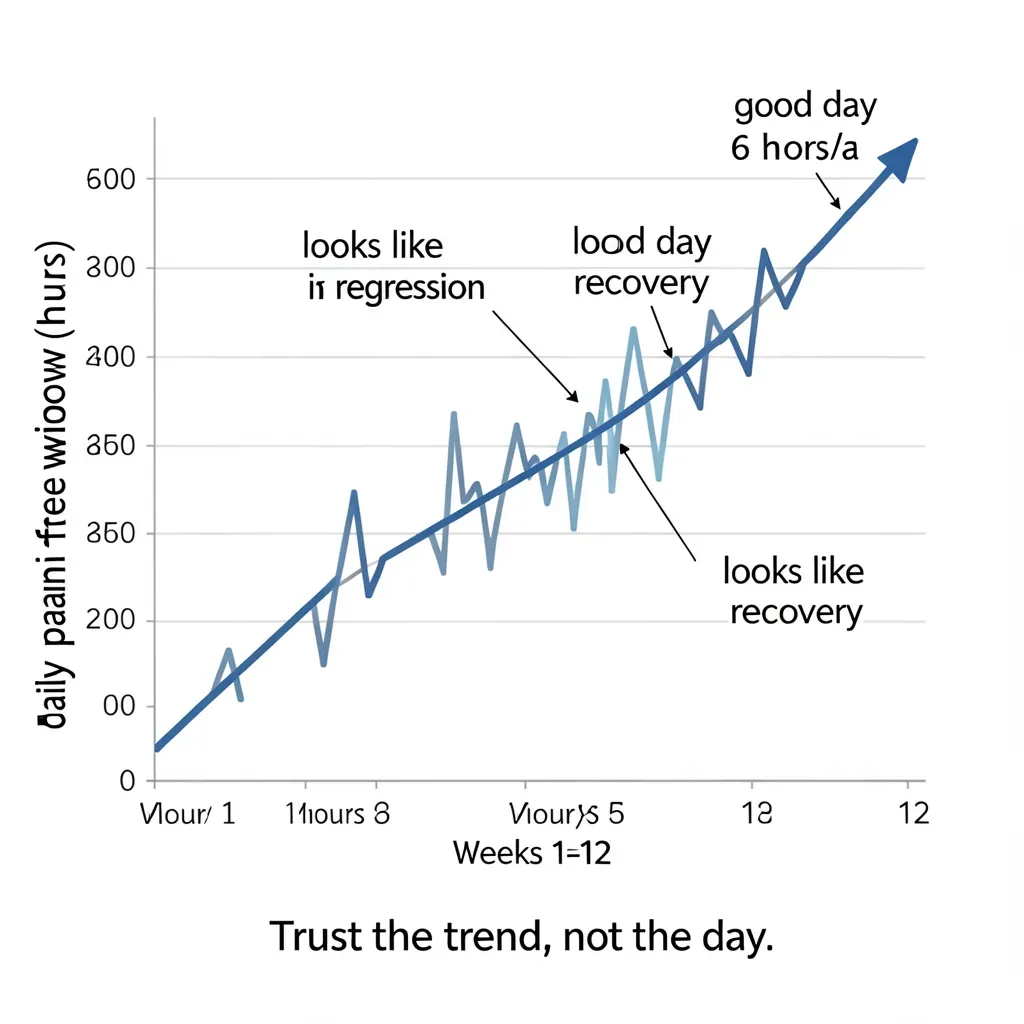
The trend is the only thing that matters. And a trend requires at least two to three weeks of data to be readable.
Draw a rough mental line through your weekly average pain-free window duration. Is it increasing? That is a positive trend. Is it flat for more than three weeks? That is a signal to change something. Is it declining over two weeks? That is a regression requiring investigation.
The trend absorbs good days and bad days equally and reveals what is actually happening. Trust the trend, not the day.
When a Plateau Means Something Needs to Change
A plateau is three or more weeks of no measurable improvement across functional metrics. Plateaus happen — and they are a signal, not a sentence.
The most common causes:
You've hit a load ceiling you can't penetrate alone. The exercises at your current level are no longer challenging enough to drive adaptation, but you haven't earned the next progression yet. Solution: confirm technique with a qualified practitioner, ensure progression criteria are genuinely being met.
There is an unresolved mechanical trigger. Something in your daily life is still adding cumulative load — a commute, a work chair, a habitual posture — that is preventing healing from outpacing damage. Review your trigger log. Something appears repeatedly.
Sensitization is the primary driver now. If functional metrics are improving (walks are longer, Big 3 holds are progressing) but pain scores are not declining proportionally, the pain system itself may be the limiting factor. Refer to the pain sensitization chapter.
Sleep is disrupted. Recovery requires sleep. If sleep quality has declined due to stress, schedule, or pain itself, desensitization stalls regardless of how well the exercise program is going.
A plateau is not failure — it is feedback. It tells you that the current program has extracted most of what it can and that a change is needed. The change might be a new exercise, an addressed trigger, better sleep, or professional input. Plateaus that are investigated and responded to almost always break within 2–4 weeks.
Celebrating Milestones
Recovery from back pain is long. It is measured in months. Months of consistent, unglamorous work with slow and sometimes invisible progress. The people who complete it successfully are the people who track and celebrate milestones along the way.
A milestone is any meaningful functional gain: the first time you walked 20 minutes continuously, the first morning with no stiffness, the first time you played with your children without calculating every movement, the first session with the full Big 3 progression, the first week with no identifiable triggers.
These are not small things. They are the point.
Record them in your log. Acknowledge them explicitly. They are evidence that the work is working — and that evidence is what sustains the effort through the weeks when daily pain scores refuse to cooperate.
In Review
- Pain scores are unreliable day-to-day — they are sensitive to sleep, stress, and weather, not just tissue state
- Functional measures (Big 3 hold times, walking duration, pain-free window length, task completion) cut through pain noise and reflect actual capacity
- The daily log requires 90 seconds: morning stiffness, peak pain and trigger, one win, exercises completed
- The weekly review — 10 minutes — is where the log becomes useful; look for trends across four metrics
- Bad days are noise; good days are not permission to push harder; the trend is the only meaningful signal
- A plateau lasting three or more weeks signals an unresolved mechanical trigger, a load ceiling, sensitization, or disrupted sleep — investigate and change something
- Track and explicitly acknowledge milestones; they are the evidence that the work is working