Bone Health & Nutrition
Calcium, vitamin D, K2, magnesium, and collagen for spine health — what you need, how much, and how to get it.
Why Bone Health Is Central to Back Pain Recovery
The vertebral column is a stack of bones, and the health of those bones determines the structural foundation of everything else. Vertebral body strength resists compressive loading from posture and movement. Endplate integrity — the thin cartilaginous layer between vertebral bodies and intervertebral discs — determines how well nutrients and waste products diffuse in and out of the disc. When endplate microfractures occur, disc nutrition is compromised, accelerating degeneration. Vertebral compression fractures, often silent and frequently misattributed to "muscle pain," are a significant source of chronic mid-back and low-back pain in older adults. Nutrition cannot reverse advanced structural damage, but it directly determines the rate of bone remodeling and loss over years.
Calcium: Getting the Dose and Source Right
The recommended dietary intake for calcium is 1,000mg daily for adults aged 19-50, rising to 1,200mg for women over 50 and men over 70. Most adults in Western populations fall short of this.
Bioavailability varies significantly by source. Dairy calcium is roughly 30-35% absorbed. Calcium from kale and broccoli is actually slightly better absorbed (around 40-50%), despite lower total content per serving. Calcium in spinach is poorly absorbed due to high oxalate content binding the calcium before it can be absorbed — spinach is not a reliable calcium source despite appearing on many lists.
For supplements: calcium citrate is better absorbed than calcium carbonate, particularly in people with reduced stomach acid (common with age and with proton pump inhibitor use). Calcium carbonate requires stomach acid for dissolution and should be taken with food. Calcium citrate can be taken without food.
Vitamin D: The Critical Co-Factor
Calcium cannot be properly absorbed without adequate vitamin D. The relevant biomarker is serum 25-hydroxyvitamin D [25(OH)D]. For musculoskeletal health, the target range supported by most evidence is 30-50 ng/mL (75-125 nmol/L). Below 20 ng/mL is deficiency; below 30 ng/mL is insufficiency associated with impaired calcium absorption and increased bone turnover.
Testing before supplementing is worth doing. A simple serum 25(OH)D test reveals whether you have a deficiency to correct or are already in range. This matters because dosing varies considerably: someone at 15 ng/mL needs a different dose than someone at 28 ng/mL.
D3 (cholecalciferol) is significantly more effective than D2 (ergocalciferol) at raising and sustaining serum 25(OH)D levels. All supplements should specify D3 unless you have a specific reason to use D2.
Sun exposure produces vitamin D via UVB radiation acting on 7-dehydrocholesterol in the skin. However, reliable skin synthesis requires direct UVB exposure (not through glass), occurs primarily between 10am-3pm, and is dramatically reduced by sunscreen, skin pigmentation, and latitude above 35 degrees north or south. For most people in northern climates, sun exposure alone is insufficient to maintain adequate D levels year-round.
Vitamin K2: The Under-Appreciated Co-Factor
K2 receives far less attention than calcium and vitamin D, but it may be the most important piece of the puzzle for ensuring calcium ends up in bone rather than in arteries and soft tissue.
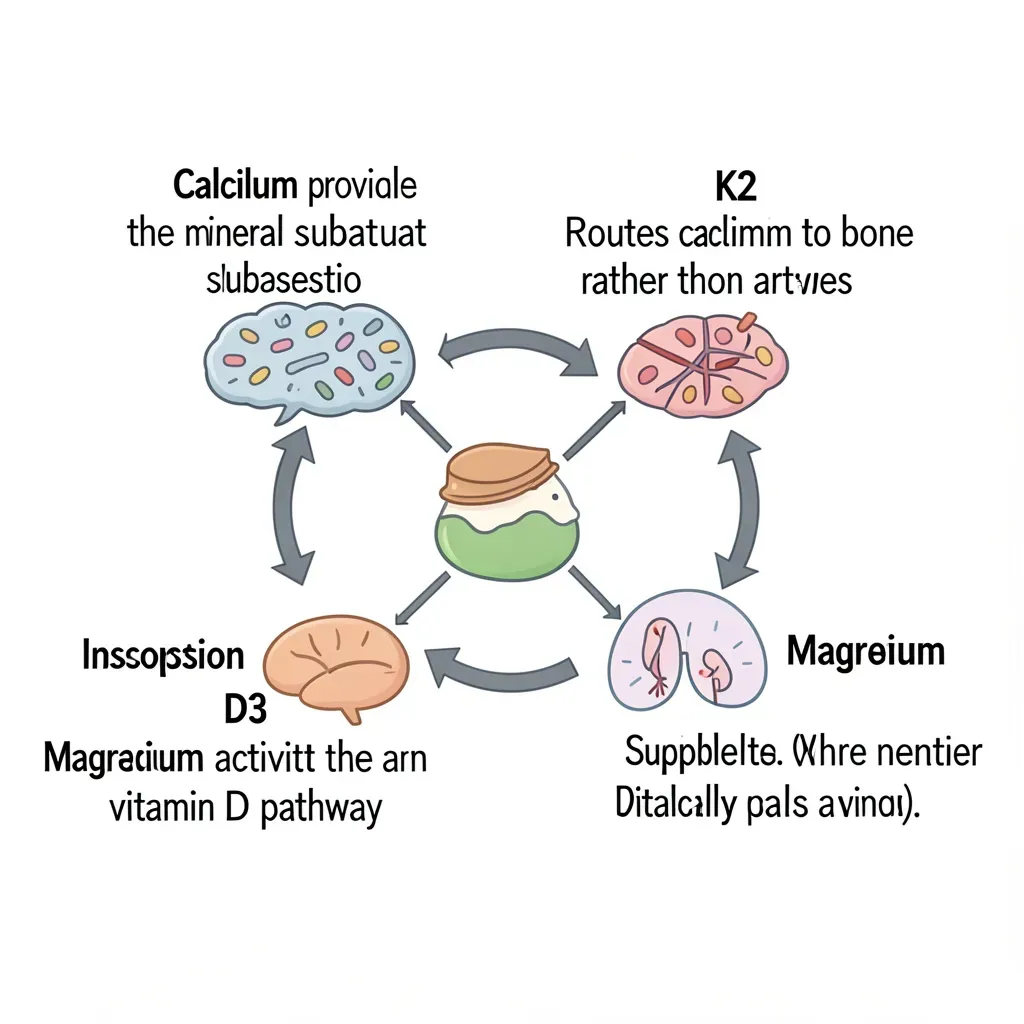
K2 activates two critical proteins through a process called carboxylation: osteocalcin (which anchors calcium into the bone matrix) and matrix Gla protein (which prevents calcium deposition in artery walls). Without sufficient K2, vitamin D increases calcium absorption but the calcium has no guaranteed destination — it can deposit inappropriately.
Two forms matter: MK-4, found in animal products (liver, egg yolks, butter from grass-fed animals), has a short half-life and requires multiple doses to maintain blood levels. MK-7, found in fermented foods (natto is the richest source by far) and increasingly in supplements, has a half-life of approximately 72 hours, meaning once-daily dosing is practical.
For supplements, MK-7 at 100-200mcg daily is the most studied and practical form. The combination of D3 + K2 in a single supplement makes sense because they work synergistically — D3 increases calcium absorption, K2 ensures appropriate calcium routing.
Magnesium: Bone and Beyond
Approximately 60% of the body's magnesium is stored in bone, where it contributes to hydroxyapatite crystal structure. Adequate magnesium is independently associated with higher bone mineral density. Importantly, magnesium is also required to activate vitamin D — the conversion of inactive vitamin D to its active form (1,25-dihydroxyvitamin D) requires magnesium-dependent enzymes. Supplementing vitamin D without adequate magnesium may be less effective than expected.
Deficiency is common. Surveys suggest 50-80% of adults in developed countries consume below the RDA for magnesium (310-420mg daily depending on age and sex). Food sources: pumpkin seeds, dark chocolate, leafy greens, legumes, nuts.
For supplementation, form matters significantly: magnesium oxide is poorly absorbed (around 4% bioavailability). Magnesium glycinate, malate, and citrate are all substantially better absorbed and better tolerated. Magnesium glycinate is particularly useful because glycine itself has benefits for sleep and connective tissue.
Phosphorus, Protein, and Acid Load
High protein and high phosphorus diets (common in Western eating patterns) generate an acid load that the body buffers in part by drawing alkaline calcium from bone. This is the theoretical basis for "acid-forming diets leaching bone." The clinical evidence is more nuanced: adequate protein is actually beneficial for bone health, and the buffering effect is relevant primarily in the context of genuinely poor dietary quality or high phosphate intake from processed foods (phosphate additives are widespread).
The practical takeaway: protein is not a threat to bone health when overall diet quality is reasonable. Phosphate additives in ultra-processed foods are a more genuine concern than natural protein from whole food sources.
Collagen Peptides and Bone
Bone is approximately 30% organic matrix by weight, and collagen type I makes up 90% of that organic matrix. Several randomized controlled trials have shown that collagen peptide supplementation stimulates osteoblast activity and increases bone formation markers. A 2018 study by König et al. found significantly increased bone mineral density in postmenopausal women supplementing with 5g collagen peptides daily over 12 months compared to placebo.
The mechanism involves collagen-derived peptides stimulating osteoblast differentiation and reducing osteoclast activity. This is distinct from simply consuming collagen as a protein source — the bioactive peptides (particularly Pro-Hyp dipeptides) appear to have signaling properties independent of their amino acid contribution.
Vitamin C is required for collagen synthesis (prolyl and lysyl hydroxylation), so ensuring adequate vitamin C when supplementing collagen makes mechanistic sense — take them together.
In Review
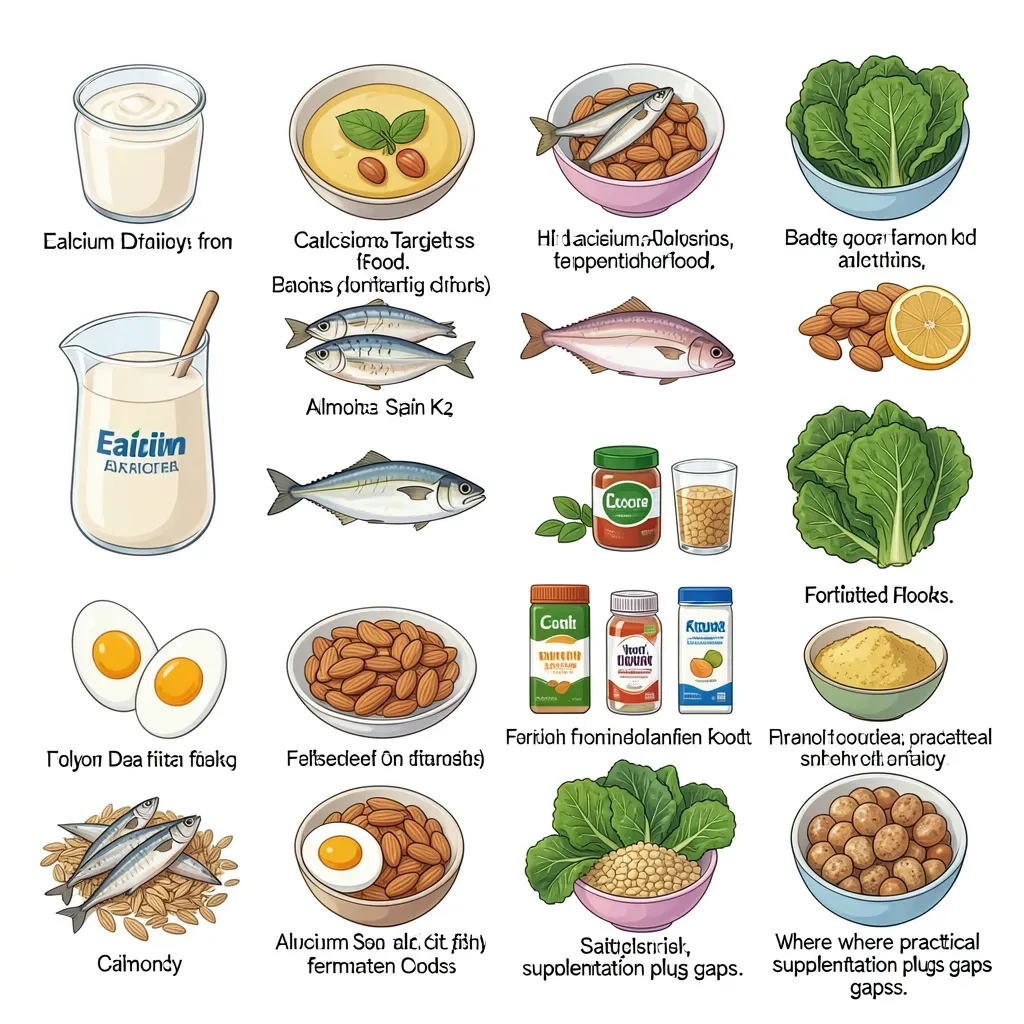
- Calcium from food is safer and better utilized than high-dose supplements — meet targets through diet first
- Vitamin D3 is the only form worth supplementing; test 25(OH)D before starting to calibrate the right dose
- K2 as MK-7 at 100-200mcg daily ensures calcium goes into bone rather than arteries — especially important when supplementing D3
- Magnesium is required to activate vitamin D and contributes directly to bone density; most adults are deficient
- Collagen peptides (5g daily with vitamin C) have RCT evidence for increasing osteoblast activity and bone density
- The four co-factors work together as a system — optimizing one while neglecting others produces diminished returns