Advanced Big 3 Progressions
How to progress the McGill Big 3 beyond the standard protocol — variations, loading, and integration into a full training program.
When You Are Ready to Progress
The McGill Big 3 — the curl-up, side bridge, and bird-dog — are not beginner exercises to be discarded once you feel better. They are foundational spine stability movements with a progression range that extends into serious athletic performance. The question is not whether to keep doing them, but how to evolve them as your capacity grows.
The prerequisites for advancing beyond the standard protocol are: standard endurance targets met consistently (hold times you can achieve without compensation or pain), pain-free for at least three months during all activities of daily life, and daily function that feels genuinely normal rather than carefully managed. If you are still navigating symptoms, the standard protocol is still the right tool.
Progressing too early is the most common mistake at this stage of rehabilitation. Meeting hold time targets once or twice is not the same as owning the movement. The spine needs weeks of consistent, pain-free performance at a given level before loading that pattern further. When in doubt, wait another four weeks at the current level.
Curl-Up Progressions
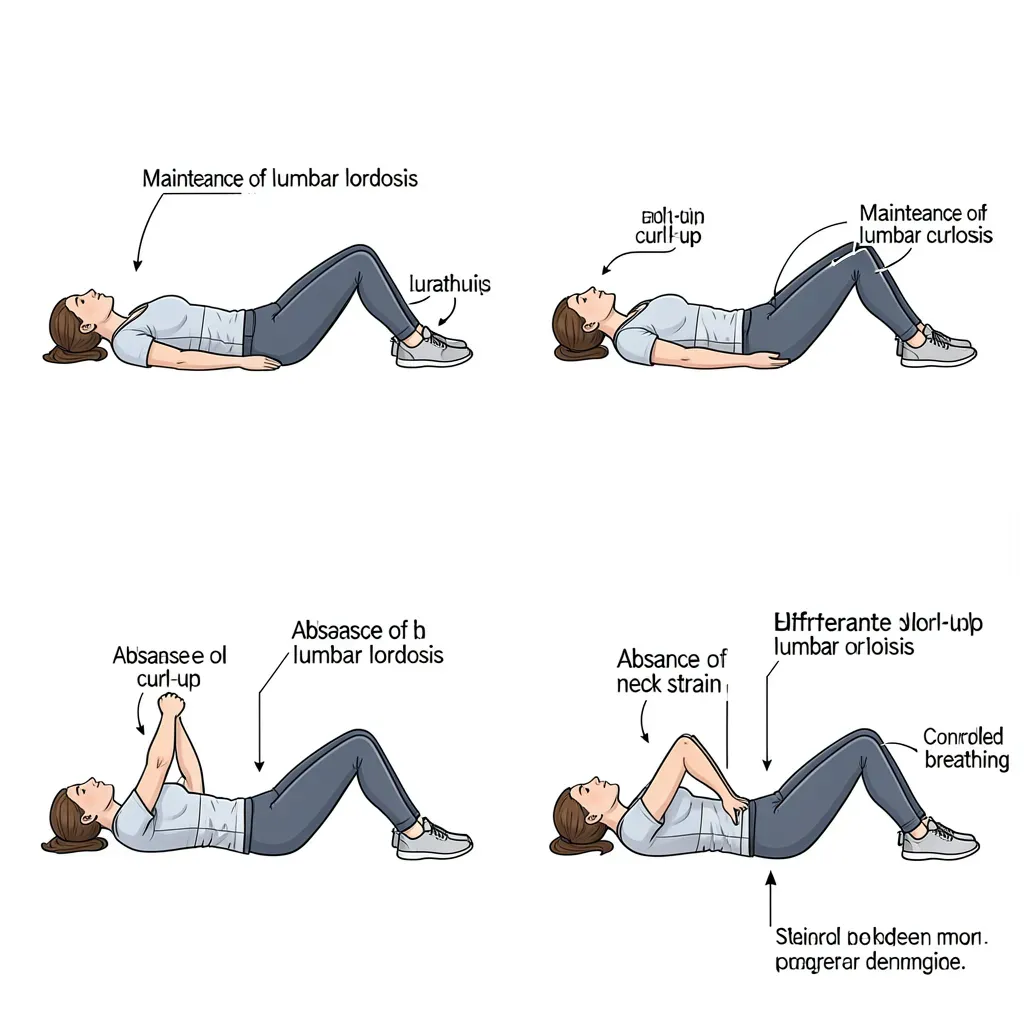
The standard curl-up — hands under the lumbar lordosis, one knee bent, gentle cervical flexion — is a good starting point. The progressions systematically increase the demand on the anterior core without compromising the spine-sparing mechanics that make the exercise valuable.
Single-leg extended curl-up: The standard curl-up with one leg extended (rather than both knees bent, one is now flat). This increases the lever arm and demands more anterior core engagement to maintain the neutral lumbar position.
Contralateral leg raised curl-up: From the standard position, raise the bent knee to approximately 90 degrees hip flexion during the isometric hold. The contralateral hip flexor now adds a flexion moment at the lumbar spine, increasing the stability demand significantly.
Weighted curl-up: Hold a light weight plate (2-5kg) across the chest with arms crossed. The added load increases the demand linearly. Progress in small increments — this is not a heavy exercise.
Unstable surface curl-up: Perform the curl-up with the heels on an unstable surface (a rolled towel, half foam roller, or balance board). The proprioceptive challenge increases neuromuscular demand without adding external load.
Side Bridge Progressions
The side bridge is already a demanding exercise in its knee-supported form. The full side bridge — performed from the feet — is substantially harder and should be the first progression target.
Full side bridge (feet stacked): From the standard knee-supported position, transition to supporting on the side of the bottom foot with the top foot placed in front. The increased lever arm and reduced base of support make this significantly more demanding.
Side bridge with hip dip: In the full side bridge position, allow the hip to drop toward the floor and then drive it back to alignment. This dynamic variation increases the muscular demand and introduces movement into what was previously purely isometric.
Side bridge with leg raise: In the full side bridge position, raise the top leg to approximately 30 degrees and hold. This adds a hip abductor demand and further destabilises the position.
Star side bridge: In the full side bridge, raise the top leg and extend the top arm overhead simultaneously, creating a five-point star position. This is a genuine advanced exercise requiring excellent lateral stability.
Side bridge with cable row: Using a cable machine or resistance band anchored at approximately hip height, perform a single-arm row in the full side bridge position. This integrates the lateral stability demand with an upper body pulling pattern — an excellent transfer to real-world activities.
Bird-Dog Progressions
The bird-dog is perhaps the most versatile of the three, with a wide progression range from beginner to advanced.
Ankle and wrist weights: Adding modest loads (0.5-2kg) to the extending limbs increases the anti-rotation and anti-flexion demand linearly. Start conservatively — the lever arms are long.
Band-resisted bird-dog: A resistance band looped around the extending wrist creates a lateral pull during the movement, challenging the oblique system in a way that purely loaded bird-dogs do not. This is particularly valuable for rotational sport preparation.
Bird-dog on an unstable surface: Performing the bird-dog on a half foam roller or wobble board significantly increases proprioceptive and stabilisation demand. The exercise feels completely different and should be introduced at a much lower progression rate than the stable version.
The swimmer: Both limbs raise simultaneously — the contralateral arm and leg extend at the same time. This is the advanced version of the standard bird-dog and represents a substantial increase in stability demand. The lumbar spine must resist both extension and rotation simultaneously.
The advanced bird-dog benchmarks for experienced trainees are: 30-second isometric hold at the fully extended position with perfect form, repeated 3 times per side with 10-second rest between holds. If you can achieve this bilaterally without any lateral pelvic shift or lumbar rotation, you have a genuinely well-trained posterior stability system.
Programming the Progressions
As progressions advance, the programming approach evolves from endurance-focused to strength-endurance focused. The standard protocol uses high-rep, low-load endurance training. Advanced progressions use moderate-load, moderate-rep sets with short rest periods (30-60 seconds between sets).
A mature Big 3 programme for someone well into the advanced stage might look like: curl-up progression 3 × 8-12 reps (if dynamic) or 3 × 20-30s holds (if isometric), side bridge progression 3 × 45-60s per side, bird-dog progression 3 × 8-10 per side with a deliberate 2-second pause at the extended position. This can be completed in 20-25 minutes and represents a genuinely challenging stability workout.
Integration into a Full Training Programme
Advanced trainees often ask whether the Big 3 should be maintained as a standalone programme or absorbed into a broader workout. Both approaches work. The Big 3 as a warm-up before any lower body or loaded session is an excellent use — it activates the stability system before it is challenged under load. This takes 15-20 minutes and produces a measurably more stable spine for the subsequent session.
The alternative is a standalone stability day, where the advanced Big 3 progressions are the primary training focus. This makes sense for people whose rehabilitation remains a significant priority alongside other fitness goals.
In Review
- Prerequisites for advanced progressions: standard endurance targets met consistently, pain-free for 3+ months, daily function genuinely normal
- Curl-up progressions: single-leg extended, contralateral leg raised, weighted, unstable surface
- Side bridge progressions: full bridge feet stacked, hip dip, leg raise, star position, cable row variation
- Bird-dog progressions: ankle and wrist weights, band resistance, unstable surface, the swimmer (bilateral simultaneous)
- Programming shifts from endurance focus to strength-endurance as progressions advance — shorter rest, more demanding load
- The Big 3 as a pre-session warm-up before loaded training is one of the most effective integration strategies