Stretching Science: What the Research Actually Shows
A critical look at stretching for back pain — what types of stretching help, which are counterproductive, and the specific role of hip flexor and hamstring flexibility.
The Stretching Assumption
Ask most people with back pain what they should do and stretching will appear near the top of the list. Touch your toes. Stretch your hamstrings. Stretch your back. It feels intuitive: tight muscles cause pain, so stretching them should relieve it. This logic is simple, widely repeated, and largely incorrect.
The research on stretching for back pain is considerably more nuanced than this model suggests. Some types of stretching help. Some are actively counterproductive. Several muscles that feel tight in back pain patients are not causing the pain and will not benefit from being stretched. Understanding the distinction requires looking at what stretching actually does, and what the sensation of tightness in the context of pain actually means.
Static Versus Dynamic Stretching
There are two broad categories of stretching that come up in back pain management: static stretching, where a position is held for a sustained period (typically 30–90 seconds), and dynamic stretching, which involves moving through a range of motion repeatedly without holding end-range positions.
The research on static stretching for back pain shows mixed results, and the context matters considerably. A brief session of static stretching for the hip flexors or hip rotators, performed before exercise to access range of motion, is generally safe and potentially useful. However, prolonged static stretching of the lumbar spine itself — particularly sustained lumbar flexion positions — is a different matter.
Dynamic movement, by contrast, shows more consistent benefit across the literature. Moving the joints through their available range without sustained end-range loading reduces intraspinal pressure variation, promotes synovial fluid distribution in the facet joints, and reduces the morning stiffness that many back pain patients experience. The cat-camel exercise is a good example: it moves the lumbar spine through flexion and extension in a non-loaded, cyclical fashion and has been shown to reduce internal spine friction.
The distinction between static and dynamic stretching matters most in the morning, when the disc is maximally hydrated and intradiscal pressure is highest. Sustained lumbar flexion first thing after waking — reaching to the floor, prolonged sitting, or toe-touch stretches — applies sustained stress to a disc that is already at maximum hydration. Brief dynamic movement is a better morning strategy.
Why Lumbar Flexion Stretching Can Worsen Disc Issues
The lumbar disc is a hydraulic structure. Its outer annulus fibrosus contains the nucleus pulposus under pressure. When the lumbar spine flexes, the anterior disc space narrows and the posterior annulus is stretched. In a healthy, well-hydrated disc this is tolerable for short periods. In a disc that is already compromised — whether from age-related degeneration, an annular tear, or a bulge — sustained flexion loads increase pressure within the nucleus and push it posteriorly toward the neural elements.
This is why the classic toe-touch stretch and the knees-to-chest lumbar flexion stretch, while they may feel temporarily relieving, can worsen disc-based symptoms over time. The relief during the stretch is real — you are decompressing the posterior facet joints and lengthening the erector spinae. But if the underlying issue involves the disc, you are simultaneously applying load in the direction most likely to aggravate it.
The clinical signal to watch for is symptom centralization. If lumbar stretches cause radiating leg symptoms to move into the back (centralize), the stretch is directionally appropriate. If they cause symptoms to move further down the leg (peripheralize), the stretch is doing harm regardless of how it feels locally.
McGill's work makes a specific point here: repeated flexion of the compromised disc — even without load, even during stretching — accumulates fatigue damage in the annular fibers. The disc does not adapt to repeated flexion stress the way muscle adapts to exercise. Instead, cyclic loading of a compromised disc produces progressive annular failure. Replacing lumbar flexion stretches with extension-biased movement or neutral-spine mobility work is typically more appropriate for disc pathology.
Hamstring Tightness: Symptom, Not Cause
Hamstring tightness is nearly universal in chronic back pain patients. The intuitive response is to stretch the hamstrings. The problem is that hamstring tightness in back pain is very often a symptom of the underlying problem, not a cause of it.
There are two mechanisms by which hamstrings become functionally tight without being structurally short. First, when the sciatic nerve is irritated — whether from disc pressure, piriformis tension, or neural tension — the nervous system protectively contracts the hamstrings to reduce neural tension. Stretching in this case may temporarily change the sensation but does nothing to address the neural irritation and may, if vigorous, provoke further symptoms.
Second, the hip hinge pattern itself affects how long the hamstrings feel. People who cannot posteriorly tilt their pelvis at the limit of hamstring length will feel a hard stop in their forward bend that they interpret as tight hamstrings. Often what they are actually experiencing is a failure to produce pelvic motion beyond a certain point — which is a hip mobility and motor control issue, not a hamstring length issue.
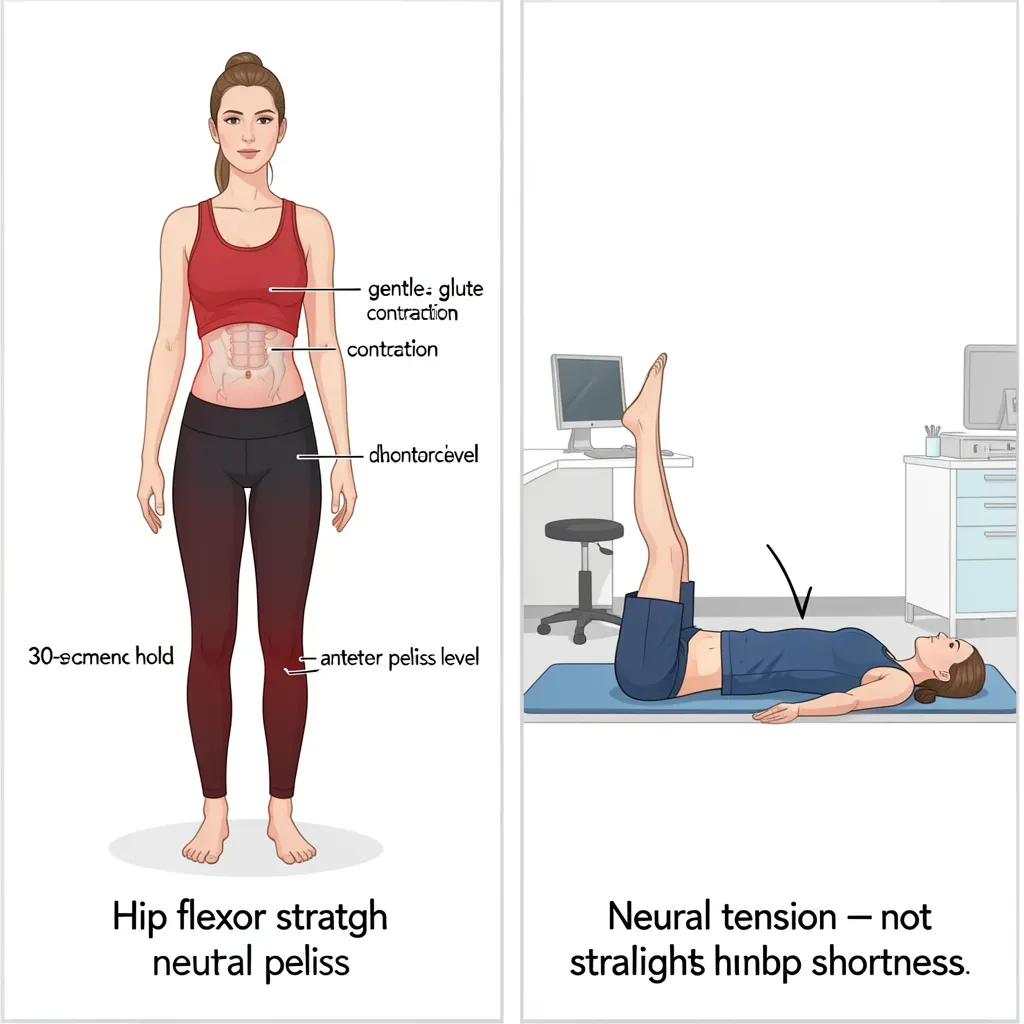
Clinical tests exist to distinguish structural hamstring shortness from neural tension. The straight leg raise tests hamstring length and sciatic nerve mobility simultaneously. Adding dorsiflexion (pulling the toes toward the shin) during the test increases neural tension; if this dramatically increases symptoms, neural tension is a significant component and aggressive hamstring stretching is contraindicated.
If hamstring stretches cause pain to shoot down the back of the leg, worsen leg symptoms, or create tingling or numbness in the foot, stop the stretch. These are signs of neural tension — the hamstrings are not the structure being limited and stretching is not the solution. Nerve flossing and addressing the source of neural irritation are more appropriate.
Hip Flexor Length and Anterior Pelvic Tilt
The hip flexors — primarily the iliopsoas and rectus femoris — have a different relationship to back pain. Unlike the hamstrings, hip flexor shortness can genuinely contribute to lumbar mechanics problems. When the hip flexors are shortened, they pull the anterior pelvis downward and forward, increasing lumbar lordosis and loading the lumbar facet joints and posterior disc. This is the mechanism behind anterior pelvic tilt and is directly relevant to the back pain that many desk workers and people who spend prolonged time seated develop.
The Thomas test assesses hip flexor length. Lying on the edge of a table with one knee pulled to the chest, the opposite leg should hang below horizontal. If it does not — if the thigh remains above the table level — the hip flexors on that side are shortened.
Hip flexor stretching has genuine value in this context, but the technique matters. The kneeling lunge stretch is the most commonly used approach and is appropriate if performed correctly: a tall spine, a gentle posterior pelvic tilt, and a hold of 30–60 seconds. The error most people make is arching the lumbar spine as they drive the hip forward, which compresses the lumbar facets and defeats the purpose of the stretch while potentially aggravating the back.
A more effective technique combines the stretch with a light contraction of the ipsilateral glute, which drives pelvic rotation in the correct direction and deepens the hip flexor stretch without requiring lumbar extension.
What Actually Needs to Be Lengthened
Once you move past the assumption that any area that feels tight needs to be stretched, a more useful question emerges: which tissues genuinely need greater range of motion for the back to function well?
The hip capsule is often overlooked. Hip mobility — specifically hip internal rotation and extension — directly affects lumbar motion. When the hip cannot fully extend, the pelvis must rotate anteriorly to allow the person to stand upright, which compresses the lumbar facets. When hip internal rotation is limited, the lumbar spine and sacroiliac joint compensate during walking, creating excessive rotary stress. Hip mobility drills — particularly 90/90 hip rotations and hip flexor stretches with neutral spine — address this.
The thoracic spine is the other critical area. Thoracic extension stiffness is extremely common and forces both the lumbar spine and the cervical spine to compensate. Thoracic extension exercises over a foam roller, performed with appropriate technique, are among the most clinically useful mobility interventions for back pain patients with sedentary lifestyles.
What Needs to Be Loaded, Not Lengthened
This is perhaps the most clinically important distinction in this area: a large proportion of what back pain patients experience as muscle tightness is actually neurological inhibition or muscular weakness that creates protective guarding.
The glutes are a key example. Gluteal inhibition is extremely common in chronic back pain — the nervous system downregulates glute activity as a protective response, and the hamstrings and lumbar erectors compensate. The result is that the posterior chain feels tight, the hamstrings work overtime, and the lumbar spine is under excessive load during movements that should be driven by the glutes. Stretching the hamstrings does not solve this. Loading the glutes — through hip bridges, single-leg deadlifts, and kettlebell swings — is what addresses the underlying dysfunction.
Similarly, the thoracic extensors often feel stiff and sore not because they are tight in a structural sense, but because they are working too hard to maintain posture against a weak deep stabilizer system. Foam rolling and thoracic extension stretches provide temporary relief. Building the endurance of the deep cervical flexors, lower trapezius, and deep thoracic extensors provides durable improvement.
When a muscle consistently feels tight despite regular stretching, ask whether it might be the muscle doing too much work rather than a muscle that is too short. Load it, strengthen its antagonists, and address the movement patterns that are overusing it. Persistent tightness that does not respond to stretching is almost never a flexibility problem.
A Practical Stretching Framework for Back Pain
Based on the evidence, a rational stretching strategy for most back pain patients looks like this:
Include:
- Hip flexor stretches (kneeling lunge with neutral spine and glute contraction): 2–3 times per day, 30–60 seconds per side
- Hip internal and external rotation mobility drills (90/90 or figure-4): 10 slow repetitions per side
- Thoracic extension over foam roller: 5–8 reps per spinal level from T4 to T10
- Dynamic lumbar mobility (cat-camel): 7–10 repetitions, not held at end range
Approach with caution or avoid:
- Sustained lumbar flexion stretches (toe touches, knees to chest held for 60+ seconds): reduce or eliminate if disc symptoms are present
- Aggressive hamstring stretching with sciatic symptoms: assess for neural tension first
- Any stretch that consistently causes symptoms to peripheralize
Add loading, not more stretching:
- Glute bridges and single-leg deadlifts for posterior chain activation
- Side-lying clamshells for hip abductor strengthening
- Thoracic rotation under load (Pallof press variations) for rotary stability
In Review
- Static lumbar flexion stretching can aggravate disc pathology despite temporarily feeling relieving; centralization of symptoms during stretching is the critical test
- Dynamic movement through range of motion (cat-camel, hip rotation drills) is generally safer and more consistently beneficial than sustained static lumbar stretches
- Hamstring tightness in back pain patients is frequently a symptom of neural tension or motor control deficits, not structural hamstring shortness — always assess before prescribing aggressive stretching
- Hip flexor shortening genuinely contributes to anterior pelvic tilt and lumbar loading; kneeling stretches with neutral spine and active glute contraction are the appropriate intervention
- The Thomas test distinguishes true hip flexor shortness from compensatory posture; the straight leg raise with dorsiflexion distinguishes hamstring shortness from sciatic neural tension
- Persistent tightness that does not respond to stretching is almost always a loading problem — the muscle is overworking, not overlengthened
- Thoracic extension mobility and hip internal rotation are the two areas most consistently worth working on for lumbar back pain patients
- The practical framework is to stretch the hip flexors and move the thoracic spine, load the posterior chain, and be cautious with sustained lumbar flexion