Stress, Sleep & Back Pain
The physiological links between chronic stress, poor sleep, cortisol, and pain amplification — and what to do about it.
Why Stress Shows Up in Your Back
The relationship between psychological stress and low back pain is not metaphorical. There are specific, measurable physiological mechanisms by which chronic stress degrades the tissues that support the spine, amplifies pain signals that arise from those tissues, and prevents the recovery that sleep and rest are supposed to deliver.
Understanding these mechanisms removes the stigma — stress-driven pain is not "weakness" or "imagined" — and it identifies specific intervention points where behavioral changes produce real physical improvements.
The HPA Axis and Cortisol
When the brain perceives a threat, it activates the hypothalamic-pituitary-adrenal (HPA) axis. The hypothalamus signals the pituitary gland, which signals the adrenal glands to release cortisol. This is normal and necessary — cortisol mobilizes energy, suppresses non-urgent functions, and prepares the body to respond to the threat.
The problem arises when the threat is chronic. Modern stress — financial pressure, relationship conflict, work demands, chronic pain itself — activates the HPA axis continuously. Cortisol levels that should spike and resolve stay elevated throughout the day.
What Elevated Cortisol Does to Spinal Structures
The effects are direct and measurable:
- Collagen synthesis suppression. Cortisol directly inhibits fibroblast activity, reducing the synthesis of Type I and Type II collagen. Intervertebral discs, spinal ligaments, and tendons all depend on continuous collagen turnover for maintenance. Under chronic cortisol elevation, this maintenance slows. Discs become less resilient; ligaments lose stiffness and protective function.
- Increased inflammatory mediators. Paradoxically, chronic cortisol dysregulation (as opposed to the acute response) is associated with elevated systemic inflammation — the opposite of cortisol's short-term anti-inflammatory effect. This creates a background state of tissue irritability.
- Muscle tension. Cortisol-driven sympathetic activation maintains chronically elevated muscle tone in the paraspinal muscles. This low-level sustained contraction increases compressive spinal load without any conscious effort or heavy lifting.
Chronic stress is not a lifestyle issue separate from spine health — it is a tissue-level issue. Elevated cortisol measurably degrades the collagen-dependent structures that give the intervertebral disc its capacity to absorb compressive load. A person under chronic stress who is also performing repetitive spinal loading is working with compromised tissues they cannot see on any scan.
Central Sensitization and Pain Amplification
Beyond tissue effects, chronic stress amplifies pain through direct neurological mechanisms. The pain sensitization article covers the mechanics in detail. The stress-specific contribution is this: the HPA axis and the pain processing system share common circuitry.
Cortisol modulates the activity of the amygdala (the brain's threat-detection center), which modulates descending pain inhibition from the periaqueductal gray. When the HPA axis is chronically activated:
- The amygdala runs in a hyper-vigilant state, interpreting ambiguous signals as threatening
- Descending pain inhibition weakens — the brain's natural "volume down" system is suppressed
- The spinal cord undergoes wind-up more readily with repeated stimulation
- Pain thresholds drop: stimuli that would not have been painful become painful
This is measurable. Research using quantitative sensory testing shows that people under chronic stress have demonstrably lower pain thresholds than matched controls, even without any structural spinal pathology. The same disc bulge in two people can produce radically different pain experience based on their HPA axis state.
Lorimer Moseley's pain science framework makes a critical point: pain is the brain's output based on a threat assessment, not a readout of tissue damage. Chronic stress permanently shifts the threat assessment toward "danger," meaning the same input reliably produces more pain output. This is not a personality trait or a coping failure — it is a neurobiological state that can be shifted with the right interventions.
The Sleep-Pain Bidirectional Cycle
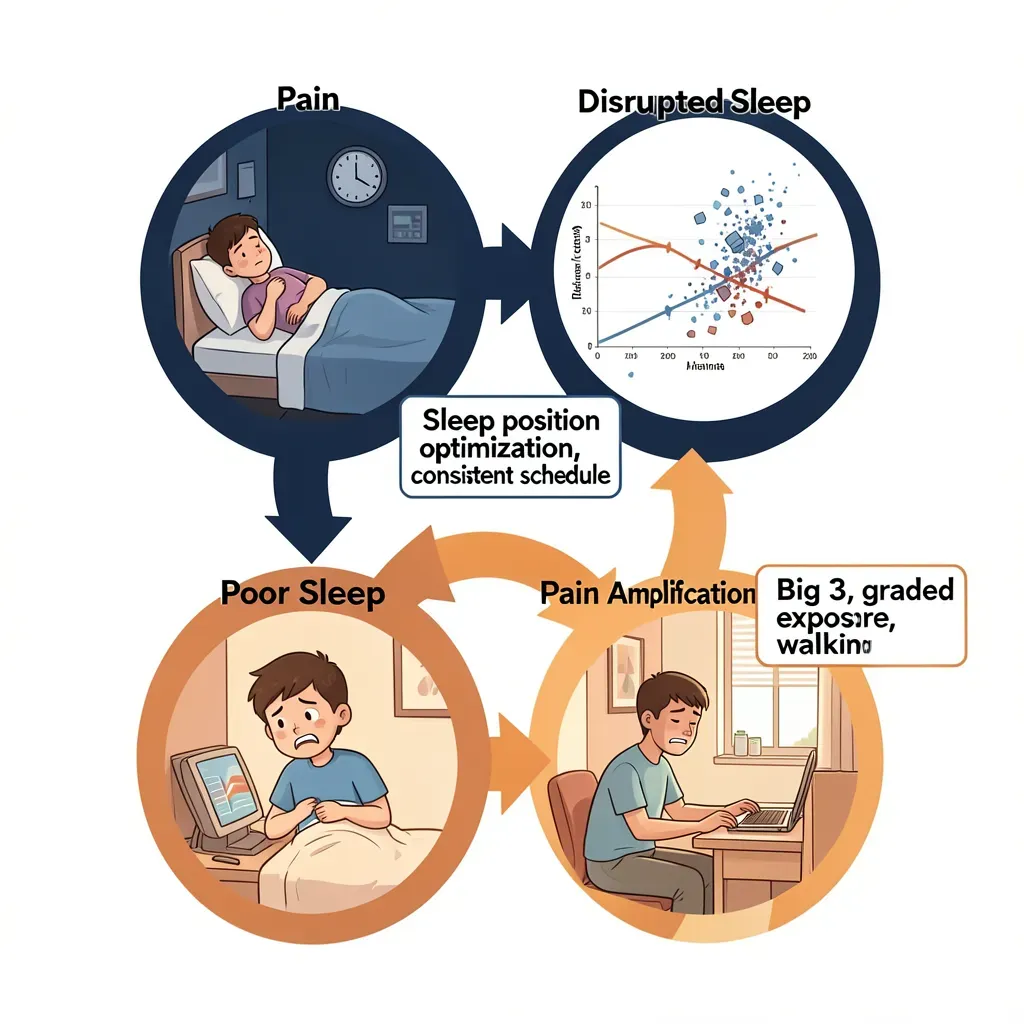
Pain and sleep disrupt each other in both directions, and the cycle is one of the most clinically significant obstacles to back pain recovery:
Pain disrupts sleep:
- Nocturnal pain signals interrupt sleep continuity and prevent deep stage entry
- Uncomfortable sleeping positions create micro-arousals
- The anxiety and rumination that accompany chronic pain prevent sleep onset
- Pain medications (especially opioids) suppress REM sleep architecture
Poor sleep amplifies pain:
- Restorative deep sleep (slow-wave sleep) is when growth hormone is secreted and tissue repair occurs. Disrupted slow-wave sleep means the night's repair cycle is incomplete
- Sleep deprivation increases systemic inflammatory markers (IL-6, TNF-alpha) within 24 hours
- Even one night of disrupted sleep measurably reduces pressure pain thresholds
- Sleep deprivation suppresses the endogenous opioid system — your own painkillers become less effective
- Fatigue reduces movement quality and motivation, increasing mechanical loading errors
The result: pain makes sleep worse, which makes pain worse the next day, which makes sleep worse again. Patients often report a pattern of "bad nights" followed by "bad pain days" that feels chaotic but is actually this cycle running predictably.
Sleep Quality Interventions
These are the interventions with the most consistent evidence for improving sleep in people with chronic pain:
Sleep Schedule Consistency
The single most powerful intervention. The circadian system runs on a 24-hour entrainment cycle that requires consistent light-dark and activity-rest timing. Varying wake time by more than 30 minutes systematically disrupts sleep architecture. Fix the wake time first — the body adjusts sleep onset to match it over 2-4 weeks.
Room Temperature
Core body temperature must drop approximately 1°C for sleep onset to occur. A room temperature of 16-19°C (60-67°F) supports this. Most people sleep in rooms that are too warm, particularly those who run the sympathetic nervous system hot from chronic stress and pain.
Screen Exposure and Light Timing
Blue light from screens suppresses melatonin synthesis with a 2-hour delay. This means a screen viewed at 10 p.m. suppresses melatonin that would otherwise begin rising around midnight. The practical window: eliminate screens 60-90 minutes before target sleep time. Red-spectrum light (incandescent, candle) does not suppress melatonin and is appropriate for evening use.
Pre-Sleep Tension Reduction
People in chronic pain often arrive at bedtime in a state of sympathetic activation — muscles contracted, HPA axis still running, attention fixed on pain. Progressive muscle relaxation (PMR) is specifically effective here: systematically tense and release each major muscle group from the feet upward. Clinical trials show PMR reduces time to sleep onset and increases total sleep time in chronic pain populations.
If pain wakes you during the night, the worst response is lying still and ruminating. Get up, find a relief posture (the spine hygiene article covers these), wait until the acute flare subsides, and return to bed. The goal is to break the association between the bed and pain arousal. The bed should signal safety and rest — not the anticipation of pain.
Catastrophizing: The Neurological Mechanism
The pain sensitization article covers catastrophizing conceptually. The stress-specific mechanism is worth adding here: catastrophizing is not just a cognitive habit — it is measurably associated with altered HPA axis reactivity.
People who catastrophize show:
- Higher baseline cortisol
- Exaggerated cortisol response to pain stimuli
- Slower cortisol recovery after stressors
- Greater amygdala activation during pain anticipation on fMRI
Moseley's graded exposure model is the evidence-based counter. Avoidance of feared movements maintains the threat assessment and sustains HPA activation. Graded exposure — carefully titrated, pain-free contact with feared movements — accumulates evidence that the movement is not dangerous, progressively reducing the amygdala's threat response and the pain output that follows.
This is not "pushing through pain." It is the systematic, measured introduction of movements at intensities below the pain threshold, then progressively expanding that threshold over weeks. The Big 3 and walking program perform exactly this function. Every pain-free rep is a data point that down-regulates the threat response.
Catastrophizing is one of the strongest independent predictors of chronic pain outcomes — stronger than MRI findings in multiple large studies. Addressing it is not a soft add-on to a physical rehabilitation program. It is a mechanistically necessary component of recovery. A program that ignores it is incomplete.
Stress Reduction Modalities with Evidence
Not all stress-reduction practices are equal. These have the most consistent evidence in back pain and chronic pain populations:
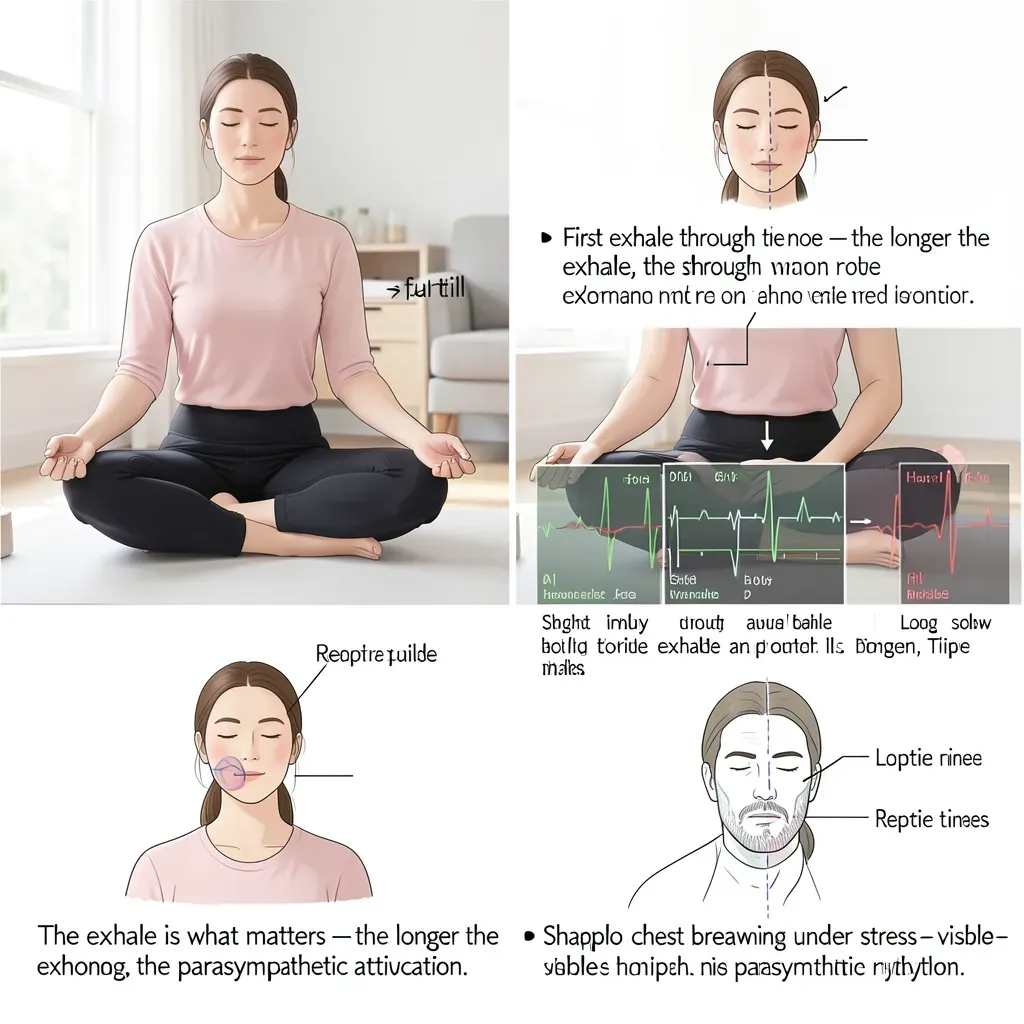
Controlled Breathing (Physiological Sigh)
A double-inhale through the nose followed by a long, slow exhale through the mouth activates the parasympathetic nervous system more rapidly than any other voluntary maneuver. Mechanically, the extended exhale increases vagal tone, dropping heart rate and initiating HPA down-regulation. Ten repetitions takes less than 90 seconds. Research from Huberman Lab and others demonstrates measurable reductions in physiological stress markers within minutes.
This is the most accessible and immediately deployable tool available. It requires no equipment, no special training, and no extended time commitment.
Progressive Muscle Relaxation
PMR has the largest evidence base in chronic pain populations. Consistent practice (10-20 minutes, 5 times per week) reduces self-reported pain intensity, improves sleep quality, and reduces anxiety in randomized controlled trials with back pain patients. The tension-release mechanism provides direct evidence of voluntary muscle control at a time when pain has made many patients feel they have none.
Brief Mindfulness (Focused Attention Protocol)
Mindfulness-based stress reduction (MBSR) trials in chronic pain show modest but consistent reductions in pain catastrophizing, improvements in pain acceptance, and reductions in depressive symptoms. The key word is "brief" — research shows benefits from as little as 13 minutes of focused attention practice per day. The mechanism: repeated attentional practice strengthens the prefrontal cortex's ability to modulate amygdala reactivity, directly dampening the threat-assessment pathway that amplifies pain.
The evidence does NOT support vague "mindfulness apps" used passively. The effective protocol is structured: focus attention on breath or body sensation, notice when the mind has wandered to pain or worry, and deliberately redirect. The redirection is the training stimulus.
Tissue Damage vs. Sensitized Pain: Knowing the Difference
This distinction is clinically important because the management differs:
Pain driven by ongoing tissue damage:
- Constant or near-constant regardless of activity
- Worsening with specific, reproducible mechanical loads
- Associated with a recent injury or identifiable structural change
- Responds to tissue-level interventions (spine hygiene, load modification, the Big 3)
Pain amplified by sensitization:
- Disproportionate to the mechanical challenge
- Fluctuates with sleep quality, stress levels, and mood
- Spreads beyond the original injury site
- Present even during activities that logically shouldn't load the spine
- Associated with catastrophizing, poor sleep, high life stress
- Responds to desensitization strategies (graded exposure, sleep, controlled breathing, addressing stress)
Most chronic low back pain is a mixture of both. The error is assuming it is purely one or the other. Someone who only addresses the mechanical dimension will plateau when sensitization is maintaining the pain level. Someone who only addresses sensitization while continuing to mechanically irritate the spine will not improve either.
The correct approach addresses both simultaneously — which is why this program integrates spine hygiene, movement training, and the psychological and stress components as a single integrated protocol, not a menu of optional add-ons.
When to Involve a Psychologist
Self-directed tools (PMR, controlled breathing, brief mindfulness, sleep hygiene) are effective for mild-to-moderate stress-related pain amplification. Refer yourself for professional psychological support when:
- Catastrophizing persists despite understanding the mechanism
- HPA axis dysregulation appears to be driven by trauma (past or ongoing) — this requires specialized treatment that self-help cannot address
- Depression meeting diagnostic criteria is present (see the Mental Game article for screening signs)
- Sleep disruption has persisted beyond 3 months despite behavioral interventions
- Anxiety about movement is severe enough that you cannot begin the Big 3 at any graded level
A psychologist trained in Acceptance and Commitment Therapy (ACT) or CBT for chronic pain is the most effective referral. These are structured, evidence-based protocols — not general talk therapy — and they have been specifically validated in chronic low back pain populations.
The goal of psychological input in back pain recovery is not to determine that "the pain is in your head." It is to restore the HPA axis and pain-processing system to a calibrated state in which physical rehabilitation can produce its full effect. Psychological work and physical rehabilitation are not alternatives — they are synergistic, and the research is consistent that combined approaches produce substantially better outcomes than either alone.
In Review
- Chronic stress activates the HPA axis and elevates cortisol, which suppresses collagen synthesis, degrades disc and ligament integrity, and elevates baseline muscle tension — all contributing to spine vulnerability
- Elevated cortisol weakens descending pain inhibition and lowers pain thresholds through direct neurological mechanisms, independent of tissue damage
- Pain and poor sleep are mutually reinforcing: pain fragments sleep, and disrupted sleep amplifies next-day pain through inflammation, opioid suppression, and reduced tissue repair
- Sleep interventions with the strongest evidence: consistent wake time, room temperature 16-19°C, eliminating screens 60-90 minutes before bed, progressive muscle relaxation
- Catastrophizing is not a personality trait but a measurable neurobiological state associated with altered HPA reactivity — and one of the strongest predictors of chronic pain outcomes
- Graded exposure addresses catastrophizing mechanistically: accumulating pain-free movement data down-regulates the amygdala's threat response that amplifies pain
- Evidence-based stress reduction: physiological sigh (double-inhale, extended exhale), progressive muscle relaxation, and brief structured mindfulness (minimum 13 minutes/day, 5 days/week)
- Chronic back pain usually involves both tissue-level and sensitization-driven pain — addressing only one dimension produces incomplete recovery
- Involve a psychologist when catastrophizing, depression, trauma, or movement anxiety exceeds what self-directed tools can address