Pilates for Back Pain
The evidence for Pilates, what the research shows, which principles conflict with spine biomechanics, and how to adapt the method safely.
Pilates and the Evidence Base
Pilates enjoys a strong reputation in the back pain world, and that reputation is partly deserved. A body of randomized controlled trial evidence — including a well-regarded Cochrane review update — supports Pilates as more effective than minimal intervention (usual care, general practitioner advice) for reducing chronic low back pain and improving disability scores. The effect sizes are moderate: Pilates is meaningfully better than doing nothing, roughly comparable to general exercise, and probably works through mechanisms of improved motor control, proprioception, and movement confidence rather than through any specific structural change.
The complications begin when you look at which Pilates exercises are actually being used in the research-supported programs, and compare them against the full catalogue of classical Pilates method. Several classic Pilates movements impose spinal loads that are biomechanically indistinguishable from the exercises McGill's laboratory identified as harmful. Understanding the distinction allows you to use what works and discard what injures.
The Imprinting Problem
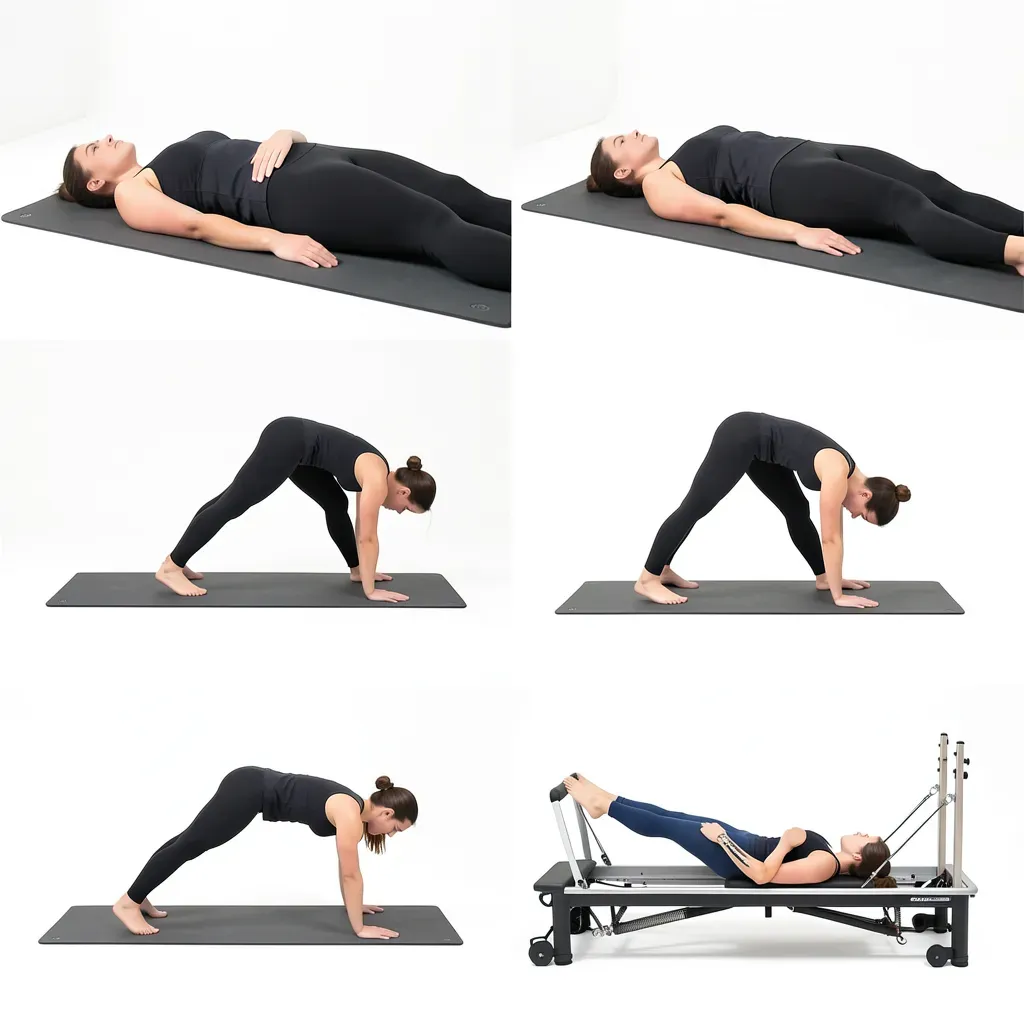
"Imprinting" is a foundational cueing concept in many Pilates traditions: the instructor asks the student to press the lumbar spine flat against the mat, eliminating the natural lordotic curve. The intention is to stabilize the pelvis and prevent the lumbar spine from arching during leg movements.
The biomechanical problem is clear: flattening the lumbar curve reverses the natural lordosis and increases posterior disc pressure. The posture that "imprinting" creates is nearly identical to the posterior pelvic tilt position that spine biomechanics research has consistently associated with elevated disc load and reduced spinal stability. The neutral spine — preserving a gentle natural lordosis — is the spine-protective position, not the flattened one.
When an instructor cues "imprint your spine," substitute "maintain your natural lumbar curve." Your lumbar spine should maintain a small space beneath it, not be pressed flat.
The roll-up — a classical Pilates exercise performed by rolling from supine to seated — is biomechanically equivalent to a full sit-up. McGill's laboratory measurements show that full sit-ups generate approximately 3,300 Newtons of compressive force on the lumbar disc — exceeding the injury threshold for susceptible tissue. The roll-up is contraindicated during recovery and should be replaced with a modified curl-up performed with neutral lumbar spine.
Exercises to Modify or Defer
The Teaser: A full V-sit position requiring simultaneous hip flexion and spinal flexion under load. High lumbar disc compression. Defer entirely during recovery.
Double-leg stretch: Both legs extended away from the torso simultaneously, requiring the lumbar spine to resist extension against the significant lever arm of two legs. Without exceptional core stiffness, the lumbar spine sags into extension. Defer or perform with a single leg while the other foot remains on the mat.
Hundred (unmodified): The classical hundred with both legs extended at table height and the head and shoulders lifted creates sustained spinal flexion under load. The modified hundred — legs at 90-90 (hips and knees at 90 degrees, shins parallel to floor) with the head resting on the mat — maintains most of the core training stimulus with a fraction of the spinal load.
Roll-over: Legs extended overhead, spine in extreme flexion. Contraindicated. Same biomechanical territory as the yoga plow pose.
What IS Beneficial
Side-lying leg work: Clamshells, side-lying hip abduction, inner-thigh lifts — performed lying on the side with a neutral spine. These train the hip abductor and adductor complex without spinal loading. They are the same exercises prescribed in McGill-based rehabilitation programs.
Prone work: Lying face down with spinal extensions (small range, controlled), opposite arm-leg reach (bird-dog in Pilates terminology), and prone hip extension. These activate the posterior chain with the spine in a supported, neutral position.
Balance on the reformer: The reformer (Pilates resistance machine) provides spring resistance and a sliding platform. Kneeling and standing balance work on the reformer challenges proprioception and stabilizer endurance in ways that mat Pilates cannot. The reformer's springs can assist rather than resist movement, making it useful for patients who need support to complete certain movements.
Breathing emphasis: Pilates instruction heavily emphasizes lateral thoracic breathing — directing the breath into the ribs rather than the belly. This breathing pattern activates the deep abdominals and the diaphragm in a way that increases intra-abdominal pressure and contributes to spinal stability. This is consistent with the IAP principles covered in Article 35. The breathing emphasis in Pilates is one of its most legitimate rehabilitative contributions.
Clinical Pilates — conducted one-on-one or in small groups by a physiotherapist who has trained in Pilates method — is meaningfully different from fitness Pilates offered in a gym class. The physiotherapist screens your specific presentation, selects appropriate exercises, and monitors your response in real time. If you are in active recovery, clinical Pilates is strongly preferred over a general group Pilates class.
Reformer vs Mat Pilates
For back pain patients, the reformer offers one major advantage: the equipment can support the body in positions that would otherwise be too demanding, and can provide feedback through resistance that mat work cannot. The footbar and carriage allow leg press-type movements that train the posterior chain with minimal spinal load. The long box prone setup allows supported spinal extension work with precise range control.
Mat Pilates without modification carries more risk during recovery because the exercises rely more heavily on the patient's own stability — and stabilizer function is precisely what is compromised in a recovering spine.
In Review
- Pilates has moderate RCT evidence for reducing chronic low back pain, comparable to general exercise
- The imprinting cue (flattening the lumbar spine) increases posterior disc pressure and should be replaced with neutral spine maintenance
- The roll-up generates approximately 3,300N of lumbar disc compression and is contraindicated during recovery
- Defer the teaser, double-leg stretch at low heights, and roll-over; modify the hundred with legs at 90-90 and head on mat
- Beneficial Pilates work: side-lying hip work, prone opposite arm-leg reach, balanced reformer work, lateral thoracic breathing
- Clinical Pilates conducted by a trained physiotherapist is significantly safer than general group fitness Pilates during recovery
- The reformer provides body support and feedback that makes it preferable to mat-only work for back pain patients
- The breathing emphasis in Pilates — lateral thoracic expansion — contributes to intra-abdominal pressure and spinal stability