The Athlete's Back: Sport-Specific Strategies
Evidence-based spine protection for athletes — from golfers to lifters to combat sports — reducing injury risk without sacrificing performance.
The Athletic Spine Paradox
Athletes need their spines to transmit enormous forces — from a golfer's rotational power to a lineman's blocking force to a fighter's strike. Yet the spine is most vulnerable precisely when these forces are highest.
The solution isn't avoiding force production. It's ensuring the spine is LOCKED in neutral while the hips and shoulders generate the power. The spine is the transmission, not the engine.
Every high-performance athlete who has recovered from a back injury and returned to elite sport did so by learning one thing: how to generate force through the hips while keeping the spine locked. They didn't get "stronger backs" — they got smarter movement strategies.
The Spine-Sparing Power Principle
Force production in sport follows a kinetic chain: ground → feet → legs → hips → locked spine → shoulders → arms → implement (bat, club, racket, ball).
The spine's job is to transmit force, not create it. A stiff spine transmits force efficiently. A moving spine leaks force and gets damaged.
The Two Requirements
- Proximal stiffness for distal performance — a rigid core allows the limbs to produce maximum force
- Hip mobility for spine protection — every degree of motion the hips provide is a degree the spine doesn't need to contribute
Sport-Specific Applications
Golf
Golf destroys backs because of extreme combined rotation and lateral bend. Research on professional golfers shows the spine reaching:
- 100% of lateral bending capacity
- 96% of twisting capacity
- Repeated 200-300 times per practice session
Spine-sparing golf strategy:
- Reduce the backswing slightly (the last 10% of backswing produces minimal ball distance but maximum spine load)
- Brace the abdominals to lock the rib cage to the pelvis during follow-through
- Generate rotation from the HIPS, not the lumbar spine
- Accept a small distance trade-off for career longevity
A professional golfer in the research lab suffered chronic back pain. Analysis revealed his spine hit extreme end-range with every swing. Reducing the backswing and training abdominal bracing eliminated symptoms. He lost a few yards per drive but saved his career — professional golf is about placement, not maximum distance.
Powerlifting and Strength Training
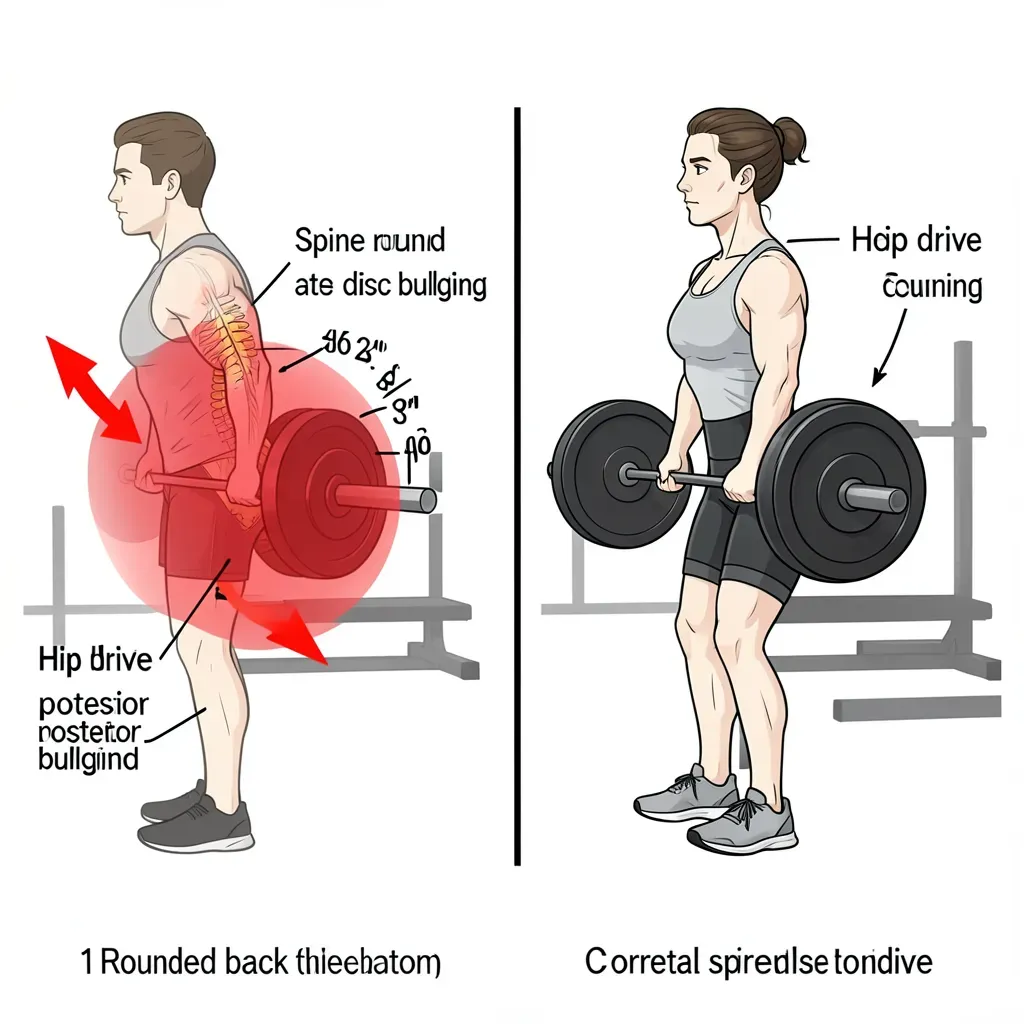
The spine during heavy lifting must be the stiffest link in the chain. Problems occur when:
- The spine rounds under load (flexion instability)
- Excessive arch develops (extension overload)
- The lifter "grinds" through a sticking point by moving the spine instead of the hips
Key principles:
- Lock the spine before the lift begins. The brace must be established before the bar moves.
- Train the hip hinge, not the back lift. In deadlifts and squats, the back doesn't move — only the hips do.
- Use the "twist the bar" cue. Externally rotating the hands engages the lats, which stiffen the spine.
- Respect fatigue. Form breakdown occurs on the last rep. If you can't maintain position, the set is over — regardless of your planned rep count.
- Don't bounce. At the bottom of a squat or deadlift, the stretch reflex can override motor control. Pause briefly to maintain bracing.
Running
Running imposes thousands of low-level loading cycles per session. For most runners, this is safe. Problems arise from:
- Excessive thoracic kyphosis (rounded upper back) from training posture
- Insufficient gluteal activation causing pelvic drop with each stride
- Running on hard surfaces with poor shock absorption
- Running when fatigued (end of a long run = worst form)
Spine-sparing running strategy:
- Maintain upright posture — "run tall"
- Strengthen the glute medius (hip airplane, clamshell) to prevent pelvic drop
- Address thoracic kyphosis with extension work
- Shorten runs when form begins to deteriorate
- Use appropriate footwear with cushioning (minimalist shoes increase spinal load)
Combat Sports (MMA, Wrestling, BJJ)
Combat sports combine the worst elements: forced spinal flexion, unexpected loading, twisting under load from an opponent's force.
Key strategies:
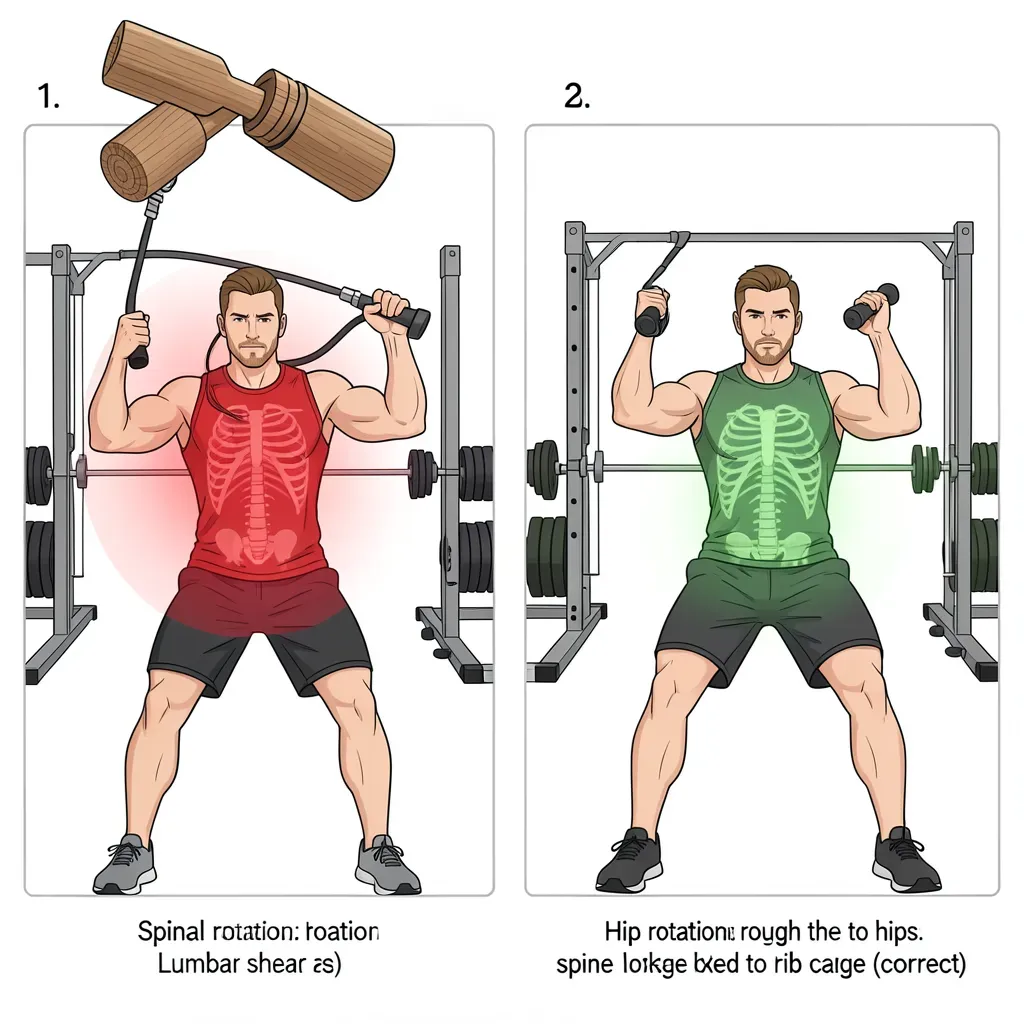
- Train the anti-rotation capacity. Pallof presses, band rotations with a locked spine
- Build the ability to brace under surprise load. Partner drills where forces arrive unexpectedly
- Condition the neck. Neck endurance reduces concussion risk AND reduces cervical contributions to back pain
- Avoid training to spinal failure. Sparring should stop when fatigue compromises bracing ability
Team Sports (Football, Rugby, Hockey)
Contact sports add external impact forces that can exceed voluntary stability. The spine must be pre-braced before contact arrives.
Key strategies:
- Anticipatory bracing. Train to brace before impact, not in response to it
- Carry training. Farmer's walks, sled pushes — these replicate game demands safely
- Neck and trap development. A thick, stiff neck-trunk connection protects the cervical and upper thoracic spine
- Rotational training without spinal rotation. Cable chops, Pallof presses — create rotational force at the shoulders while the spine stays locked
The Training Session Structure
Warm-Up (Non-Negotiable)
- Cat-camel: 7-8 cycles (joint lubrication, not stretching)
- Bird-dog: 3-5 reps each side (activate stabilizers)
- Side bridge: 2-3 holds each side (engage lateral system)
- Hip mobility: hip airplane, leg swings (free the hips)
Main Training
- Begin with the most technically demanding exercises (when fresh)
- End with assistance work and conditioning
- Monitor form quality — if you can't maintain neutral spine, STOP
Cool-Down
- Walk 5-10 minutes (gentle decompression)
- Avoid static stretching of the spine (stretch hips instead)
- If spine feels compressed: decompression hang or traction stretch
Common Athletic Mistakes
"Activate Your Core" Doesn't Mean "Suck It In"
Many trainers cue "draw in" or "pull navel to spine." This activates the transverse abdominis in isolation while REDUCING the contribution of the obliques and erectors. Research shows this actually DECREASES spine stability under load.
The correct cue: Brace as if someone is about to punch you in the stomach. This coactivates ALL abdominal muscles — the entire cylinder stiffens.
Stretching Before Training
Static stretching of the trunk before demanding activity reduces muscle stiffness — the very stiffness that protects the spine. Never stretch the trunk before lifting, sprinting, or contact activity.
What to do instead: Dynamic warm-up. Cat-camel for motion. Hip mobility drills. Sport-specific movement at gradually increasing intensity.
Training Through Pain
Pain is information. It tells you a tissue is being loaded beyond its current capacity. "Working through" back pain during sport accelerates degeneration and sensitizes the pain system.
The athletic ego is the biggest enemy of back recovery. Reducing training load or modifying technique feels like failure. It isn't. Athletes who modify early recover in weeks. Athletes who push through often face months or years of chronic pain. Modify the movement, not your standards.
Return to Sport After Injury
The Progression
- Pain-free daily life (spine hygiene + Big 3) — 2-4 weeks
- Tolerate training positions unloaded (sport-specific postures without resistance) — 1-2 weeks
- Tolerate light training loads (50% of previous) — 2-3 weeks
- Progressive loading to full (increase 10-20% per week) — 4-8 weeks
- Full return with maintenance (Big 3 daily forever) — ongoing
Red Flags for Return
Do NOT return to sport if:
- Pain returns within 24 hours of training
- You cannot maintain bracing throughout the movement
- Fatigue causes form breakdown before the session ends
- You're compensating with the spine for limited hip mobility
Every successful athletic return includes a lifetime commitment to spine hygiene and daily stabilization work. The athletes who stop their maintenance routine are the ones who get re-injured.