Loaded Carries Program
Farmer carries, suitcase carries, waiter carries, and rack carries — a progressive loaded carry program for building real-world spine stability.
Why Loaded Carries Belong in Every Back Rehabilitation Programme
Loaded carries are among the most functional exercises that exist. Every time you carry shopping, lift a child, move luggage, or bring equipment from one place to another, you are performing a loaded carry. The spine's ability to maintain stable, neutral alignment under those conditions is exactly what protects you from injury in daily life.
Beyond functional transfer, carries offer something that most isolation exercises do not: they train intra-abdominal pressure under genuine load. The bracing required to walk a meaningful distance with a challenging weight is closer to what your spine experiences in real life than almost any other exercise. They also demand proper breathing mechanics — you cannot hold your breath through a 30-metre farmer carry, so you are forced to learn how to breathe while bracing.
Carries are also excellent for identifying asymmetry. The body compensates under load in predictable ways — lateral lean, ipsilateral shoulder elevation, contralateral hip drop — and these compensations become visible during carries in a way that static exercises do not always reveal.
Loaded carries are typically introduced in the later stages of rehabilitation, once the Big 3 endurance targets are met and basic hip hinge mechanics are established. Do not rush into heavy carries. Start lighter than you think necessary — the spine fatigue from carries is different from the fatigue you feel in floor exercises, and it takes time to develop the specific tolerance.
The Suitcase Carry
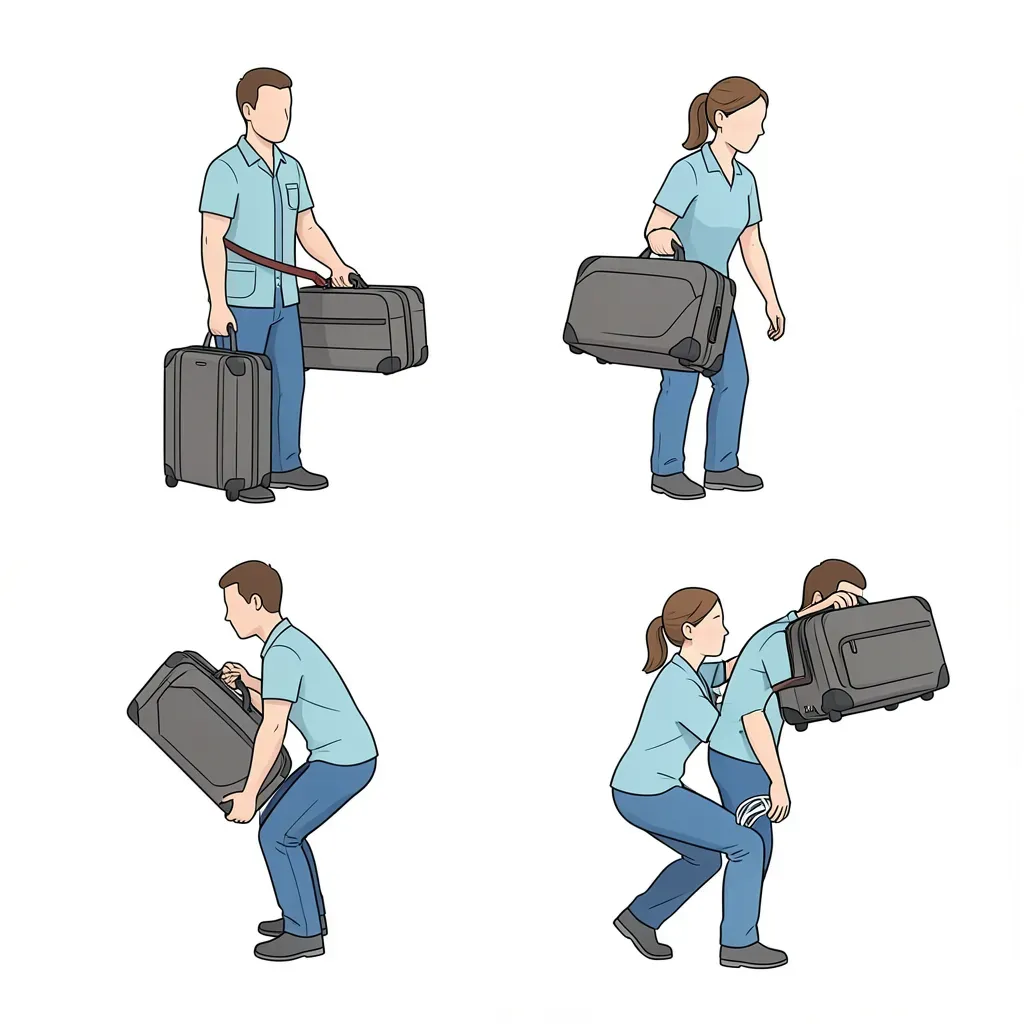
The suitcase carry is a unilateral hold — one hand carries the weight, the other hangs free. It is the most direct replication of carrying a bag, shopping, or a child on one side.
The primary demand is lateral stability: the loaded side creates a lateral flexion moment that the quadratus lumborum, obliques, and contralateral hip abductors must resist to keep the trunk vertical. This is exactly the stability demand that daily life places on the spine, and it is one that standard bilateral exercises do not adequately train.
Starting load: approximately 20% of body weight in one hand. For a 75kg person, that is 15kg. This may feel light in the first few steps but will become challenging over 20-30 metres. Walk with the trunk completely vertical — any lean toward or away from the loaded side indicates the weight is too heavy.
Common errors: leaning away from the load (too heavy or insufficient lateral stability), elevating the loaded shoulder (a compensation to shorten the lever arm — the shoulder should be packed down), and breath-holding (breathe normally throughout).
The Farmer Carry
The farmer carry is bilateral — a weight in each hand. It trains symmetrical bracing and is the most accessible carry variation for people who are earlier in their progression, since the bilateral load is easier to balance than the unilateral suitcase.
The primary demand is maintaining a neutral spine under axial compression as fatigue accumulates. The spinal extensors, deep stabilisers, and bracing system must work continuously to prevent progressive spinal flexion as the walk extends.
Starting load: 20-30% of body weight per hand. Progress toward 40-50% per hand over months. At that load level, the farmer carry becomes a genuinely challenging full-body exercise. Walk 20-40 metres per set, rest 60-90 seconds, and perform 3-4 sets.
The key coaching point is to walk tall with the shoulders slightly retracted and packed — not rounded or elevated. The grip should be firm but not crushing. If the spine begins to flex as fatigue sets in, that is the termination point for that set. Do not push through form breakdown.
The Waiter Carry
The waiter carry is the most technically demanding variation: a single weight held overhead in one hand, like a waiter carrying a tray. The overhead position requires maximum lateral trunk stability — any loss of lateral control results in lateral trunk lean and shoulder deviation that becomes immediately apparent.
This variation trains the integration of shoulder stability and trunk stability simultaneously. The rotator cuff and periscapular muscles must work to maintain the overhead position while the obliques and QL resist the side-bending moment.
Start with a very light load — 5-8kg is appropriate for most people initially. The overhead position changes the mechanics substantially, and the spine stabilisation demand is higher than it looks. Walk 20 metres, rest, and build from there.
The waiter carry can serve as a useful diagnostic tool. If you notice that you consistently lean to one side during overhead carries regardless of which hand holds the weight, this suggests a trunk lateral stability deficit that may be contributing to your back pain pattern. Address it with targeted side bridge progressions alongside the carry programme.
The Rack Carry
The rack carry uses a dumbbell or kettlebell held at shoulder height — the "rack" position used in Olympic lifting. The weight rests on the forearm and upper arm, held close to the body. This position creates a significant anterior loading challenge: the weight in front of the body's centre of mass demands engagement of the thoracic extensors and posterior chain to prevent forward trunk collapse.
The rack carry is particularly useful for people who have difficulty maintaining thoracic extension under load. The anterior load makes the thoracic extension demand unmistakable — you will feel the thoracic extensors working in a way that is rarely achieved in other exercises.
Start with a single-arm rack carry (one side only) before progressing to bilateral. A single-arm rack carry also has a lateral stability demand from the unilateral load, making it a hybrid between the rack and suitcase carry in its demands.
The Zercher Carry
The Zercher carry places the load in the crooks of the elbows, held in front of the body in a bear-hug position. This is an advanced variation. The anterior loading is even more pronounced than the rack carry, and the demand on the spinal extensors — particularly the erector spinae and thoracic extensors — is substantial.
The Zercher carry is best introduced after all other carry variations have been trained for several months. It is not appropriate for early rehabilitation.
Programming the Carry Programme
Carries fit naturally into 3-4 sessions per week, either as a standalone focus or integrated after the Big 3. A typical carry session: choose 2-3 carry variations, 3-4 sets of each, 20-40 metres per set, 60-90 seconds rest between sets. Total session time: 20-30 minutes.
Progress by increasing either distance or load, but not both simultaneously. A common approach is to add 5 metres per week until reaching 40 metres, then add load and return to 20 metres. The distance-before-load principle ensures that the carry pattern is solid before the intensity increases.
The spine fatigue from heavy loaded carries is cumulative and is sometimes not felt until the following day. Start conservatively and monitor your response over 48 hours after your first several carry sessions. If you experience increased symptoms the day after carrying, reduce the load or distance — not the frequency.
In Review
- Loaded carries are among the most functional spine exercises available — with excellent transfer to the carrying demands of daily life
- Suitcase carry (unilateral, 20% body weight starting load) targets lateral stability and QL; farmer carry (bilateral, 20-30% per hand) targets symmetrical bracing under axial compression
- Waiter carry (overhead unilateral, very light starting load) demands the highest lateral trunk stability; rack carry (shoulder height) specifically targets thoracic extension under anterior load
- The Zercher carry is an advanced variation for those well into their progressive loading programme
- Programme 3-4 carry sessions per week: 2-3 variations, 3-4 sets, 20-40 metres per set; progress distance before load
- Monitor 48-hour response carefully when introducing or intensifying carries — spine fatigue from loaded carries differs from floor exercise fatigue