Spine Hygiene: Daily Activities
How to sit, stand, walk, bend, push, pull, and carry throughout your day without accumulating spinal stress.
What Is Spine Hygiene?
Spine hygiene is the practice of moving well throughout the entire day — not just during exercise. It means avoiding painful movements, expanding your pain-free repertoire, and building the capacity for corrective exercise.
Most back pain is NOT caused by a single catastrophic event. It's caused by the accumulation of hundreds of small insults throughout the day: slouching at a desk, bending to tie shoes, twisting to grab something from the back seat. Spine hygiene eliminates these micro-traumas.
Think of spine hygiene like dental hygiene. Brushing your teeth for 2 minutes doesn't matter if you eat sugar all day. Similarly, 30 minutes of exercise won't help if your spine is being abused for the other 23.5 hours.
Sitting Well
Sitting is the most common pain trigger. Here's how to do it correctly:
Chair Setup
- Use a firm chair with a flat seat pan
- Add a lumbar support (pad or rolled towel) to maintain your natural curve
- Feet flat on the floor, knees at approximately 90 degrees
- Elbows resting naturally — armrests can help unload the spine
The Sitting Correction
- Allow yourself to fully slouch
- Now correct: roll the pelvis forward AND lift the chest simultaneously
- Find the middle position — not military-stiff, not slouched
- The lumbar pad should support this position so muscles can relax
Time Limits
No sitting session should exceed 50 minutes. Stand, walk for 1-2 minutes, then sit again. This "micro-break" allows the disc to recover its nutrition and the muscles to reset.
If sitting increases your pain, you likely have a flexion intolerance. The disc bulges backward when the spine is rounded. A lumbar support and strict time limits are non-negotiable for you.
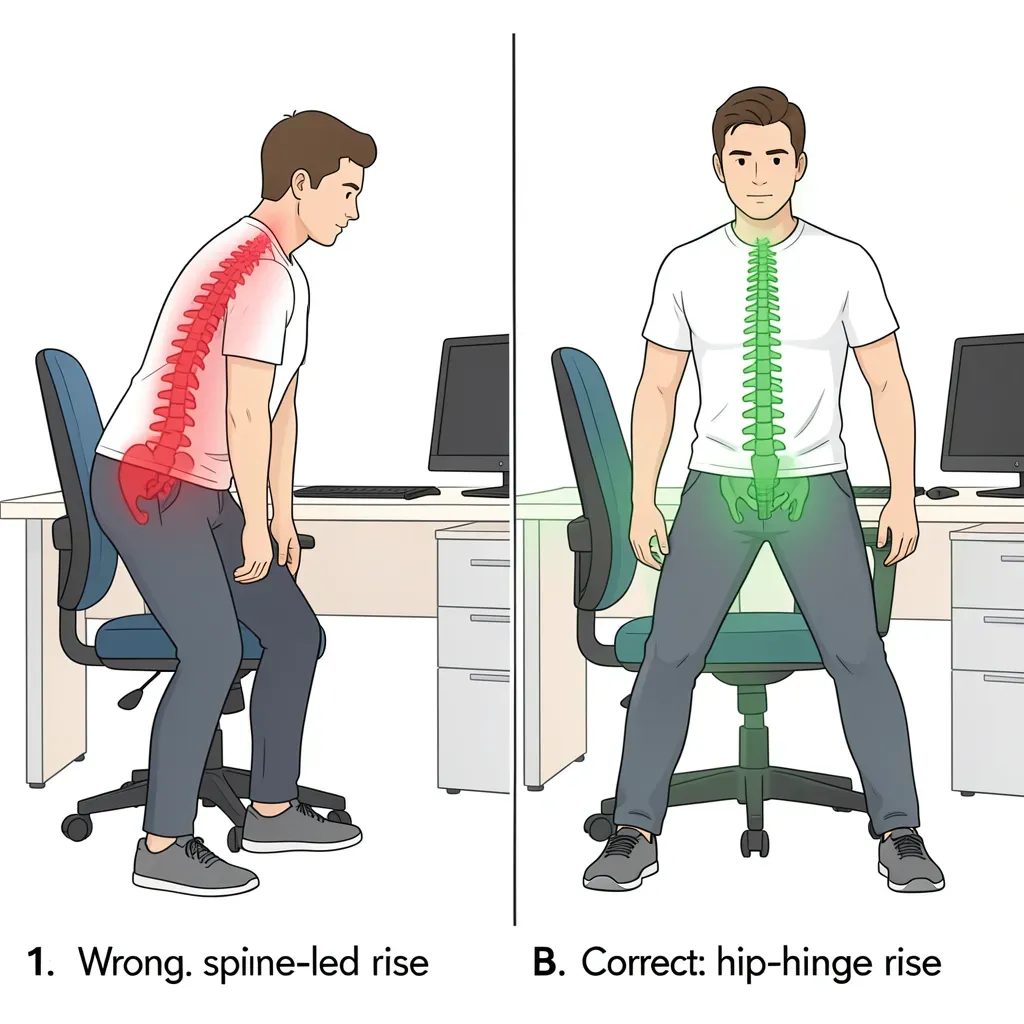
Rising from a Chair
- Spread your knees and position feet underneath you
- Lift the chest and lean forward through the HIPS (not by rounding the spine)
- Transfer weight onto the middle of your feet
- Stand by "pulling the hips forward" — NOT lifting with the back
Standing Well
The Relaxation Test
Stand and feel your low back muscles. If they're active and hard, you're standing incorrectly. Use the switch-point drill from the previous chapter to find your relaxed standing posture.
Standing Endurance
If standing causes pain that builds over time:
- Shift weight between feet periodically
- Place one foot on a small step or rail (the "bar rail" technique)
- Take micro-walks every 20 minutes
- Use the wall plank: lean back against a wall, experiment with different lumbar curves until you find the pain-free one
Posture Killers to Avoid
- Chin poking forward (activates back muscles unnecessarily)
- Rounded shoulders
- Crossed arms (encourages rounding)
- Locked knees (increases lumbar extension)
Walking Well
Walking is the single best exercise for most back pain sufferers — but technique matters.
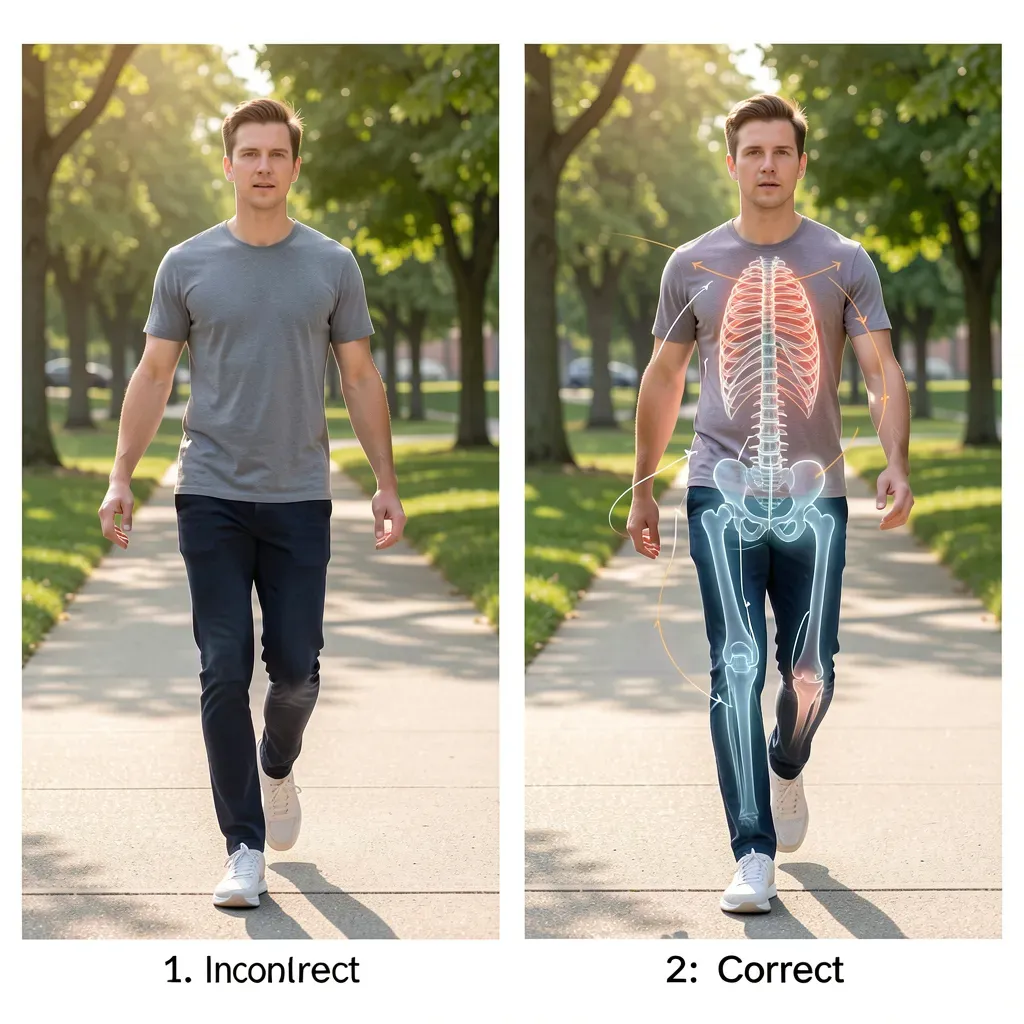
The Good Walk
- Upright posture with natural arm swing
- Moderate to brisk pace (slow "mall strolling" often increases pain)
- Push off through the toes, full stride length
- Engage a mild abdominal brace
Walking Speed Matters
For disc-related pain: FAST walking with arm swing reduces pain because it creates a natural spinal decompression cycle. Slow walking allows the spine to settle into painful compression.
For stenosis/arthritis: Walking accumulates load. Use interval training — walk for your tolerable duration, rest in a seated position (slight flexion relieves stenosis), then resume.
Bending and Lifting
Every time you bend forward, ask: "Am I bending at my HIPS or my SPINE?"
The Hip Hinge Rules
- Lock the spine in neutral with a mild brace
- Push hips backward (like closing a car door with your backside)
- Keep the object CLOSE to your body
- "Pull hips forward" to stand — don't lift with the back
Load Distance Rule
A 10 kg object at arm's length creates the same spinal compression as a 50 kg object held against your chest. ALWAYS bring the load close before lifting.
The Golfer's Lift
For lightweight objects on the ground (a pen, a sock):
- Hinge at one hip
- Extend the opposite leg behind you as a counterbalance
- Reach down with one hand, other hand on a support if available
- Spine stays neutral throughout
Before any lift, take a sharp nasal "sniff" inhale. This reflexively engages the diaphragm and adds beneficial stiffness to the spine.
Pushing and Pulling
Pushing (Doors, Carts, Mowers)
- Keep arms close to body
- Engage abdominal brace
- Push through your legs, not your back
- Move feet to face the direction of force (avoid twisting)
Pulling (Drawers, Raking, Rowing)
- Step close to the object
- Brace the core
- Pull by squeezing shoulder blades together
- Keep elbows close to torso
- MOVE YOUR FEET rather than reaching and twisting
Carrying
One-Handed Carry
- Hold object close to hip
- Engage a slightly stronger brace on the loaded side
- Switch hands frequently on long carries
- Avoid leaning away from the load
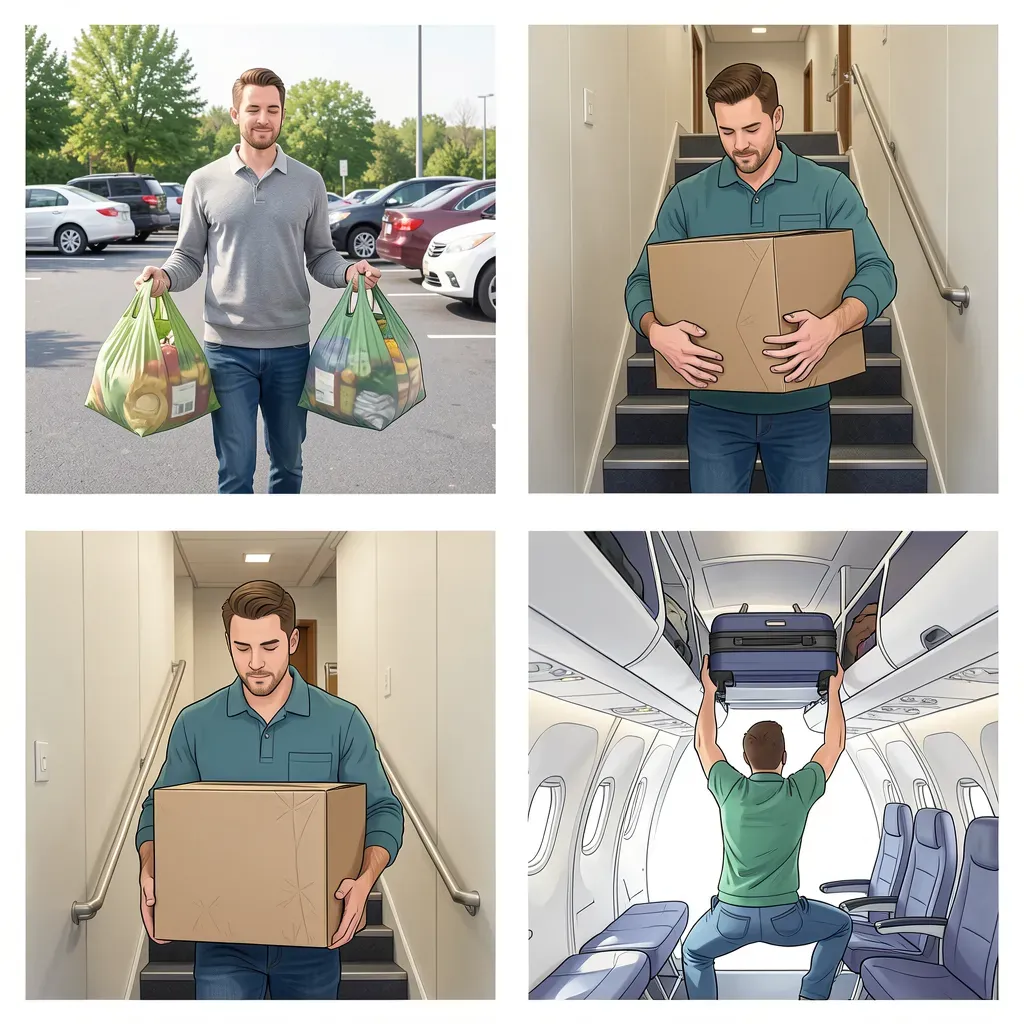
Two-Handed Carry (Groceries, Boxes)
- Split the load evenly between two hands/bags
- Keep items close to your center of mass
- Brace before picking up, maintain until set down
- For heavy boxes: bear-hug them against your chest
Overhead Carry (The Suitcase Problem)
Putting bags in overhead bins is a notorious back-pain trigger. Strategy:
- Face the bin directly (no twisting)
- Use the lunge to get under the load
- Press the bag up using arm and shoulder strength with a locked spine
- If it's too heavy, ask for help — one moment of pride isn't worth a week of pain
The 23-Hour Rule
Your exercise session is 30-60 minutes. The other 23 hours determine whether you heal or re-injure. Apply these principles ALL DAY:
| Activity | Spine-Smart Version | |----------|-------------------| | Tying shoes | Lunge or bring foot up to a stool | | Getting dressed | Sit on bed edge, use hip hinge | | Brushing teeth | Hand on counter for support, hip hinge | | Loading dishwasher | Lunge down to lower rack | | Making the bed | Kneel on one knee, avoid reaching | | Getting in/out of car | Sit first, then swing legs (no twisting) | | Picking up a child | Squat, bring child to chest, then stand |
Each pain-free repetition of a daily task is a rep in your rehabilitation program. You perform hundreds of "exercises" per day without realizing it. Make them all spine-sparing.