Workplace Spine Health
Evidence-based ergonomic strategies for desk workers, manual laborers, and everyone in between — reducing spinal risk during the workday.
The Workplace Problem
Most back injuries don't happen from a single dramatic event. They result from cumulative loading — hundreds of low-level insults throughout a workday that progressively weaken tissues until failure occurs. The workday is where most of your waking hours are spent, making it the primary battleground for spine health.
Research identifies three primary workplace risk factors for low back disorders:
- Peak spinal loads (momentary high forces)
- Cumulative compression (total load × time throughout the day)
- Repetition (cycling through damaging postures hundreds of times)
Studies tracking workers over time found that both biomechanical AND psychosocial factors predict back injury. Physical demands account for roughly 31% of the risk, while psychosocial factors account for about 12%. You can't ignore the physical mechanics just because stress is also a factor.
Desk and Computer Work
Sitting for extended periods is one of the most common pain triggers. Here's why and what to do about it.
Why Sitting Hurts
- The seated posture increases intradiscal pressure compared to standing
- The spine loses its lordotic curve, shifting load to the posterior disc
- Muscles that maintain posture fatigue, leading to progressive slouching
- Creep occurs in ligaments — after prolonged flexion, the spine loses passive stiffness
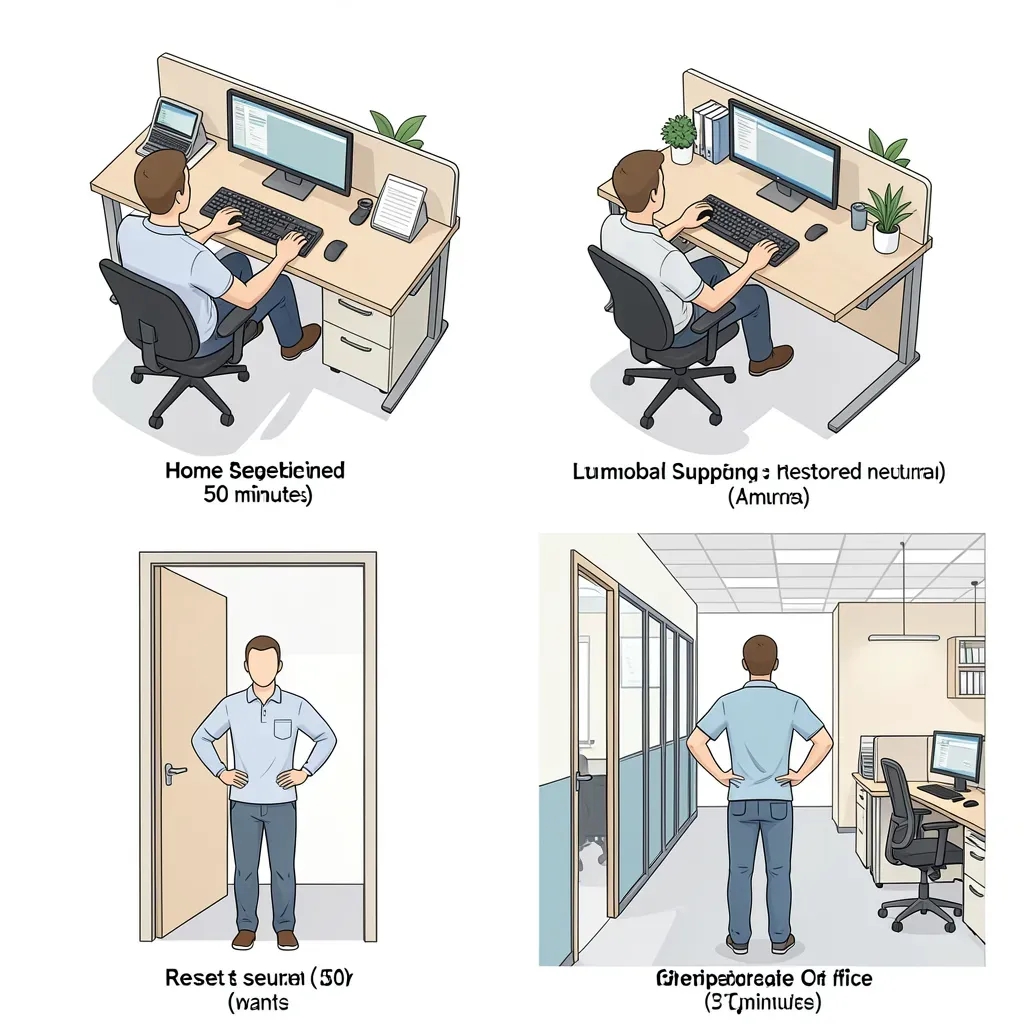
The 50-Minute Rule
Research on disc nutrition and tissue creep shows that no sitting session should exceed 50 minutes without a posture break. After 50 minutes of seated flexion:
- Ligament laxity increases significantly
- Disc nutrition cycling is compromised
- Muscle fatigue accumulates
- Pain sensitivity increases
Every 50 minutes: Stand, walk for 60-90 seconds, perform a standing extension (hands on hips, gentle backward lean). This restores tissue stiffness and resets the creep clock.
Chair Setup
| Feature | Recommendation | |---------|---------------| | Seat height | Hips slightly above knees | | Seat depth | 2-3 finger widths between seat edge and back of knee | | Lumbar support | Adjustable pad maintaining natural lordosis | | Armrests | Supporting arms reduces spine compression by ~10% | | Monitor | Top of screen at eye level, arm's length away | | Keyboard | Elbows at 90°, wrists neutral |
After prolonged sitting, the spine is particularly vulnerable to injury. Ligaments are lax from creep, muscles are inhibited. Do NOT immediately perform heavy lifting, bending, or exercise after rising from extended sitting. Walk for 2-3 minutes first to restore tissue stiffness.
The Standing Desk Question
Standing desks help — but standing all day creates its own problems (cumulative compression, fatigue). The optimal strategy is alternation: sit for 30-50 minutes, stand for 15-20 minutes, repeat. Neither sustained sitting nor sustained standing is ideal.
When standing at a desk:
- Use a footrail or low box to rest one foot (alternate feet every few minutes)
- Avoid locking the knees
- Maintain the relaxed standing posture (find your "switch point")
Manual Labor and Lifting
The Reaction Moment
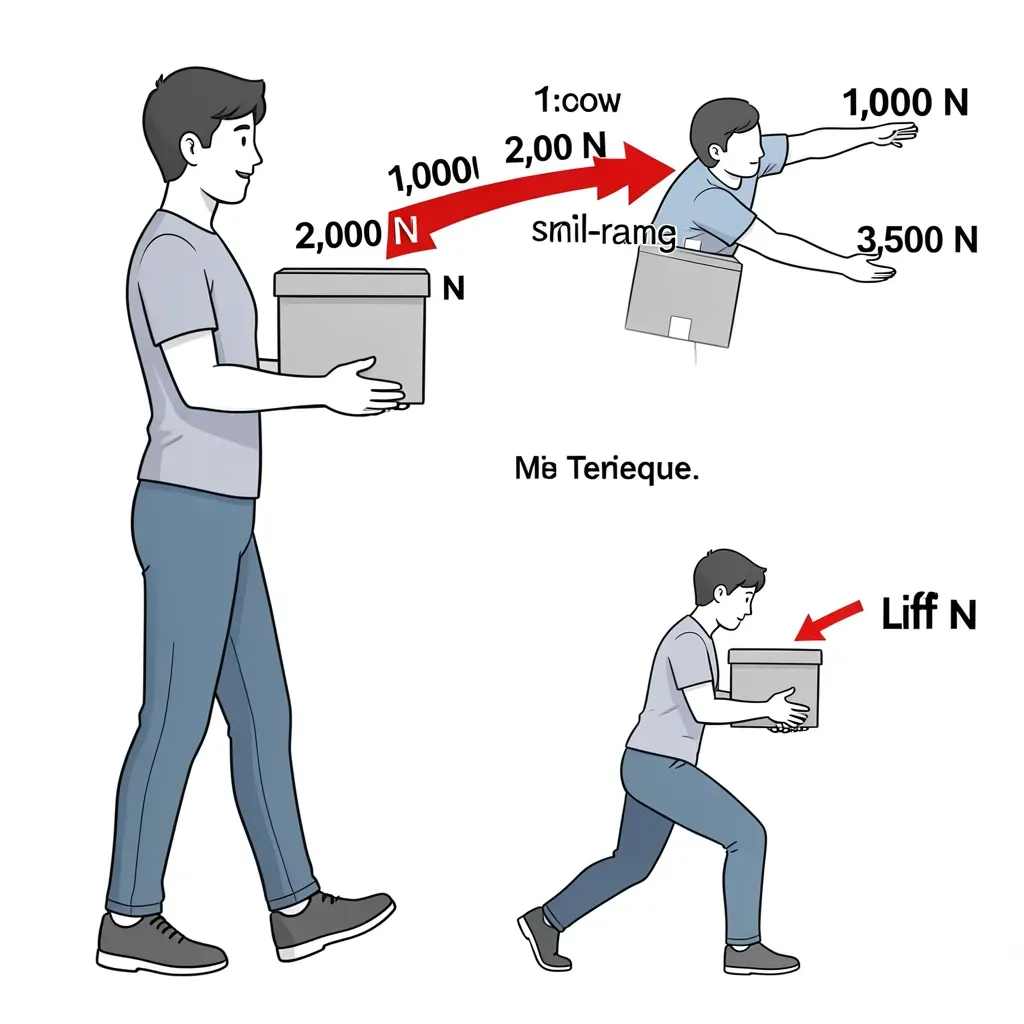
Every time you hold or lift an object, your spine must create an internal reaction force. The farther the object is from your spine, the larger this force must be.
The math is dramatic:
- A 10 kg object held against the chest: ~1,000 N of spinal compression
- The same 10 kg at arm's length: ~3,500 N of spinal compression
- Bending forward with just body weight: roughly 3,000 N (one-third of a ton)
Key Lifting Principles (Evidence-Based)
1. Reduce the lever arm. Keep loads as close to the body as possible. This single change reduces spinal load more than any other technique.
2. Avoid end-range motion during exertion. A spine at its end range of flexion has minimal muscle support — the passive tissues are bearing the load. Never lift with a fully flexed spine.
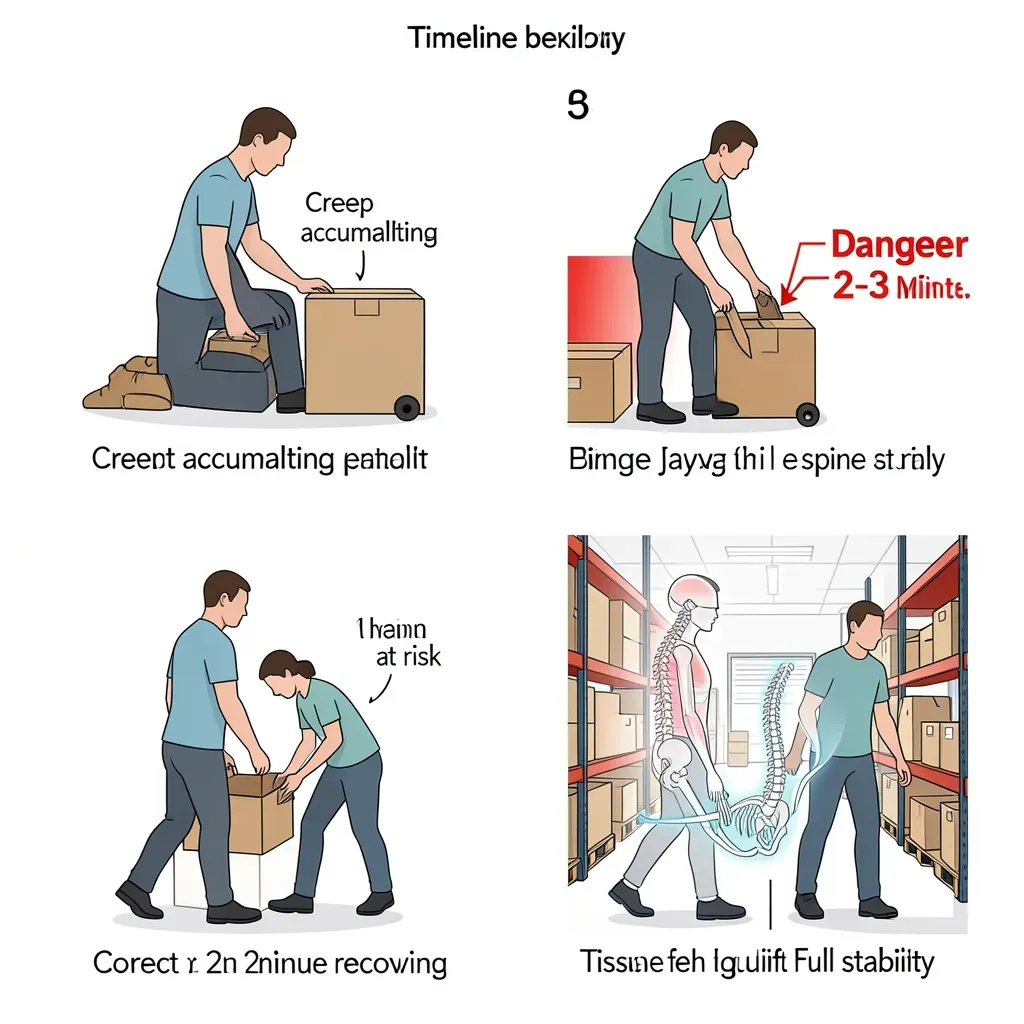
3. Don't lift immediately after prolonged flexion. If you've been sitting or bending for extended periods, the viscoelastic creep in your ligaments means passive stability is compromised. Stand and walk first.
4. Use intra-abdominal pressure wisely. A sharp inhale before lifting increases abdominal pressure, which adds spine stiffness. But sustained breath-holding (Valsalva) raises blood pressure dangerously. Use brief holds only.
5. Avoid twisting under load. Generating twisting torque imposes over 3,000 N of compression for just 50 Nm of torque — nearly 4× the cost of the same torque in extension. Move your feet instead.
The spine-sparing strategy for any lifting task: get the load close, brace, breathe in sharply (brief pressure spike), lift by pulling hips forward (not back up), and move feet to face the destination rather than twisting.
Should You "Jerk" or Lift Smoothly?
Surprisingly, the answer isn't always "smooth." Research shows that a quick acceleration at the start of a lift can reduce the total time the spine is under load. However, jerking loads is only safe when:
- The spine is in neutral (not flexed)
- The load is known and predictable
- The core is pre-braced
- You are not fatigued
For most workplace scenarios: lift smoothly. The risk of jerking with imperfect form outweighs the marginal benefit.
Seated Work Specific Problems
The Transition Problem
Research identifies a critical vulnerability: the transition from sitting to standing, and the first few minutes of activity after prolonged sitting. During this period:
- Ligaments are lax (creep hasn't recovered)
- Motor patterns are inhibited (muscles were "off" during sitting)
- Discs are loaded asymmetrically (the posterior wall was stretched during sitting)
Solution: Always stand slowly, walk for 1-2 minutes, then perform your task. Never go directly from seated to lifting, bending, or any demanding activity.
Driving
Driving combines the worst elements: sustained sitting, vibration, limited posture options, and the need to twist (checking mirrors, reaching).
- Use lumbar support (built-in or aftermarket)
- On long drives: stop every 45-60 minutes, stand, walk, extend
- Adjust mirrors to minimize extreme neck rotation
- When exiting: swing both legs out together (don't twist), use the door frame to stand
- After arriving: walk 2-3 minutes before unloading heavy items from the trunk
Vibration Exposure
Vehicles, machinery, and equipment expose the spine to whole-body vibration. Research shows this accelerates disc degeneration and increases injury risk. If your work involves vibration:
- Use vibration-dampening seats when available
- Take more frequent breaks (every 30 minutes instead of 50)
- Strengthen the stabilization system — higher endurance offsets vibration effects
- Never lift heavy loads immediately after vibration exposure
Shift Work and Fatigue
Morning Vulnerability
Your spine is most at risk in the first 60 minutes after waking:
- Discs are fully hydrated (taller, stiffer, under more internal pressure)
- Tissues haven't been "warmed up" by movement
- Disc bulge risk is highest with morning flexion
Morning rule: No forward bending under load for the first hour. Walk first. Let the discs lose their overnight fluid excess naturally.
End-of-Shift Vulnerability
After 8+ hours of work:
- Endurance is depleted
- Motor patterns degrade
- The heaviest or most demanding tasks become the most dangerous
End-of-day rule: Save demanding tasks for mid-shift when possible. If you must do heavy work at end of shift, take a 5-minute rest break with relief postures first.
The Back Belt Question
Research provides a clear verdict:
- Back belts do NOT prevent first-time injuries in workers
- They do NOT significantly reduce spinal load during lifting
- They MAY increase intra-abdominal pressure slightly
- They CAN serve as a proprioceptive reminder to brace
When belts help: As a reminder to brace for workers who otherwise forget. As temporary support during recovery from an acute injury.
When belts harm: When workers feel "protected" and take risks they otherwise wouldn't. When worn continuously (muscles can decondition).
If your workplace mandates back belts, use them as a REMINDER to brace, not as a substitute for technique. The belt does not stabilize your spine — your muscles do. Wear it only during demanding tasks, not all day.
Your Workplace Audit
Ask yourself these questions about your work environment:
- Do I sit for more than 50 minutes without moving?
- Do I transition directly from sitting to lifting?
- Are my lifting loads kept close to my body?
- Do I twist my spine to face co-workers or reach objects?
- Is my chair providing lumbar support?
- Do I perform heavy tasks when fatigued (end of shift)?
- Am I exposed to whole-body vibration without breaks?
Every "yes" answer identifies a modifiable risk factor. Apply the principles from this guide to eliminate each one systematically.