Pain Catastrophizing
What catastrophizing is, how it amplifies pain neurologically, and practical cognitive strategies to reduce it.
When the Mind Turns Up the Volume
Imagine two people with identical lumbar disc protrusions on MRI. One returns to work within six weeks. The other is still disabled a year later. Their scans look the same. What differs? Often, the answer is catastrophizing.
Pain catastrophizing — defined as the tendency to magnify pain threat, ruminate on pain, and feel helpless in the face of it — is one of the most robust predictors of chronic pain disability in the research literature. It predicts surgical outcomes more reliably than the actual surgical findings. It predicts how much opioid medication people require post-operatively. It predicts who will still be suffering two years after a back injury.
This is not a character flaw. Catastrophizing is a cognitive pattern that develops for understandable reasons, operates largely automatically, and responds to specific interventions when identified and worked with deliberately.
The Three Components of Catastrophizing
Researcher Michael Sullivan developed the Pain Catastrophizing Scale (PCS), which measures three overlapping dimensions:
Rumination — the inability to stop thinking about pain. "I keep thinking about how bad the pain is." Pain occupies attentional bandwidth that would otherwise be available for living. Rumination is cognitively exhausting and maintains the nervous system in a state of heightened alert.
Magnification — expecting the worst. "I wonder whether something serious might happen." A normal twinge becomes evidence of catastrophic structural damage. A bad day becomes proof that you will never recover. The interpretive filter is tuned to maximum threat.
Helplessness — the belief that nothing can be done. "There is nothing I can do to reduce the intensity of my pain." This component overlaps heavily with depression and drives passivity — the opposite of the active engagement that promotes recovery.
The Pain Catastrophizing Scale is publicly available and takes about three minutes to complete. Scoring above 30 out of 52 is considered clinically meaningful. If you score high, this is useful information — not a diagnosis of weakness, but a signal that addressing catastrophizing directly should be part of your recovery plan.
What Catastrophizing Does to the Brain
Neuroimaging studies have given us a window into why catastrophizing amplifies pain so effectively. When people who score high on catastrophizing receive the same nociceptive stimulus as low-catastrophizers, they show significantly greater activation in the anterior cingulate cortex (involved in pain unpleasantness and emotional processing), the prefrontal cortex, and the amygdala (the brain's threat-detection center).
The same signal from the periphery is being processed through a louder amplifier. This is not metaphorical — it is measurable brain activity. The nervous system of a high-catastrophizer is genuinely more reactive to the same input. This helps explain why catastrophizing predicts pain intensity beyond what tissue damage alone would predict.
It also explains why the answer is not to push through or toughen up. The amplifier needs recalibrating, not suppressing.
Where Catastrophizing Comes From
Catastrophizing does not arise from nowhere. Common origins include:
Previous trauma or adverse experiences that primed the nervous system for threat detection. A childhood in an unpredictable environment teaches hypervigilance — a useful survival skill that becomes costly when applied to back pain.
Unhelpful medical messaging. Being told your spine is "degenerating," that you have "the back of an 80-year-old," or that you need to be careful is catastrophizing-inducing language delivered by authority figures. This is extremely common and extremely harmful.
Social reinforcement. When pain behavior (grimacing, limping, resting) is met with increased care, attention, and relief from obligations, the system that generates those behaviors is reinforced. This is not manipulation — it is basic learning theory operating below conscious awareness.
The goal of addressing catastrophizing is not forced positivity. Telling someone to "think positive" is ineffective and often counterproductive — it adds shame to an already difficult experience. The target is accurate thinking, not optimistic thinking. Most catastrophic predictions about back pain are factually wrong, and that wrongness is the lever.
Three Cognitive Techniques That Actually Work
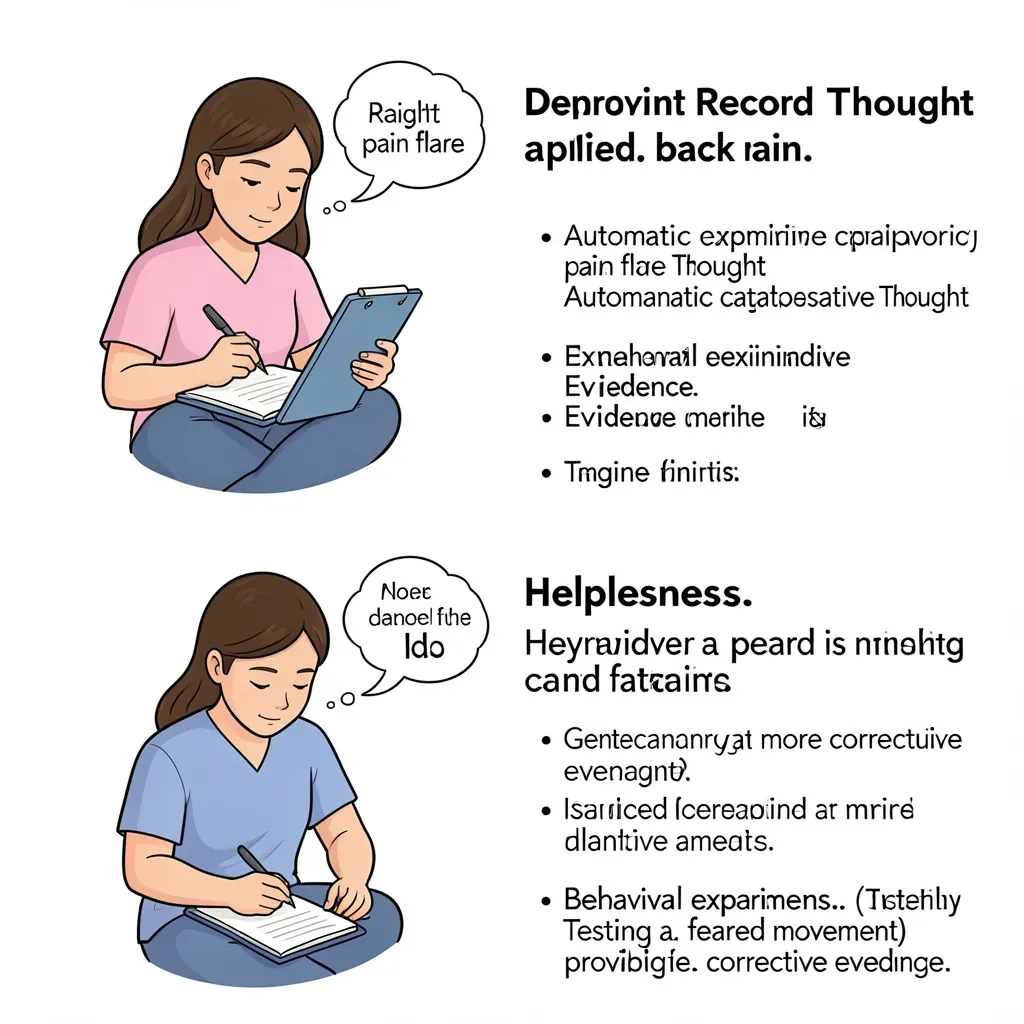
1. Identifying catastrophic thoughts. Catastrophic thoughts often feel like facts rather than interpretations. The first skill is simply catching them: "I noticed I just thought that this pain means I will be in a wheelchair." Write them down. Getting distance from a thought — even by writing it — reduces its emotional grip.
2. Examining the evidence. Once identified, a catastrophic thought can be examined like a hypothesis. What is the evidence for this thought? What is the evidence against it? Has this prediction come true before? What actually happened the last five times you had a pain flare? This is not about dismissing the thought — it is about subjecting it to the same scrutiny you would apply to any other claim.
3. Generating realistic alternatives. Replace the catastrophic interpretation not with its opposite (toxic positivity) but with a more accurate assessment: "This pain flare is unpleasant and I've had them before. They have always resolved. I know what to do." This is cognitively harder than it sounds but becomes more automatic with practice.
Behavioral Experiments
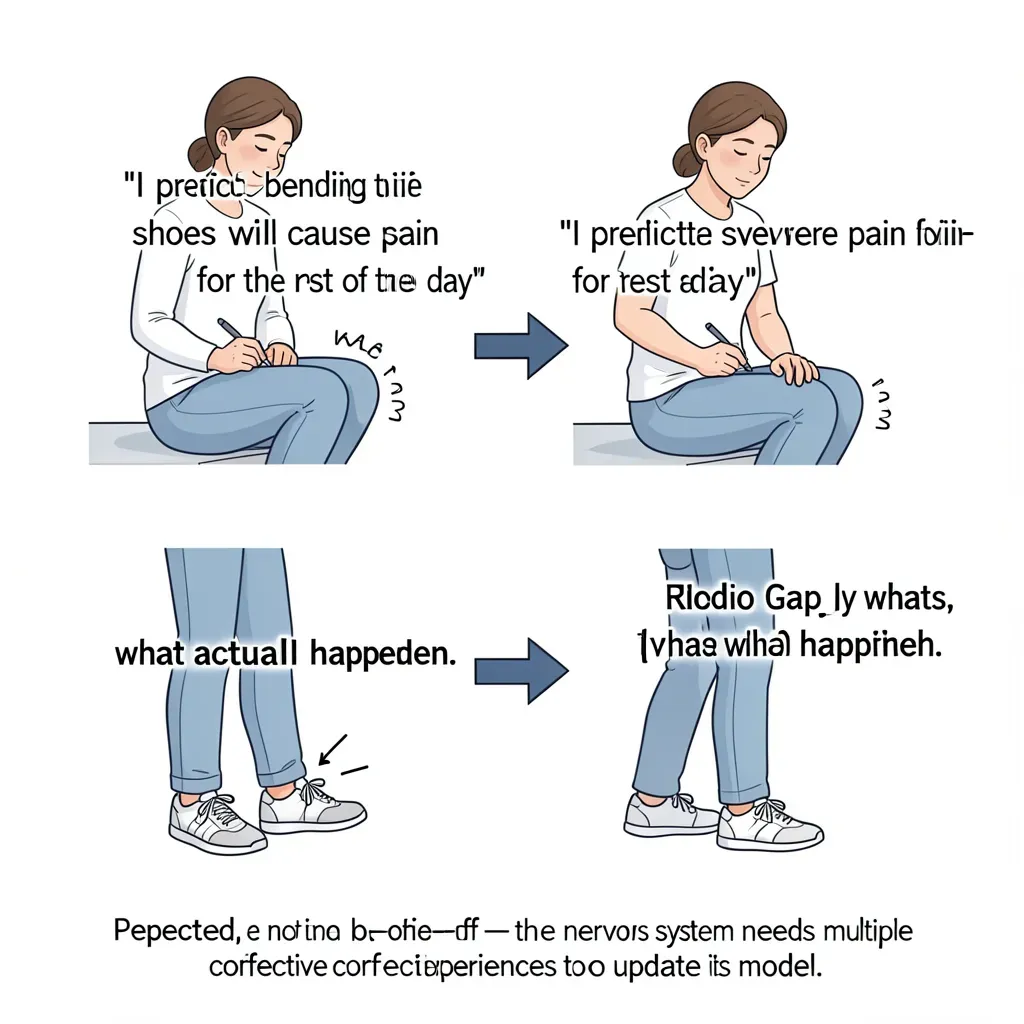
Cognitive restructuring has limits when fear is deeply embodied. Behavioral experiments — actually testing the feared prediction — are often more powerful than talking about it. If you believe that walking for 20 minutes will cause severe pain, walk for 20 minutes and record what actually happens. If you believe bending forward will injure you, bend forward in a safe context and observe the outcome.
The brain updates its threat model through experience. Accurate prediction is the goal: not "movement is safe and wonderful" but "movement produced discomfort that was manageable and did not result in injury." This corrective experience, accumulated across many trials, gradually recalibrates the amplifier.
In Review
- Pain catastrophizing involves three components: rumination, magnification, and helplessness
- Catastrophizers show greater brain activation in response to the same pain stimulus — the amplifier is genuinely louder
- Catastrophizing predicts surgical outcomes and long-term disability more reliably than imaging findings
- It develops from prior trauma, unhelpful medical messaging, and social reinforcement of pain behavior
- Three effective cognitive strategies: identify catastrophic thoughts, examine evidence for and against, generate realistic alternatives
- Behavioral experiments — testing feared predictions — often work better than cognitive reasoning alone
- The target is accurate thinking, not positive thinking; forced positivity adds shame without changing the underlying process