Golf & Back Pain
The golf swing's demands on the lumbar spine, the modifications that let you keep playing, and a prehab routine for golfers.
Why Golf Injures Backs
Golf looks gentle. You are not running, jumping, or colliding with anyone. Yet the golf swing generates compressive forces at L4-L5 estimated at eight times body weight at impact. For a 180-pound golfer, that is over 1,400 pounds of compressive load at the most vulnerable segment of the lumbar spine, repeated 80 to 100 times per round.
The mechanism is specific: the modern golf swing combines high-speed spinal rotation with simultaneous axial compression. This is precisely the combination that most efficiently degrades intervertebral discs. The X-factor — the separation between shoulder rotation and hip rotation at the top of the backswing — generates tremendous rotational torque that must transmit through the lumbar spine to produce clubhead speed. More X-factor means more power. It also means more disc loading.
The most common injuries in golfers:
- Lumbar disc herniation — The cumulative loading of repeated swings, particularly with poor mechanics, compresses and rotates the disc until the nucleus pushes posterolaterally. Right-handed golfers most commonly injure the left side of L4-L5 or L5-S1.
- Lumbar facet syndrome — Repeated extension and rotation compress the facet joints, particularly in the follow-through. The lower back stiffness that develops over a round often signals facet irritation rather than disc involvement.
- Lumbar muscle strain — The erector spinae and quadratus lumborum are working eccentrically throughout the swing. Fatigue accumulates across a round. The last six holes carry a disproportionate share of injuries.
The pain that starts on hole 14 and feels manageable is worth taking seriously. Muscle fatigue in the late holes means the passive structures — discs and ligaments — absorb load that the muscles should be handling. Finishing a round through mounting pain is frequently how a mild problem becomes a severe one.
Setup and Address Position
Poor setup amplifies every mechanical stress that follows. Specifically:
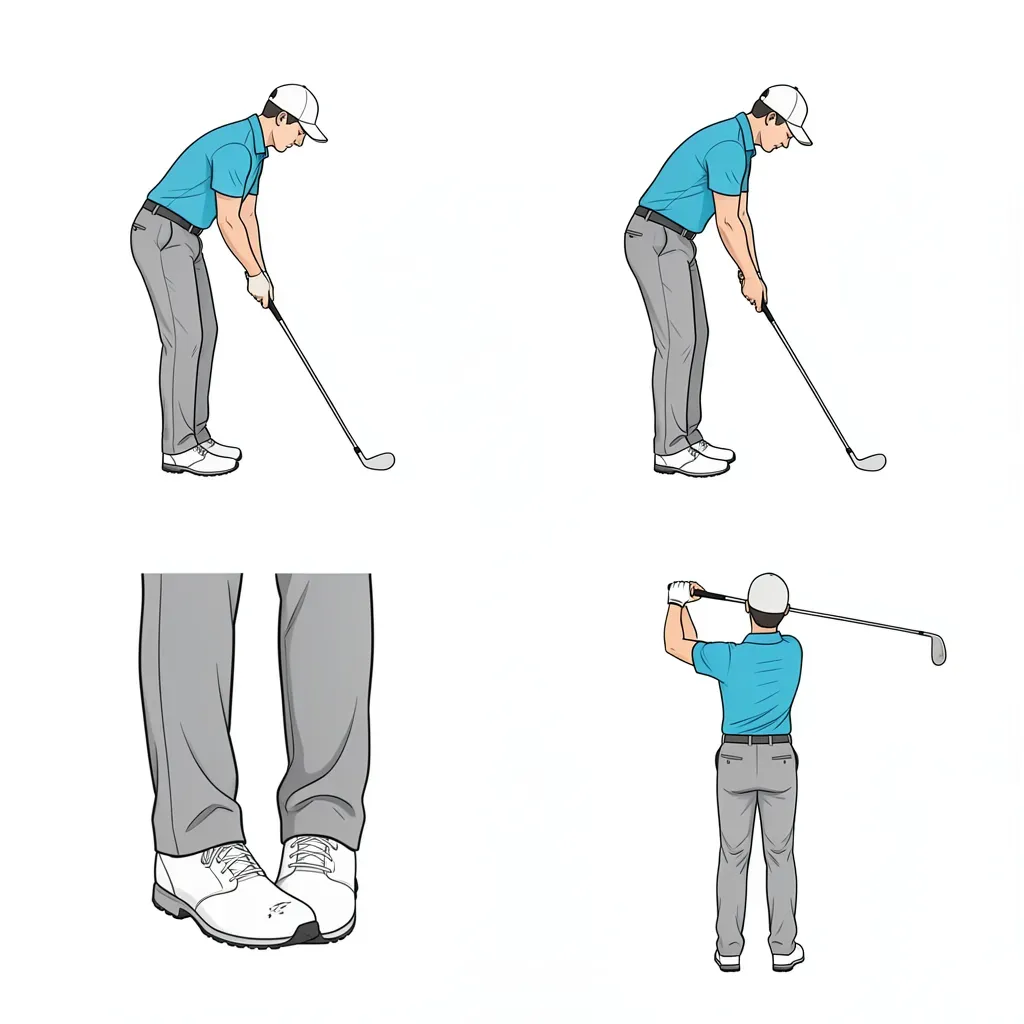
Stance width should be approximately shoulder-width for irons, slightly wider for driver. Too narrow creates instability and encourages excessive trunk movement. Too wide limits hip turn and forces compensatory spinal rotation.
Spine tilt at address should reflect a forward bend from the hips — not a rounding of the lower back. Many recreational golfers who feel they are in a "spine tilt" are actually in lumbar flexion. Maintain the lumbar curve. Think of hinging at the hip sockets rather than bending at the waist.
Knee flex should be soft — about 20 degrees. Locked knees prevent hip rotation, which then forces all rotation to come from the lumbar spine. This is one of the most common setups for lumbar injury.
Ball position errors are often underappreciated. Reaching excessively for a ball positioned too far forward creates asymmetrical loading at address that carries through the swing.
Backswing: Hip Turn, Not Spinal Rotation
The backswing should be primarily driven by hip rotation, not spinal rotation. A golfer who achieves 45 degrees of shoulder turn primarily through thoracic rotation and hip turn stresses their lumbar spine far less than one who achieves 60 degrees through lumbar rotation.
During recovery, consciously limit backswing depth. A three-quarter backswing that preserves hip-over-spine sequencing is biomechanically superior to a full backswing that comes from rotating the lumbar spine. You will lose some distance. You will keep your back.
Improving thoracic mobility — the ability of the mid-back to rotate independently — directly reduces lumbar demand in the backswing. A stiff thoracic spine forces the lumbar spine to compensate.
The Downswing, Impact, and Follow-Through
The downswing begins with a lateral hip shift toward the target, followed by rotation. This sequencing — hips first, then trunk, then arms — is both more powerful and more spine-protective than an arm-dominated swing. When arms initiate the downswing, the lumbar spine is loaded in rotation before the muscles are adequately braced.
At impact, the spine absorbs its peak compressive load. There is no meaningful modification available here — it is the nature of the swing. What you can control is how well your core is braced at this moment, and how good your mechanics are in the preceding phases that determine the spine's position at impact.
The follow-through tends to produce lumbar extension and compression on the trailing side. Players with extension-sensitive conditions (facet syndrome, spondylolisthesis) find the follow-through is their most symptomatic phase. Shortening the finish — stopping rotation earlier rather than reaching a full "C-shape" finish position — reduces this compression.
If pain occurs primarily in the follow-through, this suggests extension sensitivity rather than flexion sensitivity. Your physical therapist can use this information to guide treatment. Don't describe your pain as "golf back pain" — describe where in the swing it occurs.
Equipment Modifications
Shaft length: A shaft that is too short forces excessive forward bend at address, increasing the lumbar moment. Longer shafts allow a more upright address position. A custom fitting that optimizes shaft length for your height can reduce address-position stress.
Graphite vs steel shafts: Graphite shafts dampen vibration transmitted up the shaft at impact. For players with any kind of spinal sensitivity, the difference in shock transmission across 80 swings per round is not trivial.
Driver loft: Higher loft requires less clubhead speed to achieve optimal launch angle, which means slightly less need for maximum swing force — and slightly less peak spinal loading.
Cart vs Walking
Walking an 18-hole course provides meaningful cardiovascular and musculoskeletal benefit. The walking itself is therapeutic — it is essentially a structured walking program with extra steps. However, repeatedly getting in and out of a golf cart requires repeated lumbar flexion under load (carrying the bag) and repeated trunk rotation getting into the seat.
Walking is generally preferred for overall health and spinal conditioning. If fatigue over a round is an issue — and fatigue is a real mechanical risk factor — using a push cart removes the bag load while preserving the walking. A motorized cart can be appropriate during acute recovery, understanding that you are trading some benefit for reduced load.
Practice and Session Modifications
- Shorten sessions: 30-40 full swings is a reasonable early-return target, not 200 range balls.
- Prioritize putting and chipping: These involve minimal spinal loading and maintain feel and touch. You can do more of them with less cumulative spinal load.
- Half swings on the range: Three-quarter swings reduce peak forces considerably. Practice mechanics, not power.
- Rest between buckets: Fatigue at the range is as dangerous as fatigue on the course.
The Golf-Specific Warm-Up
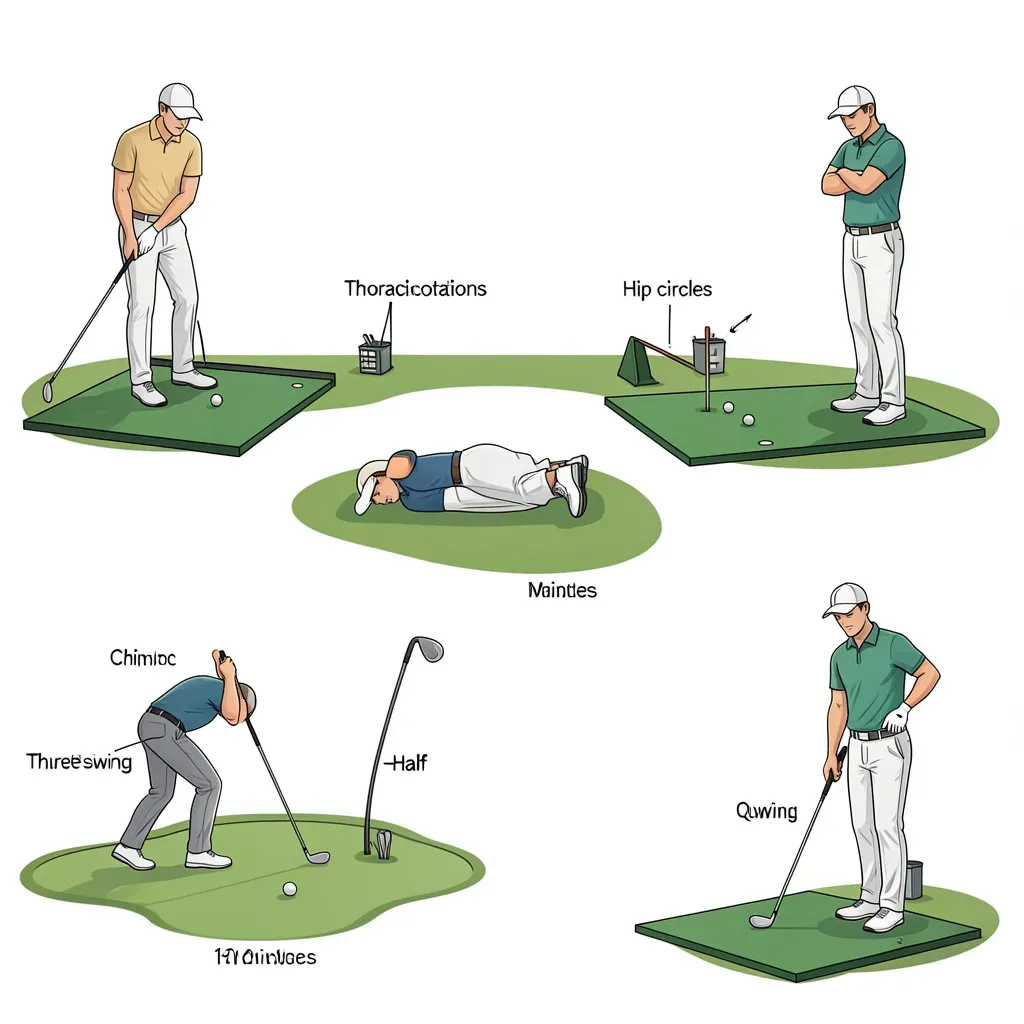
Never start a round cold. A 10-minute warm-up before the first tee dramatically reduces injury risk:
- Hip rotation circles — 10 per side, standing with hands on hips, rotating the pelvis
- Thoracic rotations — seated or standing, arms crossed, rotating the mid-back 10 times each direction
- Glute activation — 15 glute bridges or single-leg stands to pre-activate the primary power source
- Gradual swing progression — Start with chip swings, move to half swings, then three-quarter swings before any full swings
- Lateral trunk stretch — Standing, reach one arm overhead and lean away, 30 seconds per side
In Review
- The golf swing generates up to 8× body weight compressive force at L4-L5 — far more than it appears from outside
- The most common injuries are lumbar disc herniation (left side at impact for right-handers), facet syndrome (follow-through extension), and muscle strain (late-round fatigue)
- Setup errors — rounded lower back, locked knees, incorrect ball position — amplify all downstream swing mechanics
- The backswing should be led by hip turn and thoracic rotation, not lumbar rotation; limit backswing depth during recovery
- Follow-through extension sensitivity points to facet involvement, not disc
- Graphite shafts, appropriately fitted shaft length, and higher driver loft all reduce spinal loading
- Push-cart walking is the optimal mode during recovery — preserves the walking benefit, removes the bag load
- Shorten sessions dramatically during return; prioritize putting and chipping, which involve minimal spinal load
- Always warm up with hip rotations, thoracic rotations, and glute activation before the first swing