Scheuermann's Kyphosis: Living With a Stiff Thoracic Spine
Understanding Scheuermann's kyphosis — why the thoracic wedging causes pain, the relationship with hamstring tightness, and the exercise approach.
What Is Scheuermann's Kyphosis?
Scheuermann's kyphosis is a structural condition of the thoracic spine in which the vertebral bodies develop uneven growth, resulting in a wedge shape that is taller posteriorly than anteriorly. The diagnostic criteria established by Sorensen require that three or more consecutive vertebrae are each wedged by at least 5 degrees. When enough vertebrae are wedged, the cumulative effect is an exaggerated thoracic kyphosis that is measurably rigid — it does not reduce with passive extension the way postural kyphosis does.
The condition is detected during adolescence, typically in early-to-mid teenage years when the growth plates (ring apophyses around each vertebral body) are actively forming. It affects approximately 4–8% of the population, with roughly equal prevalence between males and females, though males are more likely to present clinically. The Cobb angle of the thoracic kyphosis in Scheuermann's typically measures between 45 and 75 degrees — substantially more than the 20–45 degrees considered normal.
Adults with Scheuermann's kyphosis that was not treated during adolescence carry this structural deformity into adulthood. The vertebral bodies cannot be remodeled after skeletal maturity; the wedge shape is permanent. Management therefore focuses not on correcting the underlying deformity but on managing the mechanical consequences of living with a stiff, excessively kyphotic thoracic spine.
The Vertebral Wedging Mechanism
To understand the symptoms and the approach to management, it is important to understand what the vertebral wedging actually does mechanically. Normal thoracic vertebrae are approximately rectangular in cross-section, with roughly equal anterior and posterior heights. In Scheuermann's kyphosis, the anterior vertebral body is compressed — either through asymmetric growth plate disruption or through excessive loading of the growth plate during the adolescent growth spurt (the specific etiology remains debated).
The resulting wedge shape means that each affected vertebral body contributes a few degrees of forward tilt to the thoracic kyphosis. When this is multiplied across multiple vertebrae — often T6 through T10 in the classic thoracic form — the result is a fixed forward bend in the mid-back that cannot be voluntarily corrected.
The anterior vertebral bodies are loaded in compression during forward bending. In Scheuermann's kyphosis, where these vertebrae are already wedged anteriorly, forward flexion increases this anterior compression further. This is particularly relevant during exercise and daily activities: positions and movements that add thoracic flexion stress the already-compromised anterior vertebral bodies.
A key clinical distinction: postural kyphosis — the rounded back seen in many teenagers that is entirely positional — corrects when the patient actively or passively extends the thoracic spine. Scheuermann's kyphosis does not. If a patient with apparent thoracic kyphosis is asked to stand against a wall or extend over a foam roller and the curve does not reduce, structural Scheuermann's kyphosis is likely present. Confirmation requires a lateral spine X-ray.
Why Hamstrings Are Tight — and What It Means
Tight hamstrings are a nearly universal finding in Scheuermann's kyphosis and have generated significant discussion about the relationship between the two. Most people's first instinct is to stretch the hamstrings. Understanding why they are tight suggests a different approach.
The prevailing biomechanical explanation is that the hamstrings contract protectively to limit forward pelvic tilt. Here is the mechanism: the thoracic kyphosis shifts the center of gravity forward. To maintain an upright posture and prevent forward toppling, the body extends the lumbar spine (creating a compensatory hyperlordosis) and tilts the pelvis anteriorly. The hamstrings, sensing the anterior pelvic tilt, contract to resist further forward rotation of the pelvis. They are pulling the ischial tuberosities (their attachment on the pelvis) downward and backward to counteract the forward tilt driven by the thoracic kyphosis.
In this model, the hamstrings are not the problem. They are the solution to a problem caused upstream. Stretching them releases the protective tension that is preventing the anterior pelvic tilt from worsening — which may temporarily relieve the sensation of tightness while removing a mechanical safeguard. A more rational approach is to address the anterior pelvic tilt and lumbar hyperlordosis through exercise (hip flexor stretching, glute strengthening, and thoracic extension work) rather than simply stretching the structure that is compensating for these problems.
Some researchers argue that tight hip flexors, shortened by the anterior pelvic tilt, are a more direct driver of the lumbar hyperlordosis seen in Scheuermann's, and that hip flexor stretching has greater therapeutic value than hamstring stretching. Both perspectives support the conclusion that aggressive hamstring stretching is not the primary intervention.
Thoracic Extension Limitations
The rigid thoracic kyphosis in Scheuermann's limits thoracic extension in two ways. First, the structural wedging means that the vertebral bodies cannot return to a neutral shape — the bony geometry prevents full extension at the affected levels. Second, the posterior elements (facet joints, posterior ligaments, and paraspinal muscles) that have been in a chronically shortened position over the kyphosis gradually become adaptively shortened, further limiting extension.
The combination of structural bony limitation and soft tissue shortening means that thoracic extension in Scheuermann's kyphosis patients reaches a hard ceiling. Extension exercises can improve mobility within the available range and maintain it against further tightening, but they will not produce a fully extended thoracic spine in an adult with well-established Scheuermann's kyphosis.
This is an important expectation-setting point: the goal of thoracic extension exercises in adult Scheuermann's kyphosis is to maximize the available range, maintain that range against further stiffening, and strengthen the thoracic extensors so they can support the posture at end range. It is not to correct the structural deformity.
Progress in thoracic extension for Scheuermann's patients is measured by changes in functional capacity — the ability to reach overhead, the reduction in cervical and lumbar compensatory pain, improved breathing depth, and reduced fatigue during upright activities — rather than by X-ray Cobb angle changes, which will not meaningfully improve after skeletal maturity.
Lumbar Compensation and Its Consequences
The lumbar spine's compensatory response to thoracic kyphosis is one of the primary drivers of pain in Scheuermann's patients. When the thoracic spine sits in fixed kyphosis, the lumbar spine must extend beyond its normal range to maintain an upright posture, shifting the pelvis anteriorly. This lumbar hyperlordosis concentrates load on the lumbar facet joints and the posterior disc annulus.
Over time, this compensatory pattern leads to lumbar facet joint degeneration, which can produce lumbar back pain, stiffness, and eventually lumbar stenosis. It also creates a situation where lumbar pain is largely driven by thoracic mechanics — treating the lumbar spine alone, without addressing the thoracic kyphosis, provides only partial and temporary relief.
The cervical spine faces a similar compensation problem. With the thoracic spine kyphotic, the head is carried forward. To keep the gaze level, the cervical spine must extend. Chronic cervical extension overloads the posterior cervical facet joints and suboccipital muscles, producing the chronic neck stiffness, upper trapezius tension, and cervicogenic headaches that many Scheuermann's patients report alongside their thoracic and lumbar symptoms.
Adults with Scheuermann's kyphosis who develop progressively worsening leg symptoms — heaviness, cramping with walking, weakness, or bowel and bladder changes — should seek medical evaluation. Severe thoracic kyphosis can narrow the thoracic spinal canal and compress the thoracic spinal cord, producing myelopathy. This is rare but is a serious complication that requires neurological and surgical evaluation.
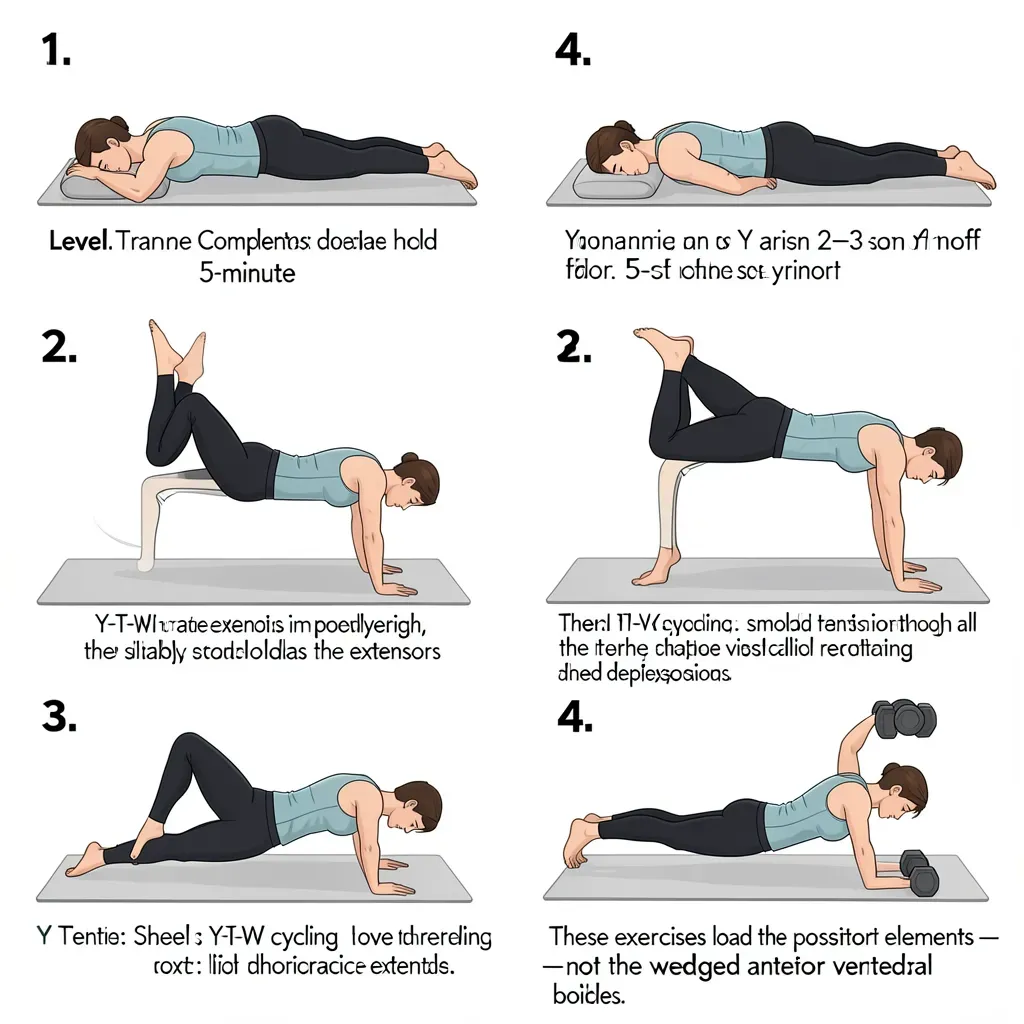
Prone Extension Exercises
Prone extension exercises — lying face down and extending the upper body against gravity — are among the most important interventions for Scheuermann's kyphosis. They directly load the thoracic extensors (lower trapezius, rhomboids, mid-thoracic erectors), place the anterior vertebral bodies in relative tension rather than compression (which is the safer loading direction for these structures), and gradually improve thoracic extension range within the constraints of the structural deformity.
The standard progression:
Level 1 (Passive prone): Simply lying prone with a pillow under the chest, arms at sides. This unloaded gravity-assisted extension helps elongate the soft tissue restrictions on the posterior thoracic wall. 3–5 minutes daily.
Level 2 (Prone arm raises): Lying prone, lift the arms to a Y or T position, hold 5 seconds, return. This activates the lower trapezius and mid-thoracic extensors with minimal compressive load on the anterior vertebral bodies.
Level 3 (Prone Y-T-W progression): A more demanding version of the above, cycling through Y (arms forward-diagonal), T (arms straight out), and W (elbows bent, shoulders externally rotated) positions. This comprehensively trains all the scapular stabilizers and thoracic extensors relevant to posture.
Level 4 (Loaded extension): Using light hand weights in the Y-T-W positions, or a suspension trainer row that requires thoracic extension to complete. Performed only when the unloaded versions are mastered.
Safe Activities Versus What Stresses the Anterior Vertebrae
Understanding which activities are safe and which place additional stress on the already-compressed anterior vertebral bodies is important for daily management.
Safe and beneficial activities:
- Walking and upright aerobic activity (loads the spine in extension-neutral)
- Swimming backstroke (actively extends the thoracic spine against water resistance)
- Rowing (requires thoracic extension at the catch position)
- Deadlifts and hip hinge exercises with a neutral or extended thoracic spine
- Overhead pressing with thoracic extension maintained (not kyphotic)
- Prone extension exercises as above
Activities that increase anterior vertebral body loading (modify or approach with care):
- Heavy barbell squats and deadlifts with a rounded thoracic spine — the thoracic rounding under load directly compresses the wedged anterior vertebral bodies
- Cycling with a forward-leaning posture — sustained thoracic flexion under low-level compression can contribute to chronic anterior loading
- Gymnastics movements that involve repeated thoracic flexion under high compressive loads
- Contact sports involving direct impacts to the thoracic spine in early adolescence — the growth plates in Scheuermann's patients may be more susceptible to impact damage
Activities that are neutral and appropriate:
- Most recreational sport and exercise that does not specifically require thoracic flexion under load
- Running with attention to upright posture
- Most yoga (avoiding extreme forward bends under load)
- Resistance training with good thoracic form
The fundamental principle is that Scheuermann's kyphosis does not prohibit physical activity — it requires that thoracic spine position be respected during loaded activities. An active lifestyle with modification of the specific loading directions that stress the anterior vertebral bodies is strongly preferable to inactivity.
In Review
- Scheuermann's kyphosis involves fixed wedging of three or more consecutive vertebral bodies (each 5 degrees or more), producing a structural thoracic kyphosis that does not correct with passive extension — distinguishing it from postural kyphosis
- The vertebral wedging is structural and permanent after skeletal maturity; management in adults focuses on consequences, not structural correction
- Hamstring tightness in Scheuermann's kyphosis is a protective response to anterior pelvic tilt driven by the thoracic kyphosis — stretching the hamstrings without addressing the upstream drivers is mechanically counterproductive
- The lumbar spine compensates for thoracic kyphosis by hyperextending, loading the lumbar facets and posterior disc; the cervical spine extends to maintain a level gaze, driving cervicogenic symptoms
- Prone extension exercises (Y-T-W progression) load the thoracic extensors while placing the anterior vertebral bodies in tension rather than compression — they are the cornerstone of the exercise approach
- Thoracic extension exercises improve range within the structural constraints and strengthen the extensors; they will not meaningfully change the Cobb angle in adults, but they do meaningfully change function, pain, and compensatory mechanics
- Activities involving thoracic flexion under high compressive loads should be modified; upright loading, swimming backstroke, and prone extension are specifically beneficial
- Progressive thoracic myelopathy symptoms — leg heaviness, weakness, or bowel and bladder changes — require urgent medical evaluation as severe kyphosis can narrow the thoracic spinal canal