Rock Climbing and Back Pain
How rock climbing affects the lumbar spine — the unique demands of overhanging routes, the protective benefits of grip and core loading, and modifications during recovery.
The Climbing Spine: A Different Kind of Load
Rock climbing is biomechanically unusual. Unlike running or lifting, where spinal loads are predominantly compressive and repetitive, climbing creates a continuously varying demand on the posterior chain — the muscles running from the feet through the glutes, erectors, and lats to the shoulders and hands. This variability is, in many cases, protective.
The muscular demands of climbing are substantial. Research using electromyography on intermediate and advanced climbers shows sustained high activation of the lumbar erectors, multifidus, and deep abdominal musculature throughout a route. Climbers are not passive hangers — they are actively bracing and repositioning through every move. For someone working to rebuild posterior chain strength after back injury, climbing's demand for integrated core stability is closer to therapeutic loading than to athletic excess.
This does not mean climbing is without risk. But understanding which aspects of the sport are genuinely hazardous versus which are beneficial — and for whom — allows a more intelligent approach to recovery and return.
Posterior Chain Loading: The Protective Mechanism
The posterior chain — the interconnected system of muscles from the hamstrings and glutes through the lumbar erectors and into the thoracic and cervical extensors — is among the most important stabilizing systems for the lumbar spine. Weakness or inhibition in this system is a consistent finding across back pain populations.
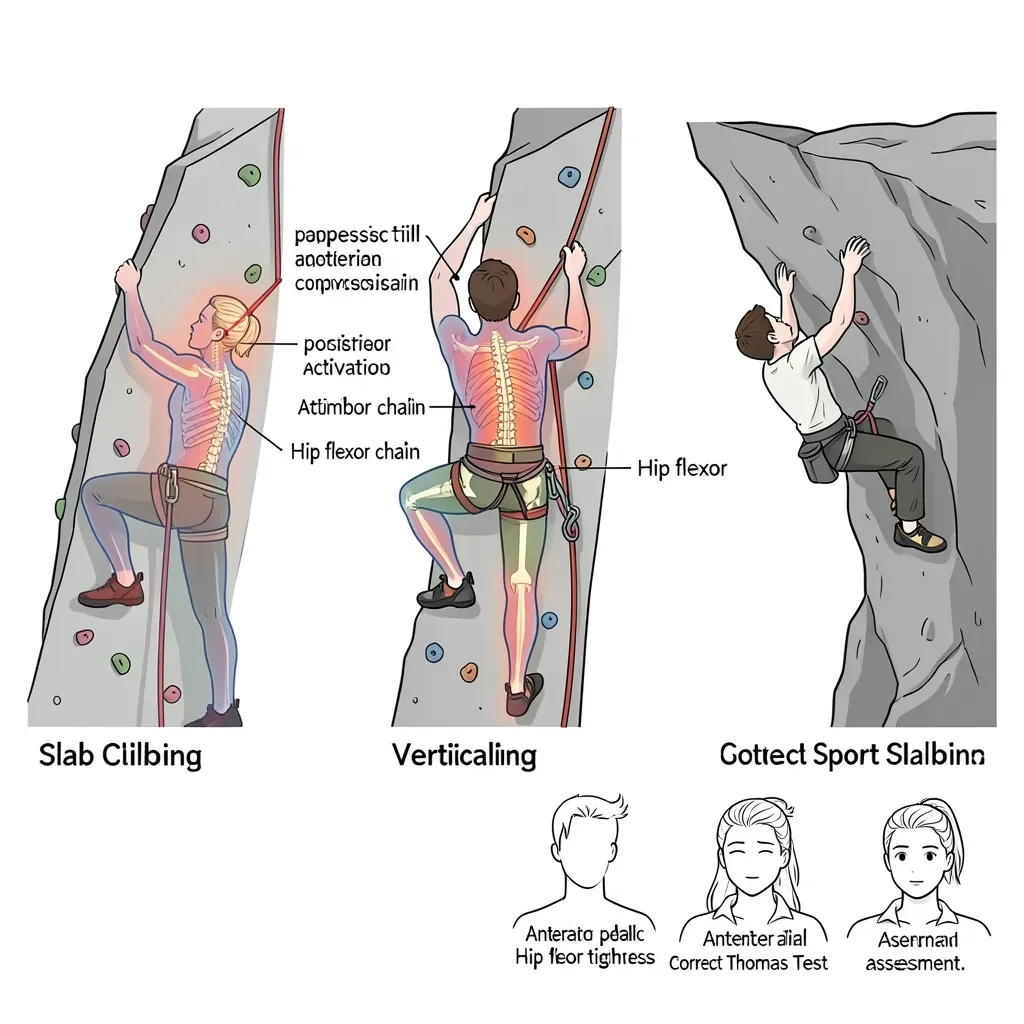
Climbing loads the posterior chain in a functionally integrated way. Every high foot placement, every lock-off, every balance-intensive slab move requires the glutes, erectors, and lats to work as a coordinated unit. The eccentric demand of lowering off the wall, and the isometric demand of holding positions on steep terrain, build the kind of time-under-tension strength that direct rehabilitation exercises can struggle to replicate.
For climbers recovering from disc injuries, facet irritation, or chronic non-specific low back pain, this is relevant. The movement pattern of pulling into the wall with the upper body while driving through the feet loads the spine in extension — the opposite of the sustained flexion loading that exacerbates most disc-related presentations. Easy to moderate slabs and vertical routes, where the climber is upright or slightly tilted into the wall, provide this benefit most clearly.
If you are cleared to begin returning to activity after a back injury, easy slab climbing (below your limit, with no dynamic movement) is often an appropriate early option. The posterior chain loading is therapeutic, the movements are deliberate and controlled, and the absence of fall risk on well-bolted easy routes makes it manageable. Discuss with your physiotherapist, but do not assume climbing is off-limits.
Hip Flexor Tightness: The Underappreciated Problem
High-stepping — placing your foot at or above hip height to gain a hold — is a fundamental climbing technique. Done repeatedly over months and years, it creates a specific and often unrecognized pattern: hip flexor shortening combined with anterior pelvic tilt.
The hip flexors (primarily the iliopsoas, rectus femoris, and tensor fasciae latae) attach to the lumbar vertebrae and the anterior pelvis. When chronically shortened, they pull the lumbar spine into extension and the pelvis forward, increasing lumbar lordosis. The erectors must then work harder to maintain upright posture, and the disc spaces at L4-L5 and L5-S1 sustain higher compressive loads.
Climbers often have excellent hip flexibility in external rotation and adduction — the hip positions that facilitate smearing and open-hip flagging — but tight hip flexors in extension. This asymmetry is clinically significant because it often goes unnoticed. The climber feels flexible overall, but the specific mobility deficit driving their back pain is hidden.
Assessment is straightforward. In a Thomas Test position (lying supine, one knee pulled to chest, the other leg lowered toward the floor), the lowered leg should reach approximately horizontal. Climbers with significant hip flexor tightness will have the lowered thigh remaining well above horizontal, often with accompanying lumbar extension visible at the lower back. This is a trainable problem. Targeted hip flexor lengthening and glute activation work — added deliberately to the training schedule, not just done briefly before sessions — produces measurable improvement in lumbar mechanics over six to eight weeks.
Overhanging Routes and Lumbar Compression
Overhanging terrain changes the spinal loading equation substantially. On a vertical or slabby wall, the spine works primarily in extension against gravity. On a steep overhang — particularly modern sport and bouldering routes that are 45 degrees or more past vertical — the spine must resist the torque of the hanging body weight pulling the torso away from the wall.
This creates a specific demand: the hip flexors and abdominals must maintain lumbar flexion to keep the hips close to the wall, while the lats and posterior chain pull the shoulders in. The spine is compressed between these competing forces. For climbers with disc herniation, this compressive load — especially combined with the spinal flexion position — is a legitimate concern.
The practical guidance is straightforward: during active recovery, avoid overhanging routes. The distinction is not arbitrary. Vertical routes and slabs produce a qualitatively different spinal load than steep overhangs, and the clinical experience of climbers with disc pathology is consistent with the biomechanics. Returning to steep territory is appropriate once a foundation of spinal stability has been rebuilt and symptoms have been absent during vertical climbing for several weeks.
Overhanging bouldering problems are among the highest spinal load activities in climbing. The combination of lumbar flexion, high compressive forces from body weight, and dynamic movement (powerful throws, campus moves) creates loading that most recovering spines are not ready for early in rehabilitation. Return to steep terrain last, not first.
Belaying: The Cervical Problem
For climbers who spend significant time at the base of routes looking up at their partner, belaying creates a sustained cervical extension load that is rarely discussed but frequently symptomatic. Watching a leader on a tall sport route can mean five to fifteen minutes of sustained neck extension — the equivalent of holding a neck-extended position during a rehabilitation class, which any physiotherapist would immediately stop.
The cervical implications are most relevant for climbers whose back pain extends into the neck or upper thoracic region, or those who are recovering from issues involving the cervicothoracic junction. However, even for purely lumbar presentations, the compensatory tension that sustained cervical extension creates through the thoracic and upper lumbar paraspinals is measurable.
Practical modifications include: choosing to delay belaying during periods of acute neck or upper back symptoms; using an assisted-braking device that allows more frequent repositioning; briefly looking down at regular intervals during long pitches; and positioning yourself so you can take a few steps back from the wall, reducing the angle of neck extension required.
Hangboard Training and the Shoulder-Spine Relationship
Fingerboard or hangboard training — gripping weighted or unweighted holds for set durations to build finger strength — has become a standard part of serious climbing training. From a spinal perspective, dead-hanging from a hangboard is not a high-risk activity for the lumbar spine. The unloaded suspension creates traction rather than compression.
Where the shoulder-spine relationship becomes relevant is in climbers who use hangboards to train through shoulder or rotator cuff dysfunction without resolving it. Shoulder pathology in climbing is common — supraspinatus and biceps tendon involvement, AC joint overload, and subscapularis strain all occur with frequency. When shoulder function is compromised, the lats and thoracic erectors are recruited differentially to compensate, creating asymmetrical loading patterns at the thoracolumbar junction.
The practical point: hangboard training is not inherently dangerous for the recovering spine, but persistent asymmetric shoulder function should be addressed directly rather than trained around. A climbing-experienced physiotherapist who understands the demands of the sport is the appropriate resource for this.
Returning to Climbing After Injury
Return to climbing after lumbar injury follows the same principles as return to any sport: load should be progressive, symptoms should guide progression, and the goal is increasing capacity rather than testing limits.
A reasonable framework:
Phase 1 (weeks 1-4 post-acute): No climbing. Address hip flexor tightness, restore posterior chain activation, manage pain. Walking, swimming, and gentle mobility work are appropriate.
Phase 2 (weeks 4-8, if symptoms allow): Easy slab climbing, well within ability. Routes below 5.8 in difficulty, no dynamic movement, focus on footwork and slow deliberate movement. Stop the session immediately if back pain increases. Two to three sessions per week maximum.
Phase 3 (weeks 8-12): Vertical routes up to moderate difficulty (5.9-5.11a range for most intermediate climbers). Begin to include mild overhang — 10 to 15 degrees past vertical — if symptoms have been absent for two consecutive weeks.
Phase 4 (12 weeks onward): Full training resumes with attention to hip flexor mobility, posterior chain maintenance, and avoiding sustained belaying with neck extension. Steep overhanging routes and bouldering return when the full range of movement is pain-free.
This timeline is a guide, not a protocol. Acute disc herniation with neurological involvement requires a longer, more conservative approach and should be supervised by a physiotherapist familiar with climbing demands. Most chronic non-specific low back pain recoveries can move through phases more quickly.
Climbing coaches with a background in movement analysis can be valuable partners in injury recovery. A coach who understands how hip position, foot placement accuracy, and body tension interact can identify technique habits — overly dynamic movement, hip dropping on overhangs, sloppy footwork — that increase spinal load unnecessarily. Technique improvement and injury rehabilitation are not separate projects.
Common Mistakes in Climbing Rehabilitation
Returning to bouldering first. Bouldering is appealing because it is convenient and social. It is also the highest-load climbing discipline — powerful dynamic moves on steep terrain, with landings and repeated attempts on the same moves. It should be the last thing to return.
Ignoring hip mobility. Climbers tend to spend time on climbing-specific training and neglect the hip extensibility work that would reduce their lumbar load. A 10-minute hip flexor stretching routine three times per week produces measurable change in six weeks.
Training through pain. Route-setters and training partners can create significant social pressure to climb despite symptoms. Pain during climbing — as opposed to mild discomfort that resolves immediately with rest — is information worth taking seriously. Climbing through pain does not build capacity; it sustains sensitization.
Ignoring the hang. The cool-down hang after a climbing session — deliberately decompressing the spine through a relaxed passive hang from a pull-up bar or hangboard — is low-effort and consistently reported as beneficial by climbers managing disc pathology. One to two minutes of relaxed hanging, post-session, is a low-risk intervention worth including.
In Review
- Climbing's posterior chain loading and integrated core demand make it more therapeutic than most athletic activities for the recovering lumbar spine
- Hip flexor tightness from repeated high-stepping is a common and underrecognized driver of lumbar pain in climbers — assess and address it directly
- Overhanging terrain produces compressive lumbar loads in a flexed position; return to steep routes last, not first
- Sustained belaying creates cervical extension load that can propagate into the upper thoracic and lumbar regions — modify or limit during symptomatic periods
- Hangboard training is not high-risk for the lumbar spine, but asymmetric shoulder dysfunction can create compensatory thoracolumbar loading
- Return-to-climbing should progress from easy slab to vertical to mild overhang to steep terrain over 8-12 weeks, guided by symptoms
- Bouldering is the highest-load climbing discipline and should return last in any rehabilitation program
- Hip flexor stretching three times per week and post-session decompression hangs are simple, low-cost interventions that reduce cumulative spinal load