The Gift of Injury: A Comeback Story
How elite powerlifter Brian Carroll recovered from a career-ending back injury using McGill's methods — and what his journey teaches every back pain sufferer.
The Worst Day
Brian Carroll was one of the strongest powerlifters in the world — a 1,306 kg (2,879 lb) total in competition, squatting over 500 kg. Then his back broke. Multiple herniated discs, nerve damage, and pain so severe he couldn't sit, stand, or sleep without agony.
Doctors told him he was done. Surgery was the only option. His lifting career was over.
He didn't accept it. Instead, he sought out Dr. Stuart McGill — and what followed became a blueprint for anyone recovering from a devastating back injury.
If an elite powerlifter who broke his spine under 500+ kg of load can recover and return to world-class performance without surgery, then your back — regardless of how hopeless it feels right now — has a path forward. The principles are the same whether you're lifting 500 kg or lifting your grandchild.
The Turning Point: Injury as Teacher
Brian's injury forced him to confront a truth he'd been ignoring: he had been succeeding DESPITE terrible movement patterns, not because of good ones. His strength had masked his dysfunction — until it couldn't anymore.
This is the "gift" of injury: it forces you to finally learn how your body actually works. Many people — athletes and non-athletes alike — are running on borrowed time with flawed mechanics. Injury is the body's way of demanding change.
The Uncomfortable Truth
Brian had to accept several things:
- His previous training approach caused the injury — not bad luck
- Strength had hidden his instability
- Recovery meant starting from absolute zero — not "modified training"
- Patience measured in months and years, not days and weeks
- He would need to move differently FOREVER — not just until it stopped hurting
Starting From Zero
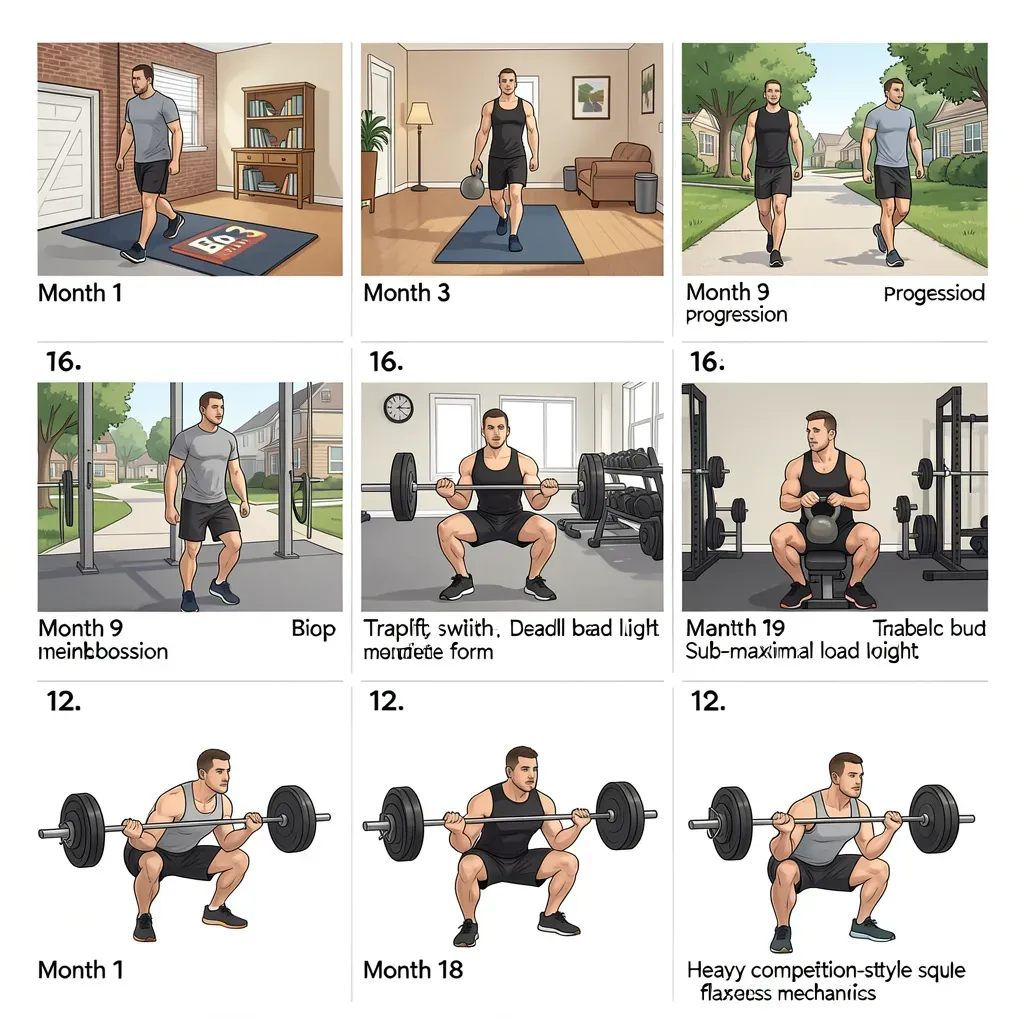
Brian Carroll — a man who had squatted over 500 kg — began his recovery by:
- Walking to the end of his driveway
- Performing the Big 3 at the most basic level (4-3-2 reps)
- Lying on his stomach to restore lordosis
- Learning to sit properly for the first time in his life
There was no shortcut. No "just push through it." No modified training that let him feel like an athlete. He was a beginner again — and accepting that was harder than any weight he'd ever lifted.
The athletic ego is the single biggest barrier to recovery. If you identify as "someone who trains hard," the humility required to walk to the end of your driveway as your workout is devastating. But it is the ONLY path. Every shortcut leads backward.
The Recovery Protocol
Phase 1: Eliminate the Cause (Weeks 1-8)
- Complete cessation of all training
- Spine hygiene — every movement, all day
- Walking program: started at 5 minutes, built by 1-2 minutes per week
- Big 3: minimal volume, perfect form
- Tummy lie several times daily
- No sitting for more than 20 minutes
Phase 2: Build the Foundation (Months 2-6)
- Walking extended to 30-45 minutes daily
- Big 3 progressed to 8-6-4 with holds
- Hip mobility work added
- Introduced bodyweight movement patterns (squat, hinge, lunge)
- Still NO barbell work
- Continued strict spine hygiene
Phase 3: Reintroduce Loading (Months 6-12)
- Goblet squats (light kettlebell)
- Trap bar deadlifts (elevated handles, light weight)
- Strict form requirements: if spine moved, the set was OVER regardless of planned reps
- Load increased only when form remained flawless for 2 consecutive weeks
- Big 3 continued daily
Phase 4: Return to Competition (Year 2+)
- Barbell squat and deadlift reintroduced
- Weight added 2.5-5 kg per week maximum
- Competition-style lifting only after months of pain-free training
- Eventually returned to a 1,000+ kg total — with completely different mechanics
Key Lessons for Everyone
1. "Earn the Right" to Progress
Brian didn't decide when to add weight. His body decided. The rule was simple: if you can't do the current level with perfect form for two weeks straight, you haven't earned the next level.
This principle applies to everyone:
- Can't walk 10 minutes pain-free? You haven't earned 15 minutes.
- Can't do bird-dog without pelvis rotation? You haven't earned the weighted version.
- Can't sit for 30 minutes without slouching? You haven't earned ignoring your lumbar support.
2. The 24-Hour Athlete
Brian learned that his recovery wasn't determined by his 45-minute exercise session. It was determined by the other 23 hours. How he sat. How he got out of bed. How he tied his shoes. How he drove.
You are a "24-hour athlete" in your own recovery. The exercises matter, but the daily movement habits matter MORE.
3. Strategic Patience
Brian's total recovery took over two years. Not two weeks. Not two months. YEARS.
But here's what made it bearable: he was never in pain during this time (after the first few weeks). He was simply building capacity. Each week was slightly better than the last. The progress was slow but constant and cumulative.
Strategic patience doesn't mean sitting still and waiting. It means being intensely active within your current capacity while having the discipline to not exceed it. It's the hardest kind of patience because you're working hard AND holding back simultaneously.
4. Movement Patterns Over Muscle
Brian didn't rebuild his strength and then fix his form. He fixed his form FIRST — at zero load — and then added strength on top of perfect patterns.
This order is non-negotiable:
- Learn the pattern (unloaded, slow, conscious)
- Groove the pattern (thousands of perfect reps in daily life)
- Load the pattern (add weight only when the pattern is automatic)
- Challenge the pattern (add speed, fatigue, unpredictability)
5. The Maintenance Commitment
After full recovery and return to elite-level competition, Brian still does his Big 3 every single day. He still practices spine hygiene. He still uses the hip hinge for every bend. These aren't "rehab exercises" he graduated from — they're lifetime maintenance.
Your Injury as a Gift
Whatever brought you here — whether it's a specific injury, years of accumulating pain, or a sudden onset that came from nowhere — consider this reframe:
Your pain is INFORMATION. It's telling you that something in your movement, your posture, your loading pattern, or your daily habits is wrong. Without the pain, you'd continue these patterns until catastrophic failure.
The "gift" isn't the pain itself. It's the forced awareness. It's the motivation to finally learn how your body works. It's the reason you're reading this right now instead of continuing to damage yourself unknowingly.
Brian Carroll's message to everyone with back pain: "The same principles that got me back to squatting 500 kg are the same principles that will get you back to playing with your kids, gardening, or just living without pain. The difference is scale, not process. Trust the process."
The Non-Negotiables (From Brian's Experience)
- Daily Big 3. No exceptions. Even on good days. Especially on good days.
- Walking every day. Rain or shine. Even if it's 10 minutes.
- Spine hygiene is forever. You don't "graduate" from proper movement.
- No more ego lifting. Perfect form at lower weight beats sloppy form at higher weight every single time.
- Track everything. Daily log of activities, pain, and exercise. Patterns emerge that you can't see in real-time.
- Accept help. Brian — one of the strongest humans alive — needed a coach. You do too, even if that coach is this program.