How to Read Food Labels for Inflammation
A practical translation guide for food packaging — how to identify hidden sugars, seed oils, emulsifiers, and ultra-processed ingredients using only the label.
The Label as a Marketing Document
Before getting into the mechanics of label reading, establish this principle: a food package is primarily a marketing document. The front of the package is designed by marketing teams whose job is to communicate a health story, a value proposition, or an emotional connection. The back of the package — specifically the ingredient list and nutrition facts panel — contains the actual information you need, and it is frequently in direct conflict with the front.
Understanding food labels is a practical skill that requires knowing what to look at first, which parts to interpret skeptically, and how to decode the terminology that manufacturers use to obscure ingredients that have become consumer liabilities. This skill matters for the back pain patient because the research connecting dietary inflammation to pain outcomes is strong enough that what you eat consistently — including the highly processed foods marketed as health foods — is a real clinical variable.
Ingredient List vs. Nutrition Facts: Which Comes First
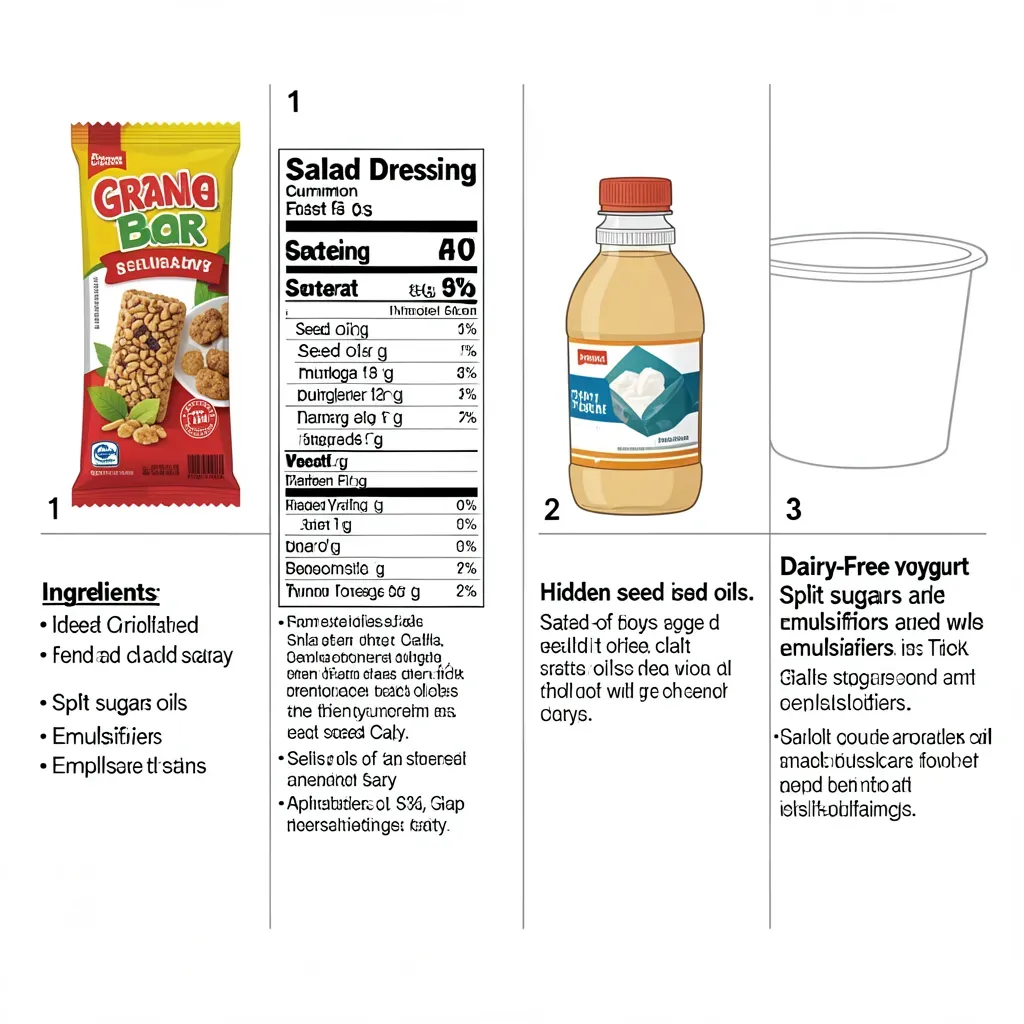
Always read the ingredient list before the nutrition facts panel. The ingredient list tells you what the food actually contains, in descending order by weight. The nutrition facts panel tells you about macronutrients and selected micronutrients, but it cannot distinguish between food and non-food ingredients — a 200-calorie serving of almonds and a 200-calorie engineered snack bar look identical on the nutrition facts panel.
The ingredient list has no analog for marketing spin. "Canola oil," "high fructose corn syrup," and "polysorbate 80" appear on the label exactly as they are. The information is there — it is just presented in small print and requires learned interpretation.
The length and composition of the ingredient list is itself informative. Whole or minimally processed foods have short lists of recognizable ingredients. Ultra-processed products tend to have long lists with multiple ingredients that serve functions other than nutrition — emulsifiers, stabilizers, artificial flavors, colorants, modified starches. As a rule of thumb, if you cannot visualize most of the ingredients as whole foods, you are looking at an ultra-processed product regardless of what the front of the package says.
Spotting Seed Oils Under Multiple Names
Industrial seed oils — soybean, corn, cottonseed, canola, sunflower, safflower, grapeseed — are high in omega-6 linoleic acid. At the scale of modern consumption (these oils are the dominant fat in virtually all restaurant food and processed food), they produce a chronically pro-inflammatory omega-6:omega-3 ratio. A hunter-gatherer diet is estimated to have had a ratio of roughly 1:1 to 4:1; the modern Western diet ranges from 15:1 to 20:1.
The problem for label readers is that seed oils appear under a wide variety of names, and manufacturers often list multiple seed oils in a single product while listing them separately (so that individually none appears as the first ingredient).
Seed oil names to recognize:
- Soybean oil (or just "vegetable oil" — typically soybean)
- Canola oil (also marketed as "rapeseed oil")
- Corn oil
- Cottonseed oil
- Sunflower oil (standard, not high-oleic)
- Safflower oil (standard, not high-oleic)
- Grapeseed oil
- Rice bran oil
- Partially hydrogenated [any oil] — trans fat, now largely phased out but still present in some products
- "Vegetable oil" without specification — typically soybean, corn, or a blend
The high-oleic exception: High-oleic versions of sunflower and safflower oil have a different fatty acid profile — high in oleic acid (like olive oil) rather than linoleic acid. These are substantially less inflammatory than their standard counterparts and are used in some healthier snack products. Check the label carefully: "high oleic sunflower oil" is meaningfully different from "sunflower oil."
The practical implication: check the ingredient list of any packaged food you eat regularly. Salad dressings, crackers, chips, bread, protein bars, cooking sprays, frozen meals, condiments, and coffee creamers are the most common hidden sources. If seed oil appears in the first three to five ingredients, that food is a significant omega-6 contributor.
Sugar's 36+ Names
The sugar identification problem is well known but still operationally confusing. Manufacturers split sugar across multiple ingredient names specifically to prevent it from appearing near the top of the ingredient list — ingredients are listed by weight, so five small amounts of different sugars each stay lower on the list than one large amount of "sugar."
The complete categories to recognize:
Obvious sugars: sugar, cane sugar, raw sugar, brown sugar, powdered sugar, coconut sugar, date sugar
Syrups: high fructose corn syrup (HFCS), corn syrup, rice syrup, brown rice syrup, agave nectar, agave syrup, maple syrup, golden syrup, barley malt syrup, tapioca syrup, oat syrup
Concentrated fruit products used as sweeteners: fruit juice concentrate, apple juice concentrate, grape juice concentrate, dried cane juice, evaporated cane juice — note that "juice concentrate" used as an ingredient is functionally sugar
Sugars marketed as healthier alternatives (functionally similar glucose/fructose load): honey, molasses, turbinado sugar, muscovado sugar, jaggery, coconut palm sugar, date paste
Chemical names appearing on ingredients lists: dextrose (glucose), fructose, galactose, maltose, lactose, sucrose, trehalose, maltodextrin (technically a starch, but rapidly converted to glucose and behaves like sugar metabolically)
The nutrition facts panel is actually useful here for a secondary check: "added sugars" in grams is now a required line on U.S. nutrition labels. Four grams equals one teaspoon. A product with 24 grams of added sugars contains six teaspoons, regardless of how many different ingredient names were used to get there.
Emulsifiers: The Least Discussed Ingredient Problem
Emulsifiers are additives that allow oil and water to mix, extending shelf life and improving texture in processed foods. They are ubiquitous in commercial food manufacturing — present in bread, salad dressings, ice cream, protein bars, nut butters, chocolate, margarine, and dairy alternatives.
Emerging research, including important preclinical work by Benoit Chassaing and Andrew Gewirtz published in Nature (2015), has shown that two common emulsifiers — carboxymethylcellulose (CMC) and polysorbate 80 (P80) — at doses comparable to human consumption disrupt the intestinal mucus layer, alter gut microbiome composition, and induce chronic low-grade intestinal inflammation in mice. This intestinal inflammation was associated with increased inflammatory markers and altered metabolic function.
Human data is still developing, but the mechanism is biologically plausible and has been replicated in multiple in vitro and preclinical models. For back pain patients already working to reduce systemic inflammatory load, minimizing emulsifier exposure is a reasonable precautionary measure based on current evidence.
Common emulsifiers to recognize:
- Polysorbate 80 (also Tween 80)
- Carboxymethylcellulose (CMC), also labeled as "cellulose gum"
- Carrageenan — derived from seaweed but associated with intestinal inflammation at commercial doses; particularly common in dairy alternatives, infant formula, and processed meats
- Lecithin (soy or sunflower) — lower inflammatory concern than the above; generally considered safer
- Mono- and diglycerides — common emulsifiers with limited concern at typical doses
- DATEM (diacetyl tartaric acid esters of monoglycerides) — common in commercial bread
- Xanthan gum and guar gum — thickeners/stabilizers with generally good safety profiles at normal doses
The most actionable targets are polysorbate 80, carboxymethylcellulose, and carrageenan — these have the strongest preclinical evidence for gut barrier disruption.
The Health Halo Problem
"Health halo" refers to the phenomenon in which a single health claim on a package causes consumers to overestimate the overall healthfulness of a food and underestimate its total calorie content. This is a well-documented cognitive bias, and food manufacturers are expert at engineering it.
Common health halo triggers: "organic," "non-GMO," "gluten-free," "vegan," "natural," "made with whole grains," "high protein," "low fat," "no artificial ingredients."
The critical point: these claims address one specific attribute and say nothing about the others. An organic product can contain significant refined sugar and seed oils. A gluten-free product can be an ultra-processed combination of refined rice flour, potato starch, and multiple emulsifiers. A "natural" product may contain carrageenan, high fructose corn syrup, and oxidized seed oils — all technically derived from natural sources.
The "made with whole grains" claim is a particular illustration: U.S. labeling requires only that the product contain some whole grain — there is no minimum percentage. A product can be primarily refined flour with trace whole grain and legitimately carry this claim. Check the ingredient list: if "whole grain [flour]" is not the first ingredient, the product is predominantly refined grain regardless of the front-of-pack claim.
Certified organic ultra-processed food is not a health food. The organic certification speaks to pesticide and production standards; it says nothing about the degree of processing, the glycemic impact, the presence of emulsifiers, or the seed oil content.
Front-of-Pack Claims vs. Ingredient Reality
A practical translation guide for the most misleading front-of-pack formulations:
"Heart healthy" — typically refers to saturated fat content or the AHA certification program. Says nothing about seed oil content, emulsifiers, or sugar.
"All natural" — has no regulatory definition in the U.S. FDA context for processed foods. Manufacturers use it freely.
"Contains omega-3s" — may refer to ALA from flax, not EPA/DHA from fish. ALA converts to EPA/DHA at approximately 5–10% efficiency in humans. Functionally negligible as an omega-3 source.
"No artificial preservatives" — natural preservatives (rosemary extract, vitamin E as "mixed tocopherols") are still preservatives. This claim says nothing about artificial flavors, emulsifiers, or other additives.
"Reduced fat" — reduced fat products frequently compensate for texture and palatability loss by adding sugar, refined starch, or emulsifiers. Compare the ingredient list of a full-fat and reduced-fat version of the same product. The reduced-fat version typically has a longer, more processed ingredient list.
"Low sodium" — independent of everything else discussed here. Relevant for blood pressure but has no direct relationship with inflammatory mediators or pain.
In Review
- Read the ingredient list before the nutrition facts panel — the ingredient list contains the actual content, the front of the package is marketing
- Seed oils appear under many names; look for soybean, canola, corn, cottonseed, sunflower, and safflower oil in the first five ingredients as a significance threshold
- High-oleic sunflower and safflower oil are meaningfully different from standard versions — check for the "high oleic" designation
- Sugar appears under 36+ names; manufacturers split sugar across multiple names to keep each lower in the ingredient list
- Polysorbate 80, carboxymethylcellulose, and carrageenan are the emulsifiers with the strongest evidence for intestinal barrier disruption
- Organic, non-GMO, and "all natural" certifications say nothing about processing degree, seed oil content, emulsifiers, or sugar
- "Made with whole grains" requires only trace whole grain content; confirm it is the first ingredient for the claim to have meaning
- The practical two-step: read the ingredient list first, then ask whether you could make this food from farmers' market ingredients