The Science of Spine Stability
How stability actually works — the ball-in-bowl model, why muscle stiffness matters more than strength, and what really prevents your spine from buckling.
Stability Is Not Strength
The most misunderstood concept in back health is stability. Most people think a "stable" spine means a strong spine. It doesn't. Stability is the ability of the spine to maintain its position under perturbation — unexpected forces that try to move it out of neutral.
Think of it this way: a ballet dancer balancing on one toe is stable despite not being particularly "strong" in the traditional sense. Her motor control system constantly adjusts tiny muscle forces to maintain position. Your spine works the same way.
Stability is a moving target. It changes with every posture, every load, and every moment. There is no single muscle or exercise that "creates stability." It's an emergent property of the entire system working together.
The Ball-in-Bowl Model
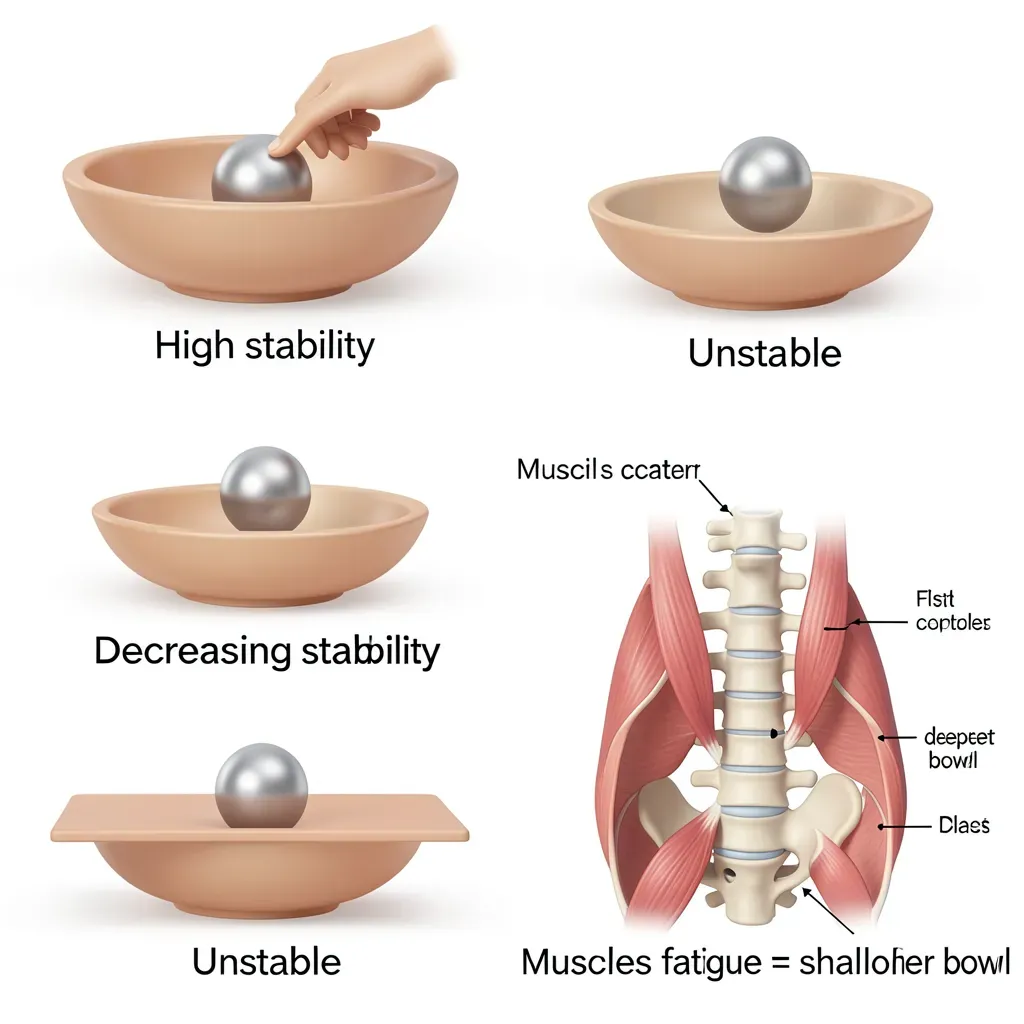
Imagine a ball sitting in a bowl. The ball represents your spine's current position. The bowl represents the stiffness created by your muscles and ligaments.
A deep bowl = high stability. The ball can be pushed, but it returns to center. A shallow bowl = low stability. Even a small push sends the ball over the rim — your spine buckles.
What Deepens the Bowl?
- Muscle stiffness — muscles that are appropriately activated create resistance to movement
- Muscle cocontraction — opposing muscles working simultaneously increase joint stiffness
- Proper motor patterns — the right muscles firing at the right time
What Flattens the Bowl?
- A single weak link — one muscle with inappropriate activation can reduce stability in one direction
- Fatigue — as endurance fails, muscle stiffness drops
- Poor motor control — the right muscles not firing at the right moment
- Damaged ligaments — passive tissues that have lost stiffness from injury
Your spine has 6 lumbar joints, each with 6 degrees of freedom. That's a 36-dimensional "bowl." If stiffness is insufficient in ANY single dimension, the spine can buckle. This is why isolated muscle training fails — you need the entire system coordinated.
Why Cocontraction Matters
When you activate a muscle, it creates force. But critically, it also creates stiffness — resistance to being stretched. Even muscles that don't create useful torque still contribute stiffness to the joint.
This is why the abdominal brace works: all the muscles of the torso cocontracting simultaneously don't necessarily produce movement, but they create a rigid cylinder of stiffness around the spine. The spine cannot buckle within this cylinder.
The Surprising Truth About Small Muscles
Research shows that most of the stability comes from the large muscles closest to the spine — the erector spinae, multifidus, quadratus lumborum, and the abdominal wall. However, even the smallest muscles contribute. A single poorly functioning muscle can reduce overall stability by allowing micro-movement in one specific direction.
This is why:
- Training only the transverse abdominis (as some Pilates approaches teach) is insufficient
- Training only the multifidus is insufficient
- The entire muscular system must be coordinated
- The Big 3 exercises were designed to train ALL stabilizers simultaneously
Sufficient Stability vs. Maximum Stability
There's a critical concept here: you don't need maximum stability. You need sufficient stability — enough to survive the perturbations you'll encounter.
More stability requires more muscle activation, which means more spinal compression. There's a trade-off:
| More Activation | Less Activation | |----------------|----------------| | More stability | Less stability | | More compression | Less compression | | Higher metabolic cost | Lower metabolic cost | | Greater fatigue rate | Better endurance |
The goal is the MINIMUM activation needed to maintain stability for the task at hand. This is why we "tune" the abdominal brace — just enough, not too much.
Research quantifies this: supporting a 50 Nm moment in extension requires about 800 N of spinal compression. The same moment in lateral bend requires 1,400 N. In axial twist: over 3,000 N. Twisting is enormously expensive for the spine, which is why the "stop twist" technique is so important.
What Actually Causes Buckling?
Spinal buckling — the moment the spine loses stability — doesn't require heavy loads. It happens when:
- A momentary lapse in muscle activation. Reaching for something while distracted. A sneeze. Tripping.
- Fatigue-induced loss of stiffness. After prolonged activity, muscles produce less stiffness per unit of activation.
- Unexpected perturbation. Being bumped, catching a falling object, a sudden vehicle stop.
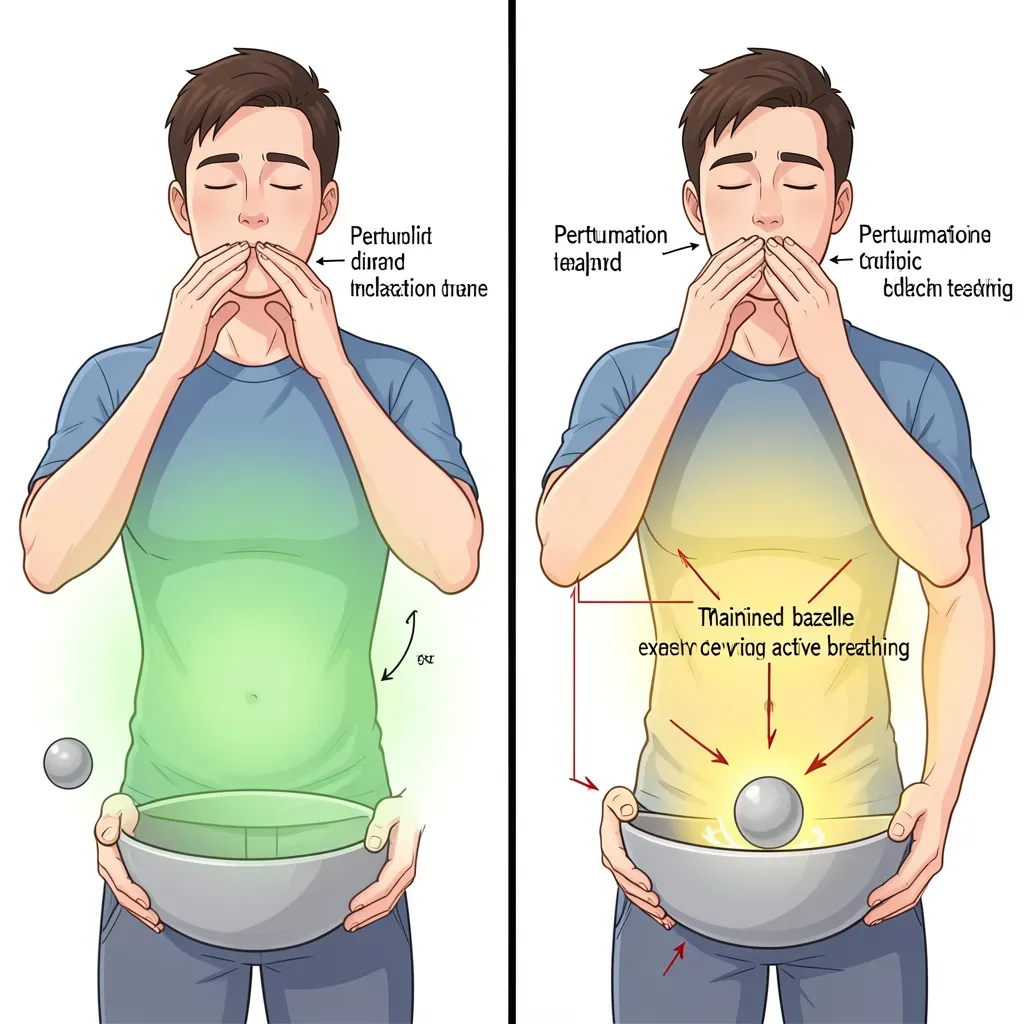
- Breathing challenges. The abdominal wall must simultaneously support breathing AND provide spine stiffness. Under respiratory stress, some people sacrifice stability for ventilation.
The Breathing-Stability Conflict
This is a clinically important finding: when breathing is elevated (exercise, anxiety, respiratory illness), the abdominal wall rhythmically relaxes and contracts for ventilation. Each relaxation phase momentarily reduces spine stability.
Research shows that fit motor systems maintain stability even during challenged breathing. Unfit systems sacrifice stability. This is one reason why aerobic fitness (walking program) contributes to back health — it trains the system to maintain bracing during elevated breathing.
Stability and Motor Patterns
Stability isn't just about how much force muscles produce — it's about WHEN they produce it. A well-timed preparatory contraction (activating before a perturbation arrives) is far more effective than a reactive contraction (after the spine has already begun to move).
Feed-Forward vs. Feedback Control
- Feed-forward: Your nervous system PREDICTS upcoming demands and pre-activates muscles. Example: bracing before lifting a known weight.
- Feedback: Your nervous system REACTS to unexpected forces. Example: stumbling on an uneven surface.
Injured backs often show disrupted feed-forward patterns — the preparatory activation is delayed or absent. This is why "grooving" movement patterns through daily practice is so important. You're retraining the feed-forward system.
Practical Applications
For Daily Life
- The abdominal brace creates the "bowl" — tune it to match the task
- Avoid tasks that create stability demands you can't meet (loads too heavy, positions too extreme)
- Don't perform demanding tasks when fatigued — stability drops with fatigue
- Pre-brace before any unexpected load (catching something, being bumped)
For Exercise
- The Big 3 train the stabilizers in their natural function (preventing motion)
- Endurance training maintains the "bowl depth" throughout a long day
- The bird-dog specifically challenges multi-dimensional stability
- Progress slowly — your stability capacity must match your loading demands
For Understanding Your Pain
- "Catches" and "stabs" during simple movements indicate stability failure
- If sneezing causes back pain, the breathing-stability conflict is relevant
- If pain worsens at the end of the day, fatigue is reducing your stability
- If pain is unpredictable, look for moments of inattention or distraction
The hallmark of a well-trained stabilization system: you can maintain spine position even when surprised. A falling object, a stumble, a sudden push — your spine stays neutral because the feed-forward system keeps a baseline level of readiness at all times.