Weight Training With Back Pain
How to maintain and build strength during recovery — exercise selection, loading principles, and the moves to defer until the spine is ready.
Strength Training Is Part of Recovery, Not Its Enemy
One of the most damaging misconceptions about back pain recovery is that weight training must stop entirely until the spine is "healed." This approach leads to progressive deconditioning — the muscles that support the spine weaken, the posterior chain atrophies, and the patient returns to the gym months later with a more fragile spine than they had before the injury.
The correct approach is spine-sparing exercise selection: loading the limbs and peripheral musculature through their full ranges of motion while carefully managing spinal load. The goal is to maintain and build strength in the legs, hips, and upper back through exercises where the spine is either supported, in a mechanically favorable position, or not bearing the primary load at all.
The Spine-Sparing Selection Principle
McGill's framework is explicit: the issue is not weight training itself, but which exercises are chosen. Any exercise that places the lumbar spine in a vulnerable position — end-range flexion, rotation under load, sustained flexion with axial load — risks re-injury regardless of the weight used. Exercises that load the limbs while maintaining lumbar neutral, or exercises where external support bears the compressive load, can be performed safely even during recovery.
Think of it as a loan: you are borrowing against future spinal capacity. The exercises in this article train around the injury site while the site heals. The compound lifts are reinstated only when the foundation is established.
Lower Body Training During Recovery
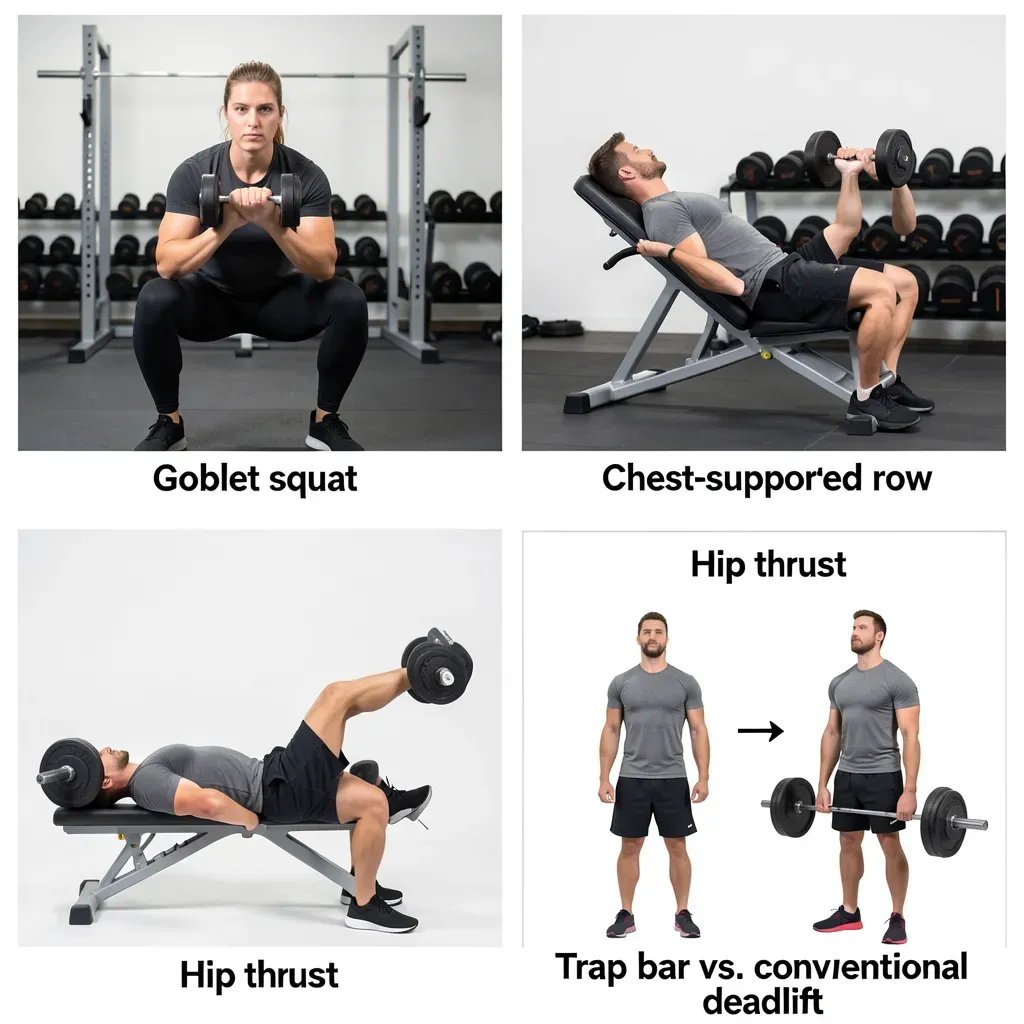
Goblet squat: Hold a dumbbell or kettlebell at the chest and squat. The goblet position counterbalances the load, promotes an upright torso, and reduces the forward lean that loads the lumbar spine in a barbell back squat. This is the starting lower-body loading exercise for most recovery patients. Begin with a light weight, focus on depth that maintains lumbar neutral, and stop before the pelvis winks (posterior tilt at the bottom).
Leg press: The leg press machine allows very high lower-body loads with minimal spinal loading — the seatback supports the spine and the load is directed through the hips and legs. It is not a substitute for free weight training long-term, but it is an excellent maintenance tool during recovery. Set the seat angle so that at bottom position, the lumbar spine does not roll under (into flexion). Starting with feet high on the plate and moderate depth achieves this.
Romanian deadlift with dumbbells: A hip hinge pattern (covered in Article 6) performed with dumbbells rather than a barbell. The dumbbells allow a narrower grip, a more natural arm path, and remove the need for a conventional deadlift setup from the floor. Excellent for posterior chain loading with controlled spinal position. Start light, keep the lumbar spine neutral throughout the hinge.
Hip thrusts: Supine on a bench with a barbell across the hips, driving the hips to full extension. This loads the gluteal complex maximally with virtually no spinal compression — the load is borne by the bench and the floor. Hip thrusts are among the highest-glute-activation exercises available and impose minimal lumbar load. An excellent addition to the recovery program.
The trap bar (hex bar) deadlift deserves a special mention as the bridge between the goblet squat and the conventional deadlift. The trap bar positions the load at the body's center of gravity rather than in front of it, dramatically reducing the lumbar flexion moment. When you are ready to progress beyond the goblet squat, the trap bar deadlift is the correct next step — not the conventional barbell deadlift.
Upper Body Training During Recovery
The upper body presents a different challenge: most rowing and pulling movements require the spine to maintain a stable, loaded position for the duration of the set.
Chest-supported row: Lying prone on an inclined bench with the chest supported, pulling dumbbells toward the hips. The bench removes all spinal loading — no erector activation required to resist gravity. This allows full rhomboid, mid-trap, and rear delt loading without any lumbar demand. Priority upper back exercise during recovery.
Seated cable row: Sitting upright at a cable machine, pulling a handle to the lower abdomen. The seated position and cable angle allow a neutral spine with minimal loading. Focus on driving through the elbows and retracting the shoulder blades rather than rocking the torso.
Lat pulldown: Seated, pulling a bar or handles from overhead to the upper chest. The seated position and downward pull direction minimize spinal load. Prefer an underhand or neutral grip to reduce shoulder impingement risk.
Bench press: Generally safe during recovery — the supine position supports the spine and the primary load is through the shoulders and chest. Maintain a natural lumbar arch (do not press the low back flat into the bench — the same imprinting error from Pilates). Feet flat on the floor.
Overhead pressing with a barbell standing up requires the lumbar spine to resist extension under load throughout the movement. This is contraindicated during early recovery. Substitute: seated dumbbell overhead press (back supported), or landmine press (angled push that reduces the direct overhead component). Return to standing barbell overhead press only when full stability is established and pain-free.
Compound Lifts to Defer
Barbell back squat: The high bar position loads the upper spine with a significant forward lean tendency, creating a large lumbar flexion moment. Defer until stability is well established and transition through the goblet squat and trap bar deadlift first.
Conventional deadlift from the floor: The full range conventional deadlift requires the lumbar spine to maintain neutral under high load from a position that begins in moderate flexion. Defer in favor of the trap bar deadlift or Romanian deadlift during recovery.
Good mornings: A hip hinge with the barbell on the upper back — the lumbar spine must resist flexion against the full barbell load through the entire range. The lumbar lever arm is at its worst in this movement. Defer entirely.
Olympic lifts (clean, snatch): High-speed, high-load spine loading under rapid direction changes. Defer until fully recovered and technically proficient.
Belt Use: When It Helps and When It Masks
A weightlifting belt increases intra-abdominal pressure and can meaningfully reduce spinal compressive load during heavy compound lifts. During recovery, it is generally deferred for two reasons: first, the loads being used during recovery are not the loads that require belt assistance. Second, and more importantly, using a belt can mask inadequate brace technique — the belt substitutes for a skill that the patient needs to develop.
Learn to generate IAP through bracing (Article 35) without a belt. Once you can reliably create a hard brace under moderate load without a belt, adding one for higher-load sets is appropriate. Using a belt as a first resort teaches dependence rather than capacity.
Training Around vs Training Through Pain
The distinction matters. Training around pain means selecting exercises that do not provoke the injury site while loading adjacent tissues — exactly what this article describes. Training through pain means continuing an exercise despite it provoking the injury site, rationalizing that you must "push through." Training through pain delays healing, sensitizes the nervous system, and reinforces guarding patterns that become their own problem.
If an exercise triggers back pain during or after the session, that exercise is removed from the current program and revisited in two to four weeks when tissue capacity may have improved.
In Review
- Spine-sparing exercise selection maintains strength during recovery by loading the limbs while managing spinal load
- Lower body priority exercises: goblet squat, leg press, Romanian deadlift with dumbbells, hip thrusts
- The trap bar deadlift is the correct progression bridge between the goblet squat and conventional deadlifts
- Upper body priority exercises: chest-supported row, seated cable row, lat pulldown, bench press
- Standing barbell overhead press is deferred; substitute seated dumbbell press or landmine press
- Defer the barbell back squat, conventional deadlift, good mornings, and Olympic lifts until stability is established
- Belt use should follow, not substitute for, development of intrinsic bracing skill
- Training around pain (selecting non-provocative exercises) is the goal; training through pain delays recovery