Kitchen Ergonomics
Counter heights, cooking postures, appliance placement, and the specific kitchen tasks most likely to provoke back pain.
The Kitchen Is a Biomechanical Obstacle Course
Kitchen design has never been optimized for spinal health. Standard counter heights are built around average body dimensions that exclude anyone tall, short, or recovering from an injury. The tasks themselves — chopping, stirring, lifting heavy pots, reaching into low cabinets, bending into the oven — are precisely the combination of postures that load the posterior disc annulus.
Unlike office ergonomics, where you can adjust the setup once, kitchen ergonomics requires adapting technique to a fixed environment. The counter height will not change. Learning to work within it safely is the practical skill.
Counter Height: The Core Problem
The standard kitchen counter in most homes sits at approximately 90 cm (36 inches). This height was designed for a person of average height to work with wrists at or slightly above counter level. For anyone over 180 cm (6 feet), this height produces sustained lumbar flexion — you are bent forward slightly the entire time you are prepping, stirring, or washing.
The test: Stand at your counter with your arms hanging naturally. Your wrists should fall at or just below counter height for light tasks. If your wrists hang several inches below the counter, you will flex forward to bring your hands to working height.
Practical solutions for fixed counters:
- Cutting boards with height: A thick wood block cutting board (4-5 cm thick) raises the working surface without any renovation. For tall people, this is a meaningful difference.
- High stool at the counter: For extended prep tasks — peeling, chopping, mixing — sitting on a high stool at counter height shifts the load entirely, eliminates standing fatigue, and is far preferable to 20 minutes of sustained lean.
- Standing at the island: If you have an island at a different height than the perimeter counters, use whichever surface puts your wrists close to neutral. Islands are often 5-10 cm taller than standard counters, which suits taller people better.
For tall people cooking in a standard kitchen, a simple intervention that costs nothing: stand with a slightly wider stance. A shoulder-width stance rather than a narrow one lowers your torso slightly relative to the counter, reducing the amount of forward lean needed to reach the working surface. Not a full solution, but a useful compensation.
Chopping and Prep Posture
Extended chopping and prep is one of the most common kitchen pain triggers. The combination of sustained standing, forward lean, and repetitive arm movement produces both spinal loading and shoulder fatigue.
Neutral spine priority: Keep a slight curve in your lower back throughout. The moment you find yourself tucking your pelvis and rounding your lower back to reach the cutting board, you've adopted the posture that loads the posterior disc annulus.
Weight distribution: Plant both feet flat. Avoid leaning into the counter with your pelvis — this collapses the lumbar spine into flexion. The counter is a working surface, not a support structure.
Time limits: For extended prep sessions (more than 10-15 minutes of continuous standing), alternate between standing and sitting on a high stool every 10 minutes. The load is not the chopping motion itself — it's the sustained static posture of standing in slight forward lean.
Reaching into Low Cabinets and Deep Drawers
Low cabinets, base drawers, and toe-kick storage are significant hazard zones. Reaching into them requires flexion, often combined with rotation when reaching sideways, and the load of whatever you are retrieving on the way back up.
The correct approach:
- Squat or use a half-kneeling position rather than bending at the waist. Lower yourself to the level of the cabinet; do not bend your spine to reach it.
- For very low or deep cabinets, get fully on one knee. This looks more effort than a quick bend, but it distributes the load through the hips and legs rather than the posterior spine.
- Pull the item to the edge of the shelf before lifting it. Lifting from a deep reach doubles the moment arm on your spine compared to lifting close to your body.
Reorganize to reduce frequency: Store the most frequently used items at counter height or in upper cabinets. Reserve low storage for items used once a week or less.
Loading and Unloading the Dishwasher
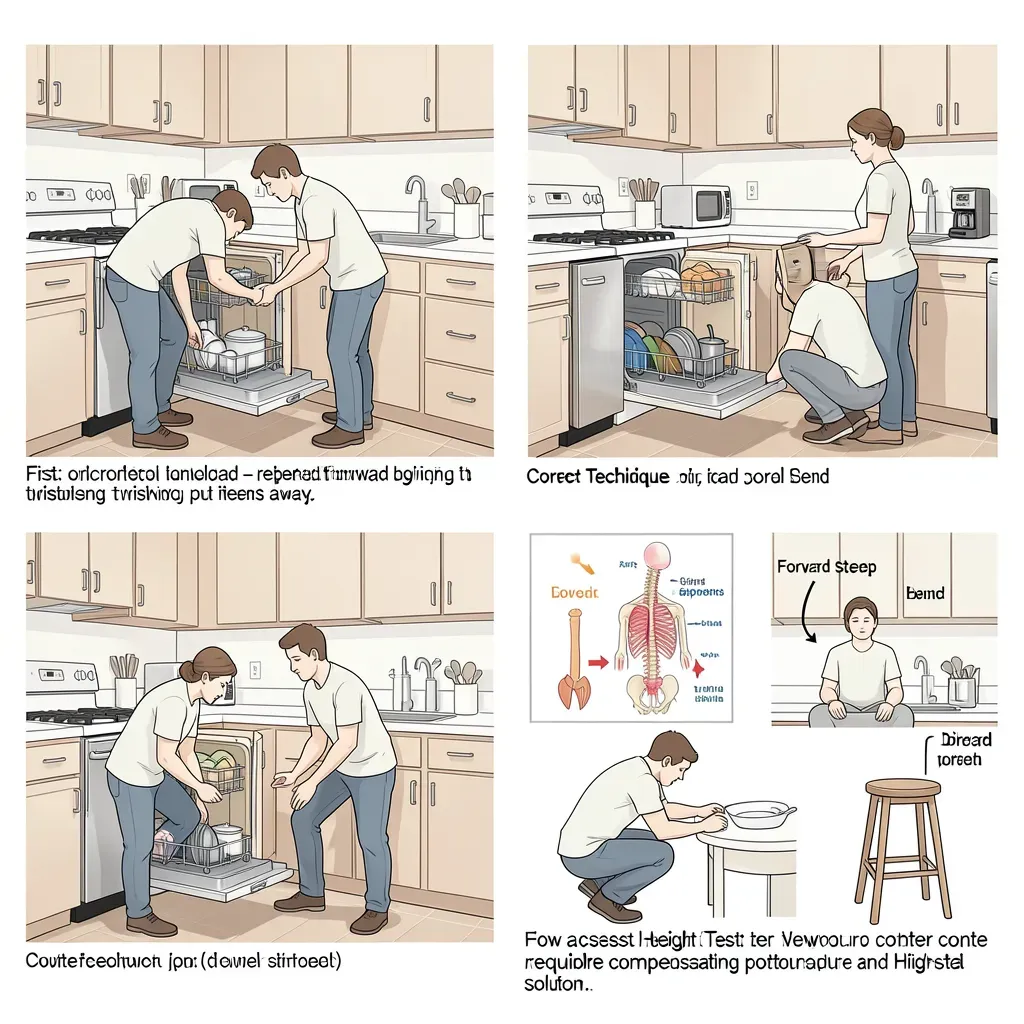
Front-loading dishwashers produce a reliably poor posture: leaning forward into the open door, bending at the waist, reaching into the lower rack. The upper rack is better, but the lower rack is the main problem.
Technique for the lower rack:
- Fully open the door and pull the lower rack out as far as it extends.
- Squat or half-kneel beside the open rack rather than bending over it from above.
- Unload one section at a time, keeping items close to your body.
- Stand up to transfer the items to their cabinet location — avoid a simultaneous bend-and-reach-and-rotate movement.
For people in acute flare: unloading the dishwasher is a reasonable thing to ask someone else to do. It is a high-frequency bending task. If you must do it yourself, the squat technique is non-negotiable.
The dishwasher unload done in a hurry — rapid forward bending, reaching for one item, twist to put it away, reach for the next — accumulates 20-30 flexion-rotation loads in 3 minutes. In the context of active disc irritation, this is the kind of routine task that triggers a flare or re-injury that the person attributes to having "done nothing." They did something — they did it 25 times in 3 minutes.
Oven Bending
The oven is one of the worst-designed appliances from a spinal perspective: you must bend forward to a height of roughly knee level, while carrying a hot, heavy dish, with both arms extended. This maximizes the moment arm on the lumbar spine.
The forward step technique:
- Before opening the oven, stand close to it with feet shoulder-width apart.
- Step one foot forward as you lean into the oven — this converts a pure lumbar flexion into a partial hip hinge where the hip of the forward leg absorbs part of the load.
- Keep your back as neutral as possible and use your legs to lower the dish in or retrieve it.
- Pull the rack out fully before lifting the dish off it — never lift from inside the oven without a fully extended rack.
For counter-height ovens or range-top ovens at the back of the range: the problem is reaching over the front burners. Keep the dish on a near burner until you can get close to it without reaching over obstacles.
Carrying Pots of Water
A full large pot of water weighs 4-5 kg or more. Carrying it from the sink to the stove with extended arms creates significant spinal loading.
Fill at the stove where possible: If you have a pot-filler tap, use it. If not, fill a smaller pitcher and make two trips. Alternatively, use the largest colander to carry pasta from pot to strainer with one short carry rather than lifting a boiling, full pot.
Bilateral carry: Use both handles or pot holders at the sides and keep the pot as close to your body as possible. Never carry a heavy pot with one hand extended to one side.
Standing at the Sink
The kitchen sink sits at the same problematic height as the counter and adds a slightly forward lean posture while washing. The classic solution from occupational medicine: place one foot on a low step or open the cabinet door underneath the sink and rest one foot on the edge.
This hip flexion on one side reduces the extension pull through the lumbar spine and is immediately noticeable as more comfortable for most people with lower back pain. Alternate feet every few minutes.
In Review
- Standard counter height causes sustained lumbar flexion for people over average height. Use a thick cutting board or high stool for extended prep.
- Squat or half-kneel to reach low cabinets and the dishwasher lower rack — never bend from the waist for repeated low reaches.
- Use the forward step technique for the oven: step one foot forward to convert lumbar flexion into a partial hip hinge.
- Fill heavy pots at the stove or use a pitcher for multiple trips; keep heavy pots bilateral and close to the body.
- One foot on a step while standing at the sink reduces lumbar loading — alternate feet frequently.
- Reorganize storage to place high-frequency items at counter height or above.