Heat and Cold for Back Pain: When to Use Each
A practical protocol for thermotherapy in back pain — what heat does mechanically, what ice does neurologically, and when each is appropriate.
Why Temperature Modalities Persist
Heat and cold are among the oldest therapeutic interventions in medicine — and among the most persistently misused in back pain management. Despite their simplicity, the common advice to "ice an acute injury" and "heat a stiff back" conceals a more nuanced picture. Applied correctly, thermotherapy is a low-cost, low-risk tool for symptom management. Applied incorrectly — heating acute inflammation, or icing a stiff spasmed back — it can delay recovery or worsen symptoms.
The goal of this article is to give you a clear decision framework grounded in the physiology of each modality, rather than a reflexive recommendation that ignores the specifics of your situation.
What Heat Does: The Physiology
Heat applied to tissue triggers several physiological responses that are relevant to back pain management.
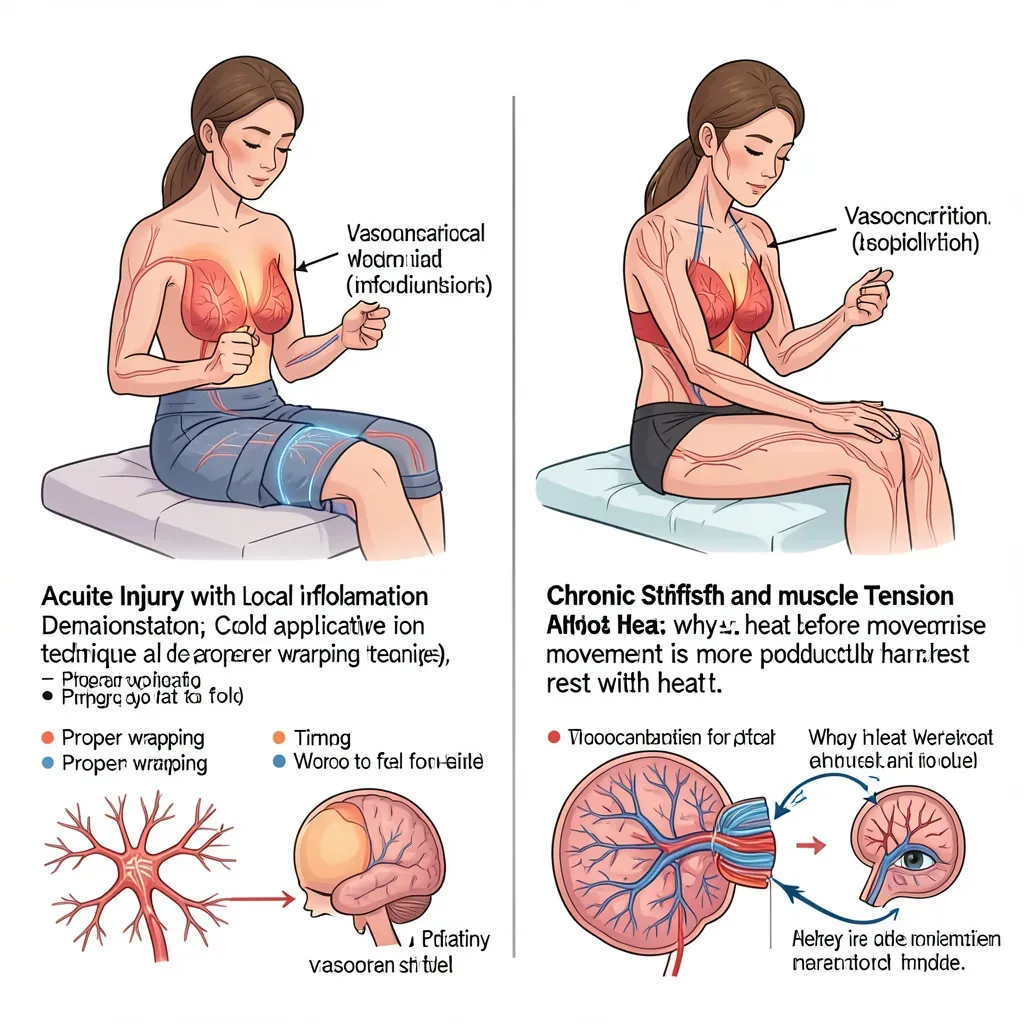
Vasodilation and increased blood flow. Heat causes local blood vessels to dilate, increasing circulation to the treated area. For back pain driven by muscle tension and ischemia — reduced blood flow to chronically contracted muscle — improved circulation helps clear metabolic byproducts (lactate, inflammatory mediators) and delivers oxygen and nutrients to the tissue.
Reduction of muscle spindle sensitivity. Elevated tissue temperature reduces the sensitivity of muscle spindles, the sensory receptors that regulate muscle tone. This is the mechanism underlying heat's muscle-relaxing effect. A heated muscle is genuinely more extensible, and range of motion often increases measurably after heat application, which is why applying heat before stretching or movement can be productive.
Altered pain signal transmission. Heat activates thermoreceptors that share neurological overlap with pain-inhibiting pathways, contributing a mild analgesic effect beyond the mechanical changes.
Increased connective tissue extensibility. Collagen-rich structures — joint capsules, ligaments, scar tissue — are more extensible when warm. This is particularly relevant for the thoracolumbar fascia and posterior spinal ligaments, which often contribute to morning stiffness in people with chronic back pain.
What heat does not do is reduce inflammation. This is the critical constraint. Applying heat to an acutely inflamed tissue — one already producing elevated prostaglandins and cytokines, with increased vascular permeability and tissue edema — is counterproductive. Heat will vasodilate into already-congested tissue and can increase swelling and pain. The rule is unambiguous: heat is not appropriate for acute inflammatory states.
What Cold Does: The Physiology
Cold acts through a different set of mechanisms, nearly opposite in several respects.
Vasoconstriction. Cold causes blood vessels to constrict, reducing blood flow to the area. In the immediate aftermath of acute injury, this limits the volume of edema that develops. Less swelling means less pressure on local nerve endings, which reduces one component of acute pain.
Nerve conduction slowing. Cold reduces the conduction velocity of nerve fibers, including pain-transmitting A-delta and C fibers. Sufficient cold essentially produces temporary local anesthesia — the clinical term is cryoanalgesia. This is why an ice pack reliably produces numbness and pain reduction. The analgesic effect is real, direct, and does not depend on placebo.
Reduction of metabolic activity. Cold decreases local tissue metabolism, reducing the rate of inflammatory mediator production and secondary tissue damage in the immediate post-injury period.
Muscle spasm interruption. Cold can also reduce muscle spasm in some cases by reducing pain-driven protective guarding. Pain triggers spasm, spasm increases pain — reducing pain with cold can interrupt this cycle in the acute phase.
What cold does not do is address the underlying source of stiffness or dysfunction. Ice is a symptom management tool. Applied to a chronically stiff, non-inflamed back, it may cause the muscles to contract further as a protective response and reduce circulation to already-ischemic tissue — the opposite of what is needed.
The classic RICE protocol (Rest, Ice, Compression, Elevation) taught for acute sports injuries has been substantially revised in sports medicine. The more current PEACE and LOVE framework acknowledges that some inflammation is necessary for tissue healing and that aggressive icing of acute injuries may impair repair. For back pain specifically, brief cold for pain control in the first 24-72 hours is reasonable, but prolonged daily icing of an injury is not supported.
Moist vs. Dry Heat: Does It Matter?
Most people apply heat via a dry heating pad, and many clinicians use moist heat packs in clinical practice. The question of whether this distinction matters has practical implications.
Moist heat penetrates tissue more effectively than dry heat at equivalent surface temperatures. The mechanism is straightforward: water is a better thermal conductor than air, so moist heat transfers more energy to deeper tissue layers in less time. Studies comparing the two consistently show that moist heat produces greater increases in intramuscular temperature at depths relevant to paraspinal muscles (3-4 cm) than dry heat of the same surface temperature.
In practical terms, a commercial moist heat pack (a gel pack warmed in hot water, or a microwavable grain-filled pad) delivers a therapeutically superior dose of heat compared to a standard electric heating pad at the same surface temperature. A damp towel wrapped around a dry heating pad is a reasonable middle-ground approach.
For clinical hydrotherapy — immersion in a hot bath or spa — the benefit extends to the relaxation of full-body muscle tension and the unloading of the spine in buoyancy, making it meaningfully different from local heat application for patients with generalized paraspinal tension.
Timing and Duration: The 15-20 Minute Rule
For both heat and cold, the clinically standard application time is 15-20 minutes. This window is long enough to produce measurable tissue temperature change and therapeutic effect, but short enough to avoid adverse consequences at either end of the temperature spectrum.
For cold therapy specifically, application beyond 20 minutes at the surface of the skin carries a risk of frostnervous response, where extreme vasoconstriction triggers a paradoxical vasodilation — the Hunting reaction — that defeats the purpose of cold application. With a standard ice pack (not an industrial cold compression device), this is unlikely to be clinically significant in back pain applications, but 20 minutes remains a sensible ceiling.
For heat therapy, extended application beyond 30-45 minutes produces diminishing returns on the vasodilatory and muscle-relaxant effects and increases the risk of burns — especially relevant for patients with reduced skin sensation, diabetes, or who fall asleep with the device in place.
This last point deserves emphasis: never sleep with a heating pad applied to the back. Burns from this mechanism are a documented, preventable injury. Auto-shutoff heating pads reduce but do not eliminate the risk.
When to Use Each: A Decision Framework
The decision between heat and cold comes down to two questions: how long ago did the pain start or worsen, and does the area feel inflamed?
Use cold when:
- The pain began or dramatically worsened within the last 48-72 hours following a specific incident
- The area is visibly swollen, hot to the touch, or tender with direct pressure in a way that suggests tissue inflammation
- Muscle spasm is severe and you need short-term pain reduction to enable movement
- You are dealing with a pain flare-up after an activity that has loaded the spine more than usual
Use heat when:
- The pain is chronic or subacute (more than 72 hours from onset) with no signs of active inflammation
- You are experiencing morning stiffness that limits your ability to move
- You are preparing for a rehabilitation session and want to increase tissue extensibility first
- You have generalized paraspinal muscle tension without acute injury
When neither is clearly indicated: if you have chronic back pain with no particular flare, both heat and cold can be used for comfort as needed. Personal preference is a valid tiebreaker — some people find cold more relieving for back pain generally, and this individual variation is well-documented in the literature.
A useful rule of thumb for sorting acute from chronic presentations: if you can point to something specific that happened in the last 72 hours that provoked the pain (a lift, a twist, a fall), think cold first. If the pain is a familiar background companion that has been present for weeks or months, heat is almost always the better starting choice. The two presentations require different initial approaches.
Combining Heat and Cold: Contrast Therapy
Alternating heat and cold application — contrast therapy — is used in both sports medicine and rehabilitation for specific purposes. The proposed mechanism is a "vascular pumping" effect: the alternation between vasodilation (heat) and vasoconstriction (cold) produces rhythmic changes in blood flow that may accelerate the clearance of inflammatory byproducts from tissue.
The evidence base for contrast therapy in back pain specifically is limited. The most consistent evidence for contrast therapy benefit is in peripheral joint recovery (ankle sprains, knee swelling after surgery). For the paraspinal region, the deeper location of target tissues means the temperature changes achievable at the surface have a less certain relationship to what is happening in the muscles and joints themselves.
A practical contrast protocol for back pain in the subacute phase (1-4 weeks post-onset) is: 3-5 minutes of ice followed immediately by 15-20 minutes of heat, ending with heat. If this produces clear subjective benefit, the mechanism is less important than the outcome.
What the Research Shows: Honest Expectations
The evidence for thermotherapy in low back pain is real but modest. The most rigorous review (Cochrane, 2006, updated with subsequent studies) found that heat wraps — specifically the thermacare-type continuous low-level heat devices — provided short-term reduction in pain intensity and disability in acute and subacute low back pain compared to placebo. The effect sizes were moderate: heat wraps reduced pain by approximately 1-2 points on a 0-10 scale.
Importantly, heat combined with exercise consistently outperformed heat alone. Heat as a standalone treatment produced symptom relief; heat as preparation for and complement to movement produced both symptom relief and functional improvement.
Cold for back pain has fewer high-quality trials. Most evidence is extrapolated from acute musculoskeletal injury research or derives from clinical consensus rather than back-specific trials.
The clinically honest summary: thermotherapy is a symptom management tool, not a treatment for the underlying causes of back pain. Its appropriate role is to reduce pain enough to allow movement and rehabilitation — not to replace them.
If you have diabetes, peripheral neuropathy, or any condition that impairs skin sensation, thermotherapy carries elevated risk of burns (with heat) or frostbite-equivalent injury (with prolonged cold). You must check the temperature of any heat source carefully against unaffected skin before applying it to an area with impaired sensation, and time applications strictly. In the presence of significant sensory impairment, discuss thermotherapy use with a clinician before proceeding.
Practical Protocol Summary
For acute back pain (0-72 hours from onset or flare):
- Cold pack, wrapped in a thin cloth to protect the skin
- 15-20 minutes on, at least 40 minutes off before reapplying
- Up to 3-4 times daily for the first 48-72 hours
- Transition to heat once acute inflammation subsides (typically after 72 hours)
For chronic or subacute back pain:
- Moist heat pack or microwavable pad
- 15-20 minutes before rehabilitation exercise to improve tissue extensibility
- Comfortable warmth — not burning — as the appropriate intensity
- Never applied during sleep
For morning stiffness:
- Warm shower before attempting any exercise or demanding activity is a practical and effective heat application for the whole paraspinal region
- A morning shower is often more effective than a heating pad because it covers the full spinal region, promotes general movement, and does not carry burn risk from extended contact
In Review
- Heat works via vasodilation, muscle spindle suppression, and improved connective tissue extensibility — it is the correct choice for chronic stiffness, not acute inflammation
- Cold works via vasoconstriction, nerve conduction slowing, and metabolic depression — it is the correct choice for acute injury and flare-ups in the first 72 hours
- Moist heat penetrates deeper than dry heat at equivalent surface temperatures and is therapeutically superior; a damp towel over a dry pad is a reasonable approximation
- Apply both modalities for 15-20 minutes; never sleep with a heating pad in contact with skin
- Heat before rehabilitation exercise increases tissue extensibility and is supported by the research; heat as a substitute for movement is not
- Thermotherapy combined with exercise consistently outperforms thermotherapy alone in the research — these are tools to enable movement, not to replace it
- Diabetes or peripheral neuropathy significantly elevates burn and cold injury risk; proceed with caution and clinical guidance if sensory impairment is present