The Big 3 Exercises
The three non-negotiable core exercises — the modified curl-up, the side bridge, and the bird-dog — that form the foundation of spinal stability.
Why These Three?
Decades of lab research have identified three exercises that, when performed together, create optimal stability around the spine without imposing damaging loads. They were selected because they:
- Train all the muscles of the core in their natural function (PREVENTING motion)
- Impose minimal compressive load on the spine
- Challenge muscular endurance rather than peak strength
- Create balanced stiffness around the entire torso
These are your non-negotiables. Regardless of your pain category, the Big 3 apply to everyone.
These exercises are NOT about "feeling the burn" or pushing to failure. They are about perfect form, sustained endurance, and pain-free execution. If any exercise causes pain, reduce the difficulty or stop. Pain means you're doing it wrong or progressing too fast.
The Russian Descending Pyramid
All three exercises use the same rep scheme:
Set 1: 6 reps (hold each for 10 seconds) Set 2: 4 reps (hold each for 10 seconds) Set 3: 2 reps (hold each for 10 seconds)
This pattern (6-4-2) allows you to build endurance while maintaining perfect form. As fatigue accumulates, you do FEWER reps — not more. This prevents form breakdown.
Progression: When 6-4-2 becomes easy, progress to 8-6-4, then 10-8-6. Always keep the descending pattern.
Balance is critical. If you do the curl-up at 6-4-2, do the side bridge AND bird-dog at 6-4-2 as well. Those with balanced numbers across all three exercises have the lowest risk of future pain episodes.
Exercise 1: The Modified Curl-Up
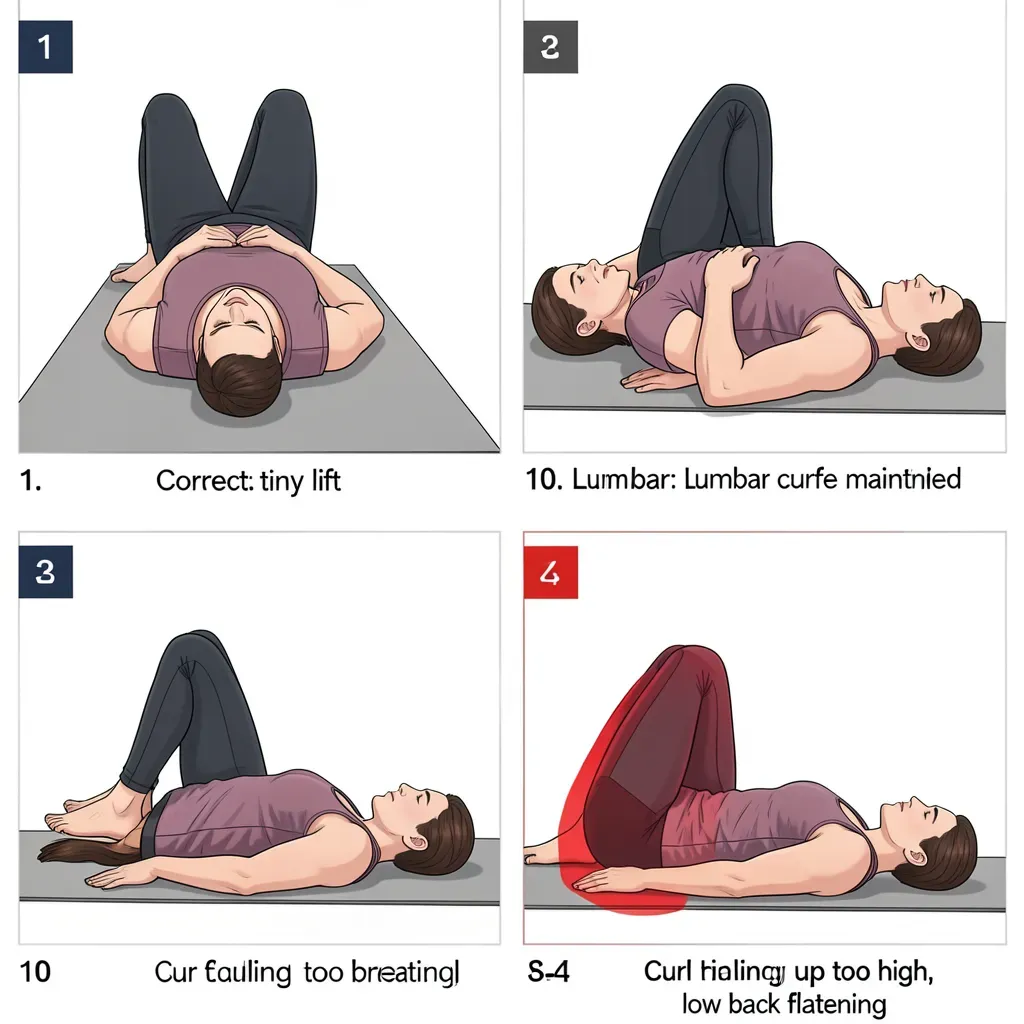
This is NOT a sit-up. The spine does NOT move. You are building the ability to maintain a braced, neutral spine under load.
Setup
- Lie on your back
- One knee bent (foot flat on floor), one leg straight
- Place both hands under your lumbar spine to preserve the natural curve
- Elbows can rest on the floor or hover slightly
Execution
- Engage the abdominal brace
- Gently lift your head and shoulders off the floor — just barely. Think of making your head "heavy" rather than curling up
- The movement is TINY — only 1-2 centimeters of lift
- DO NOT flatten your low back to the floor. Your hands are there to ensure the curve is maintained
- Hold for 10 seconds. Breathe. Lower.
Critical Points
- The low back does NOT move — it stays in neutral the entire time
- Imagine your head and shoulders lifting as a unit (like a board), not curling
- Switch which leg is bent halfway through your sets
- If your neck hurts, you're lifting too high or tucking your chin too much
Exercise 2: The Side Bridge (Side Plank)
This exercise builds the lateral stabilizers — the quadratus lumborum and obliques — which are essential for preventing the spine from buckling sideways during walking, carrying, and single-leg activities.
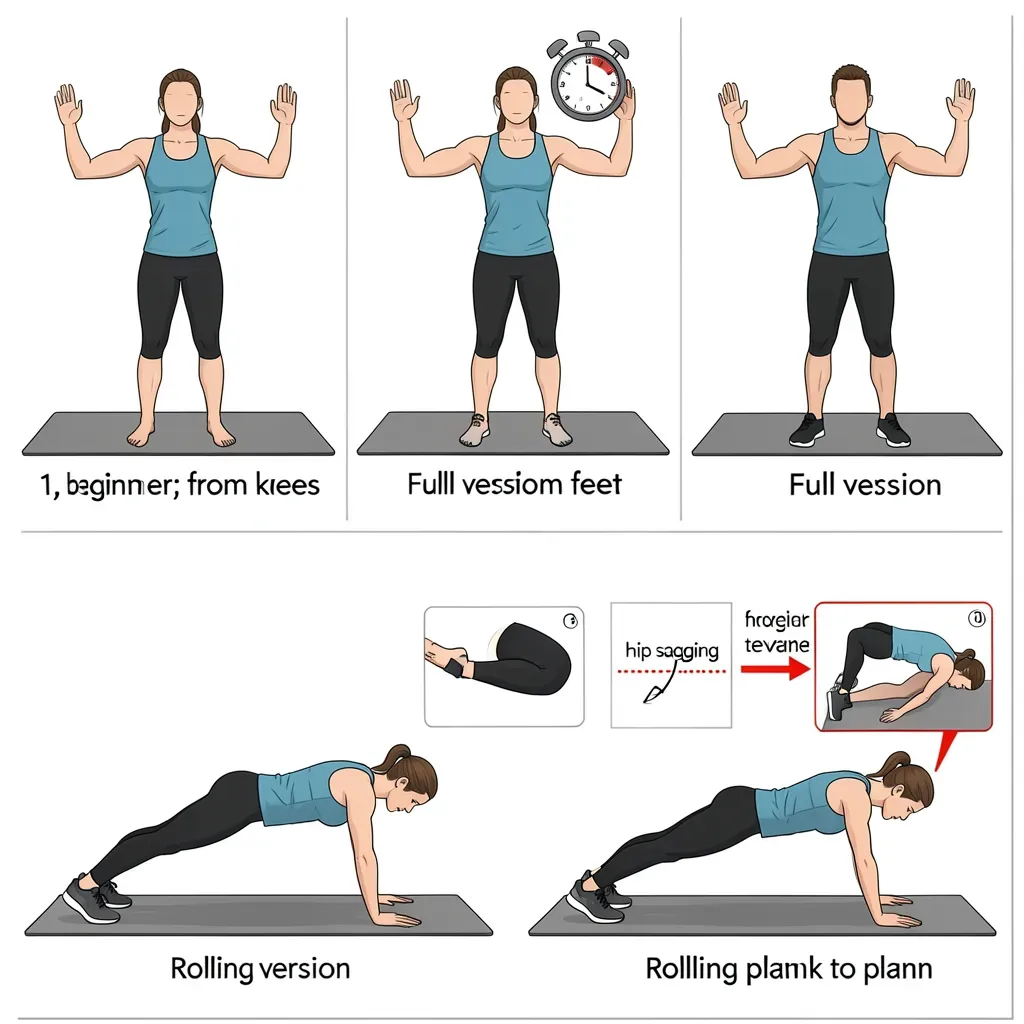
Beginner Version (From Knees)
- Lie on your side, knees bent at 90 degrees
- Prop yourself up on your elbow (elbow directly under shoulder)
- Lift your hips off the ground so your body forms a straight line from knees to shoulders
- Top hand can rest on the opposite shoulder
- Hold for 10 seconds. Lower. Repeat.
Full Version (From Feet)
- Lie on your side, legs straight and stacked
- Prop on elbow (directly under shoulder)
- Lift hips — body forms a straight line from feet to shoulders
- Top hand rests on opposite shoulder or hip
- Hold for 10 seconds. Lower. Repeat.
Advanced Version (Rolling)
- Begin in the full side bridge position
- Roll forward into a front plank (elbows under shoulders)
- Continue rolling to the opposite side bridge
- This is ONE rep — hold each position for 10 seconds
Critical Points
- Don't let hips sag or pike upward
- Keep the spine neutral — no twisting
- Breathe normally throughout the hold
- Perform BOTH sides equally
Exercise 3: The Bird-Dog
This exercise trains the spine to resist both extension and rotation while the limbs move. It directly mimics the spine's real-world job: staying stable while arms and legs create motion.
Setup
- Start on hands and knees (quadruped position)
- Hands directly under shoulders, knees under hips
- Find neutral spine — slight natural curve in the low back
- Engage a mild abdominal brace
Execution
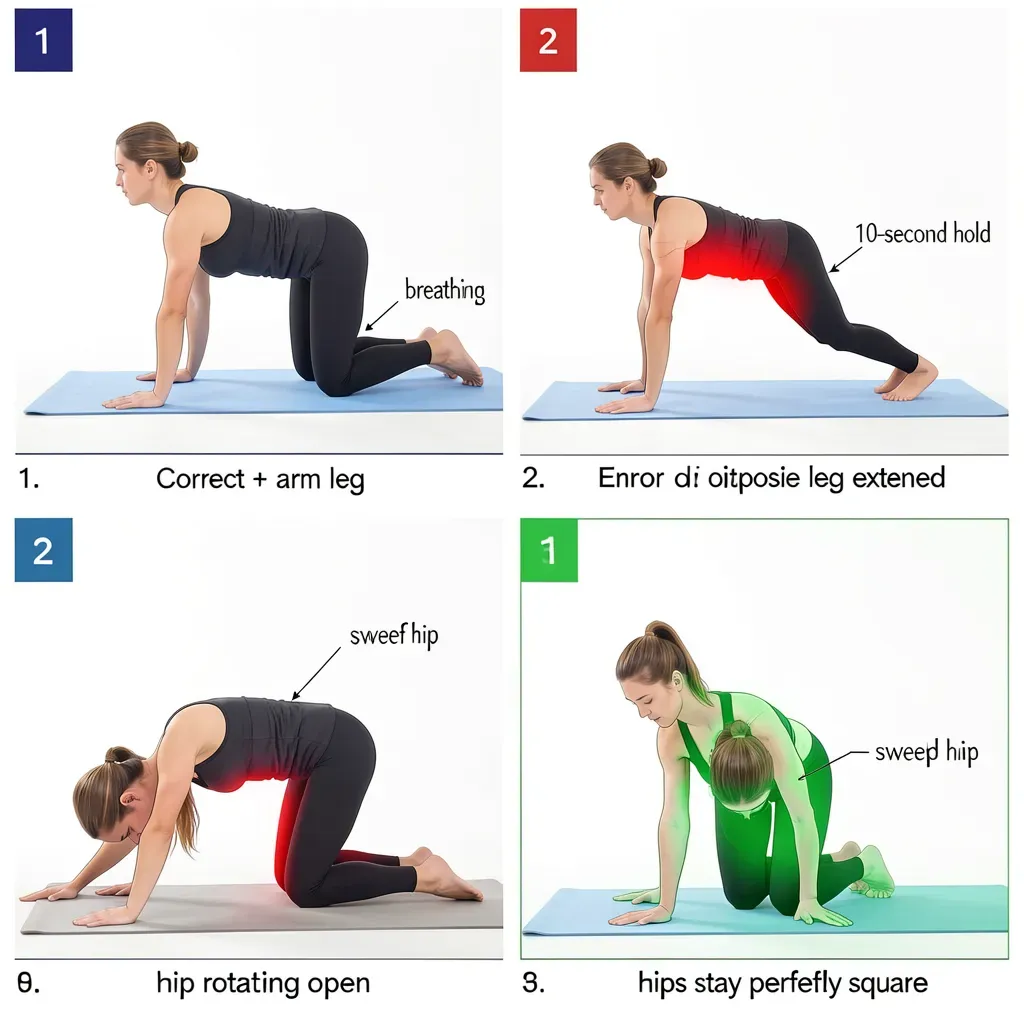
- Slowly extend one arm forward and the OPPOSITE leg backward
- Reach — don't just lift. Push the hand forward and the foot backward
- Lock the arm and leg at full extension
- Hold for 10 seconds. Return to start. Switch sides.
The "Sweep" Technique
Between each rep, bring the extended hand and knee together underneath you (like a crunch), then sweep them back out to full extension. This adds a dynamic component without spine flexion.
Critical Points
- The spine does NOT move. No arching, no twisting, no sagging
- Square your hips to the floor — don't let the pelvis rotate when extending the leg
- Make a fist with the extended hand (engages more shoulder stability)
- Don't lift the arm or leg higher than the torso — reach LONG, not high
- If you can't maintain a neutral spine, regress to extending only the arm OR only the leg
Greasing the Joints: The Cat-Camel
After the Big 3, many people want to gently move their spine. The cat-camel is the least stressful way to do this.
- On hands and knees
- Gently round the back upward (cat) — go only to pain-free range
- Gently let the back sag downward (camel) — again, pain-free range only
- Each cycle takes 3-4 seconds
- Perform 7-8 cycles — research shows this is enough to reduce internal spine friction
The cat-camel is NOT a stretch. It's a motion exercise. Move gently through pain-free range. Don't push to end range or hold positions. Think of it as "oiling the joints" before your Big 3 session.
Putting It Together: Your Daily Session
Warm-up: 7-8 cat-camel cycles (30-40 seconds)
The Big 3 (in order):
- Modified Curl-Up: 6-4-2 (switch bent leg halfway)
- Side Bridge: 6-4-2 each side
- Bird-Dog: 6-4-2 each side
Total time: 10-12 minutes
Frequency: Daily. This is non-negotiable. Like brushing your teeth — it's maintenance, not a workout.
If your training session leads to pain afterward, you've done too much. Reduce the holds to 7 seconds, reduce reps to 4-3-2, or remove the most challenging exercise temporarily. Build back up gradually.