TENS Therapy: What the Evidence Says
An honest assessment of transcutaneous electrical nerve stimulation for back pain — how it works, what Cochrane reviews actually found, and when it's worth trying.
What TENS Actually Is
Transcutaneous electrical nerve stimulation — TENS — delivers low-voltage electrical current through electrodes placed on the skin. The device generates a pulsed electrical signal that travels through the skin into the underlying tissue, targeting sensory nerve fibers. The goal is modulation of pain signals before they reach conscious awareness in the brain.
TENS devices are widely available without prescription, relatively inexpensive, and marketed aggressively for back pain. This combination — accessibility, low cost, and heavy marketing — means that TENS occupies an outsized place in public expectations about back pain treatment compared to what the evidence actually supports. Understanding both how it works and what the research shows is essential to making a rational decision about whether it belongs in your recovery toolkit.
Gate Control Theory: The Mechanism Behind TENS
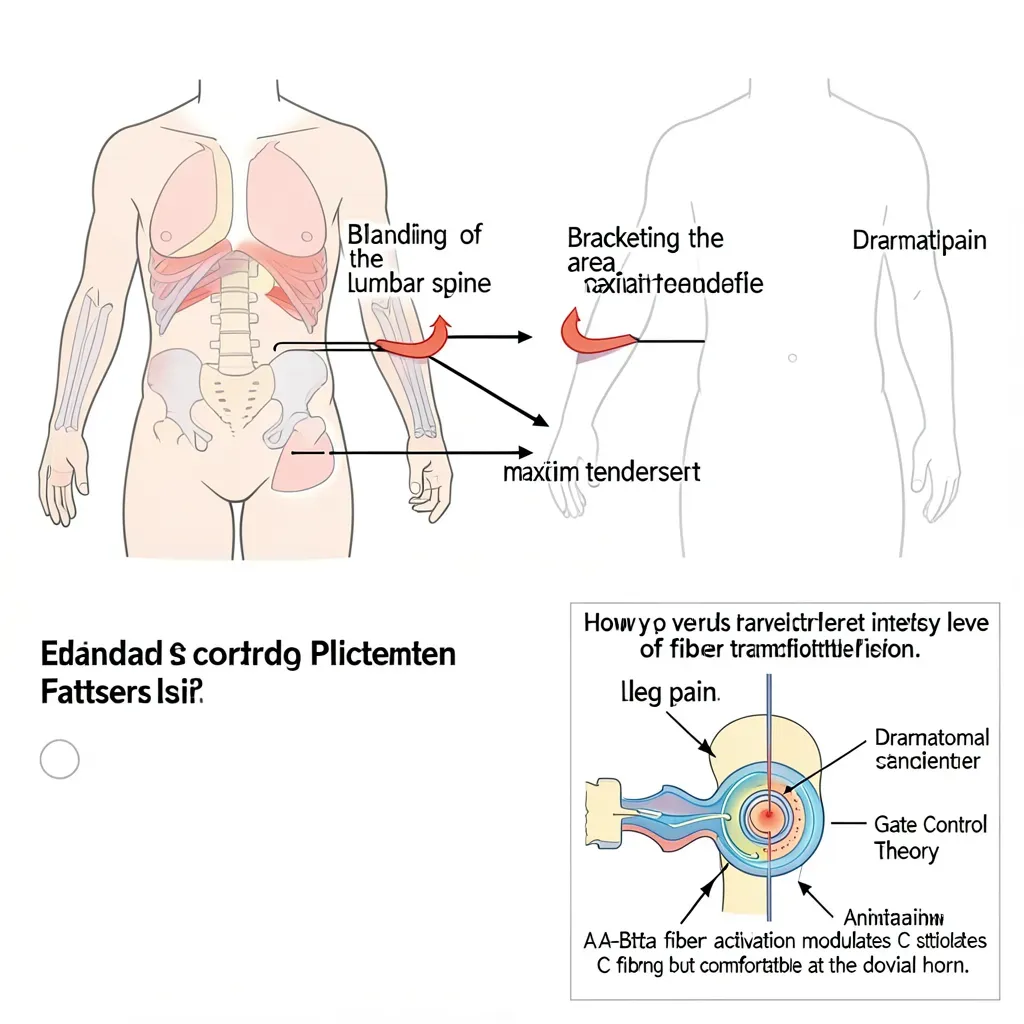
The theoretical basis for TENS is gate control theory, proposed by Melzack and Wall in their landmark 1965 paper. The theory holds that pain transmission through the spinal cord is regulated by a "gate" mechanism in the dorsal horn — a region where pain signals (carried by small-diameter C and A-delta fibers) can be modulated by simultaneous input from large-diameter A-beta fibers, which carry touch and vibration signals.
When A-beta fibers are activated — as happens during TENS, or when you rub a sore area — their input to the dorsal horn activates inhibitory interneurons that reduce the transmission of pain signals up to the brain. The gate, in effect, closes. The familiar experience of rubbing a bumped elbow and feeling immediate relief is gate control in action.
Conventional TENS (the most common type) operates on this principle by using high-frequency stimulation (80-150 Hz) at an intensity that activates A-beta fibers without triggering pain. The sensation is typically described as a tingling or buzzing, never painful. This is the type most people are using when they apply a TENS device at home.
Conventional TENS vs. Acupuncture-Like TENS
A second mode — acupuncture-like TENS (AL-TENS) — uses low-frequency stimulation (2-4 Hz) at a higher intensity that produces visible muscle twitching. Rather than operating via gate control, AL-TENS is thought to trigger endorphin release through activation of motor nerve fibers and descending inhibitory pain pathways. This is mechanistically closer to the proposed mechanism of electroacupuncture.
AL-TENS requires higher intensity, is less comfortable for most people, and is more typically administered in clinical settings rather than at home. The two modes are not interchangeable — they target different mechanisms — but in practice, the research does not clearly demonstrate superior outcomes for one over the other in back pain.
A third mode — burst mode TENS — alternates between conventional and acupuncture-like patterns. Its theoretical benefit is combining both mechanisms, though clinical evidence supporting this in back pain specifically is limited.
Gate control theory remains influential but has evolved considerably since 1965. Modern pain neuroscience recognizes that the "gate" is not a simple spinal mechanism — central sensitization, descending modulation from the brain, and neuroinflammation all contribute to pain experience. TENS may work through some of these additional pathways as well, though the mechanistic research is incomplete.
What the Cochrane Reviews Actually Found
The most rigorous systematic evaluation of TENS for back pain comes from two Cochrane reviews — the standard for evidence quality in medicine.
The 2008 Cochrane review (Khadilkar et al.) examined TENS for chronic low back pain. After analyzing the available randomized controlled trials, the authors concluded that the evidence was contradictory and of poor quality, that no firm conclusions could be drawn about the effectiveness of TENS compared to placebo, and that the trials that did show benefit had significant methodological weaknesses including inadequate blinding and small sample sizes.
The 2021 update reached similar conclusions. When pooling the best-available evidence, TENS performed no better than sham TENS (placebo electrodes that deliver no current) for chronic low back pain on the primary outcomes of pain intensity and disability. This is a meaningful finding: sham TENS itself produces a substantial placebo response — often 20-30% improvement — which makes detecting any additional "real" treatment effect difficult, but when the comparison is made, the difference disappears.
For acute low back pain, the evidence base is thinner still. Very few high-quality trials have specifically examined acute pain, making any conclusions tentative.
"Limited evidence" does not mean "proven ineffective" — it means the trials conducted so far have not been adequate to determine whether an effect exists. The distinction matters: the absence of high-quality evidence for TENS is not the same as high-quality evidence of absence. However, it does mean TENS cannot be recommended as an effective treatment with confidence, and investing heavily in it as a primary strategy is not supported.
The Placebo Problem in TENS Research
TENS is notoriously difficult to study rigorously, and this is part of why the evidence is so limited. A credible sham TENS device must deliver some sensation — otherwise participants know immediately they are in the placebo group. But any electrical sensation might itself activate gate control mechanisms, making the control condition inadvertently active. This methodological problem is unique to electrical stimulation therapies and has compromised most TENS trials.
Additionally, many TENS studies use the device in isolation, without controlling for concurrent treatment. In real-world use, TENS is typically used alongside movement, exercise, and other strategies — making it impossible to isolate the contribution of the device itself.
The practical implication: if you use TENS and experience pain relief, you may genuinely be experiencing less pain. Whether the current itself, the gate control mechanism, the placebo effect, or the act of sitting quietly for 20 minutes while applying it is responsible is largely unknowable.
Appropriate Use: Where TENS Has a Rational Place
Given the evidence, how should TENS be positioned in a back pain recovery approach?
The most defensible use is as an adjunct during acute flare-ups when pain is severe enough to impair movement and the goal is temporary symptom control sufficient to allow participation in rehabilitation. TENS can reduce pain intensity enough in the short term to make a walk or a set of movement exercises more achievable — and exercise is what moves the needle on long-term outcomes.
It should not be:
- A primary treatment or the central focus of recovery
- Used as a substitute for progressive movement and loading
- Relied on chronically as a daily coping mechanism without a plan to reduce dependence
- Expected to produce lasting structural changes to the spine
The appropriate framing is: TENS as a pain management bridge, used situationally, to support activity — not as a treatment for the underlying problem.
If you use TENS, measure whether it actually helps you specifically. Pain is subjective and individual responses to any treatment vary. Rate your pain before and 30 minutes after a session for several sessions in a row. If you consistently see a 2+ point drop on a 0-10 scale and can use that window to exercise, TENS is earning its place. If you see no consistent response after 6-8 sessions, it is unlikely to be your tool.
Contraindications: When Not to Use TENS
TENS is contraindicated in several situations that are absolute and non-negotiable:
Cardiac pacemakers or implantable cardioverter-defibrillators. Electrical current from TENS can interfere with pacemaker function and is strictly contraindicated in anyone with a pacemaker or ICD regardless of electrode placement.
Over the carotid sinuses or anterior neck. This can trigger a dangerous reflex drop in blood pressure and heart rate.
During pregnancy (particularly over the abdomen or low back, which is the area most relevant to back pain patients).
Over broken skin, open wounds, or active skin infections.
Directly over implanted metal hardware (spinal fusion hardware, joint replacements). The current dispersal pattern is unpredictable over metal. This is especially relevant for post-surgical back pain patients — a significant proportion of people who might consider TENS.
Epilepsy. There is theoretical risk of triggering seizures, particularly with electrode placement near the head or neck.
Relative contraindications — situations where caution and ideally professional guidance are warranted — include any diagnosed cardiac arrhythmia, active cancer (especially over or near a tumor site), and peripheral neuropathy where sensation is impaired (since you cannot reliably detect if the current is too intense).
How to Use TENS Correctly
Assuming no contraindications, correct technique matters. The common errors that reduce effectiveness:
Electrode placement. Electrodes placed directly over the most painful area, surrounding the area on two sides, or along the dermatome corresponding to the source of pain are the standard approaches. For low back pain, flanking the lumbar spine bilaterally or bracketing the area of maximum tenderness are both reasonable starting positions. Moving electrodes between sessions to find what works best for your pain pattern is appropriate.
Intensity. For conventional TENS (gate control), intensity should be strong enough to produce clear tingling sensation but not painful. The threshold should be described as "strong but comfortable." Erring below this level is the most common error — the stimulus must be sufficient to reliably activate A-beta fibers.
Duration. Most clinical protocols use 20-30 minute sessions. Longer sessions do not necessarily produce greater benefit and may be associated with reduced efficacy due to accommodation (the nervous system adapting to constant stimulation). For the same reason, varying parameters (frequency, intensity, pulse width) between sessions may partially offset accommodation.
Frequency. For acute pain management, daily use during flare periods is appropriate. For chronic use, daily or twice-daily sessions are common, but this should come with a plan to reassess regularly whether the device is genuinely earning its place in your routine.
The Bottom Line on TENS
TENS is a low-risk, modest-evidence tool. It works for some people some of the time, the mechanism is biologically plausible, and using it correctly carries minimal downside beyond cost and the opportunity cost of treating it as more significant than the evidence supports.
What it will not do: resolve the underlying structural or behavioral contributors to chronic back pain, replace progressive loading and movement, or produce lasting change on its own.
The evidence-based position is not "TENS is useless" — the Cochrane reviews explicitly acknowledge the limitations of the trials and the possibility that genuine effects exist but have not been adequately detected. The evidence-based position is: use TENS as a short-term symptom management tool to support your ability to exercise and move, measure whether it actually helps you personally, and keep it in its appropriate place — as a bridge, not a destination.
In Review
- TENS works via gate control theory: high-frequency electrical stimulation activates large A-beta fibers that inhibit pain signal transmission at the dorsal horn
- Acupuncture-like TENS uses low-frequency, high-intensity stimulation to trigger endorphin release via a different mechanism — the two modes are not interchangeable
- Cochrane reviews from 2008 and 2021 found that TENS performed no better than sham TENS for chronic low back pain — limited evidence, not proven ineffective
- The most defensible use is as an acute flare adjunct to temporarily reduce pain enough to participate in rehabilitation exercise, not as a primary treatment
- Absolute contraindications include pacemakers, pregnancy (over low back), implanted spinal hardware, and placement over the carotid sinuses
- Correct technique requires intensity strong enough to produce clear tingling sensation — under-stimulation is the most common error
- Measure your personal response objectively; if consistent 2+ point pain reduction enabling exercise is not achieved after 6-8 sessions, TENS is not your tool