Back Pain and Mental Illness: A Complex Comorbidity
Understanding the higher rates of back pain in depression, anxiety, PTSD, and schizophrenia — shared mechanisms, medication effects on pain, and the treatment approach.
A Bidirectional Relationship
The co-occurrence of back pain and mental illness is not coincidental. It is not simply that depressed people focus more on pain, or that painful people become depressed — though both are true. The relationship is bidirectional, neurobiologically grounded, and frequently missed in standard medical care where back pain and psychiatric conditions are managed in separate silos by different clinicians.
Population data is unambiguous: people with major depressive disorder have approximately twice the risk of chronic back pain compared to the general population. People with anxiety disorders, PTSD, and schizophrenia show similarly elevated rates. Conversely, people with chronic back pain have two to three times the prevalence of depression and anxiety compared to pain-free adults. The causal arrows run in both directions, mediated by shared neurobiological mechanisms rather than purely psychosocial attribution.
Understanding these mechanisms changes the treatment approach. A patient whose back pain is amplified by a dysregulated stress response system, impaired descending pain modulation, and sleep architecture disruption from antipsychotic medication is not simply a "complex patient" — they have identifiable targets for intervention. The clinical implication is that addressing psychiatric comorbidity is not secondary to addressing the spine; for many patients, it is primary.
Descending Pain Modulation: The Shared Neural Mechanism
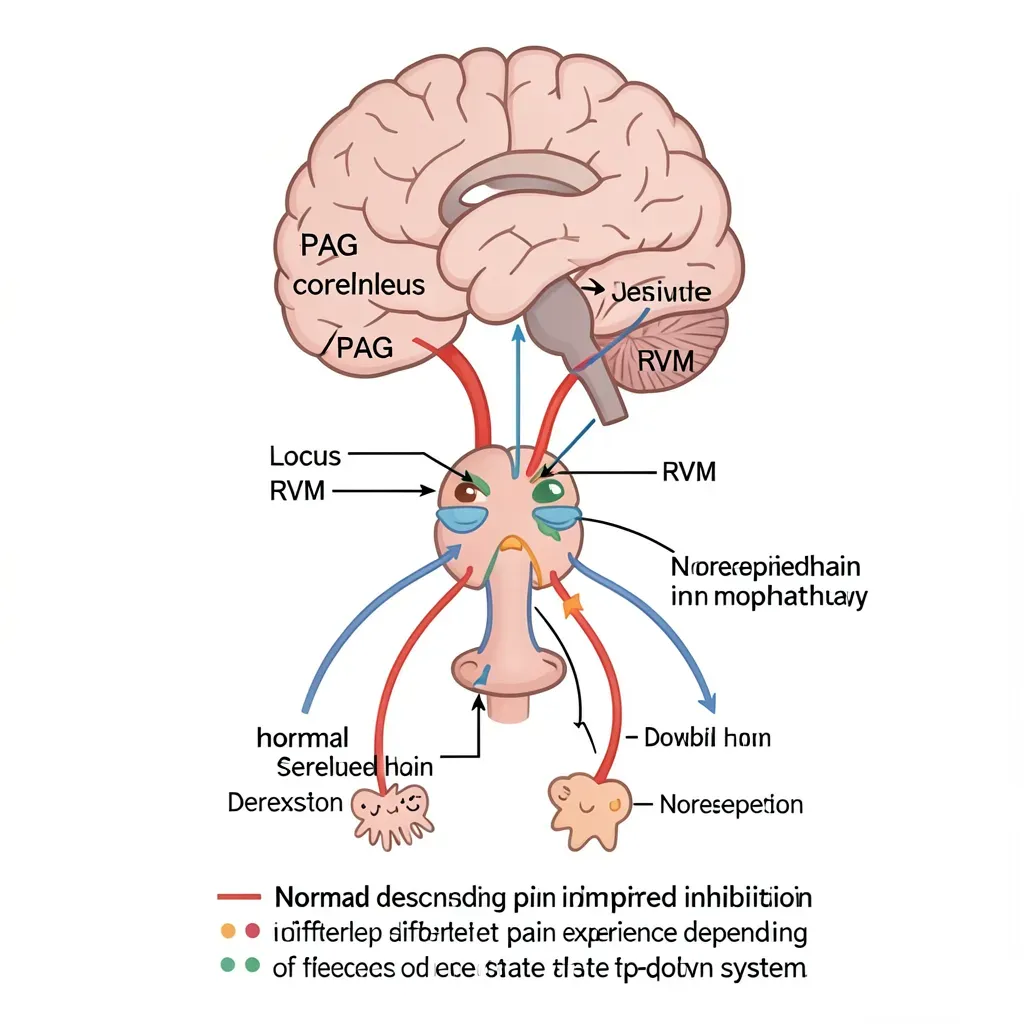
The single most important concept for understanding the back pain–mental illness link is descending pain modulation. The brain does not passively receive pain signals — it actively modulates them via descending pathways from the brainstem that regulate how strongly nociceptive signals are amplified or suppressed in the dorsal horn of the spinal cord.
Two neurotransmitters are central to this descending modulation system: serotonin and norepinephrine. The periaqueductal gray (PAG) region of the midbrain, the locus coeruleus (primary norepinephrine nucleus), and the rostral ventromedial medulla (RVM) form the core anatomical circuitry. When these pathways are functioning well, they provide significant ongoing suppression of pain signal transmission — the neurological equivalent of turning down the gain on a speaker before the sound reaches consciousness.
In major depression and chronic anxiety states, serotonin and norepinephrine signaling in these descending circuits is reduced. The result is that descending inhibition is impaired — the "gain" on pain signals is turned up. This is why people with depression genuinely experience more pain from the same physical stimulus, and why the pain is not "in their head" in any dismissive sense — it is a real neurological change in pain threshold mediated by measurable changes in neurotransmitter function.
This mechanism also explains why antidepressants that work on serotonin and norepinephrine reuptake — particularly SNRIs like duloxetine and venlafaxine — are effective analgesics in chronic pain conditions, including chronic back pain. The analgesic effect is partially independent of their antidepressant effect, because they target the same descending modulation circuitry.
Depression and Back Pain: The Mutual Amplification Loop
Depression and back pain each worsen the other through multiple parallel mechanisms, creating what clinicians sometimes call a vicious cycle but which is more precisely a mutual amplification loop with several distinct pathways.
Pain amplification from depression:
- Impaired descending inhibition (as above)
- Increased cortisol and inflammatory cytokines (depression is associated with elevated IL-6, TNF-α, and CRP — the same inflammatory mediators implicated in disc and joint pain)
- Sleep disruption — major depression produces profound sleep architecture disruption, reducing slow-wave sleep and fragmenting REM, which directly impairs pain threshold the next day
- Physical inactivity — depression's hallmark anhedonia and fatigue reduce the activity levels that are the primary modifiable driver of back pain recovery
Depression amplification from pain:
- Chronic pain activates the HPA (hypothalamic-pituitary-adrenal) axis, driving cortisol dysregulation that contributes to depressive states
- Activity limitation from pain forces social withdrawal, reducing behavioral activation and positive reinforcement
- Catastrophizing — a cognitive pattern strongly associated with chronic pain — shares cognitive features with depressive rumination
- Pain interferes with sleep, and sleep deprivation is one of the most reliable inducers of depressed mood
The implication is practical: effective treatment of either condition will modestly improve the other. But the most effective approach addresses both simultaneously and deliberately, not sequentially.
Anxiety and Back Pain: The Hypervigilance Problem
Anxiety — whether as generalized anxiety disorder, panic disorder, health anxiety, or subclinical trait anxiety — produces a specific cognitive-physiological state of heightened threat vigilance. In the context of back pain, this manifests as hypervigilance to body sensations: persistent scanning of the body for pain signals, increased attention allocation to any perceived sensation in the back, and a lowered threshold for interpreting ambiguous sensations (tightness, fatigue, the normal discomfort of sustained posture) as threatening or injurious.
This hypervigilance amplifies pain independently of the nociceptive stimulus. It is mediated by top-down cortical modulation of the sensory processing areas — when more attentional resources are allocated to monitoring a body region, the signal from that region is processed with greater amplitude. This is the same mechanism that allows musicians to hear pitch discrepancies inaudible to untrained listeners — attention increases signal fidelity, including pain signal fidelity.
The anxiety-specific treatment implication is that techniques that redirect attentional deployment — mindfulness-based approaches, acceptance and commitment therapy (ACT), and interoceptive exposure — are more targeted than approaches focused purely on physical rehabilitation. Physical rehabilitation is still essential, but an anxious patient who interprets each treatment session discomfort as evidence of further injury will not make normal progress through standard exercise-based rehabilitation without concurrent anxiety treatment.
PTSD and Back Pain: Trauma's Somatic Dimension
PTSD produces the most severe dysregulation of the systems relevant to back pain among the psychiatric diagnoses. The core features — hyperarousal, hypervigilance to threat, and chronic HPA axis activation — map directly onto mechanisms of pain amplification.
PTSD is associated with structural and functional changes in the prefrontal cortex (reduced regulatory capacity over the amygdala), hippocampus (reduced volume, impaired contextual learning), and amygdala (hyperactivation). The result is a threat-detection system that is chronically over-activated and an extinction-learning system that is impaired — meaning the nervous system continues to mount full stress responses to stimuli that are not actually dangerous, because the contextual learning that would normally allow downregulation is compromised.
In the context of back pain, PTSD produces several clinically important patterns:
Somatic hypervigilance — PTSD patients often have dissociation from body sensations as part of the traumatic response, but paradoxically also exhibit hypervigilance to somatic threat signals. Pain becomes embedded in the threat-monitoring system that PTSD has sensitized.
Movement avoidance — if injury or pain was part of the traumatic event (assault, accident, combat injury), the movements associated with that original injury may trigger trauma-response activation, producing a pain-avoidance pattern that has both a physical and a psychological component.
Treatment avoidance — medical environments, physical contact during treatment, and the vulnerability of the patient role can all be PTSD triggers, leading to inconsistent engagement with physical rehabilitation.
Schizophrenia and Antipsychotic Medication Effects
The back pain burden in schizophrenia is elevated above the general population through multiple pathways. The primary factor is antipsychotic medication effects rather than the psychosis itself.
Typical (first-generation) antipsychotics — haloperidol, chlorpromazine, fluphenazine — block dopamine D2 receptors and produce significant extrapyramidal side effects. Akathisia (a severe inner restlessness with constant movement compulsion) and drug-induced parkinsonism (rigidity, tremor, shuffling gait) are directly painful musculoskeletal manifestations. Tardive dyskinesia, which can include truncal twisting movements, also directly stresses spinal structures with involuntary repetitive loading.
Atypical (second-generation) antipsychotics are much less likely to produce these motor effects, but produce their own relevant side effects. Many second-generation antipsychotics — particularly olanzapine, quetiapine, and clozapine — produce significant weight gain, metabolic syndrome, and insulin resistance. The mechanisms are covered in detail in chapter 117 (obesity and back pain), but the clinical point here is that antipsychotic-induced weight gain is one of the most severe drug-induced weight changes in medicine, with some patients gaining 10–20% of body weight. This directly increases spinal compressive load and adipose-derived inflammatory signaling.
Some antipsychotics also produce sedation that reduces overall activity levels significantly — contributing to the deconditioning and activity-restriction patterns that worsen back pain chronicity.
How Mental Illness Complicates Adherence to Exercise
The evidence-based core of back pain rehabilitation is progressive exercise — specifically, graded exposure to loading and movement. This requires sustained behavioral engagement over weeks to months. Mental illness impairs this engagement through mechanisms that are not willpower failures:
Depression — anhedonia removes the motivational reinforcement that normally sustains health behavior. The future-oriented thinking required to sustain exercise for long-term benefit is specifically impaired in depressive states (depression biases attention toward present experience and past negative events, not future outcomes).
Anxiety — the pain catastrophizing and fear-avoidance patterns that impair exercise adherence in all back pain patients are amplified in anxious patients. Each episode of exercise-associated discomfort is more likely to be interpreted as evidence of injury.
PTSD — inconsistent attendance, avoidance of physical environments (gyms) associated with vulnerability, and difficulty with structured activity are core manifestations of PTSD's functional impact.
Schizophrenia — disorganized thinking impairs the structured, repetitive behavioral routines that exercise programs require. Negative symptoms (avolition, alogia, affective flattening) specifically reduce self-initiated activity.
The treatment implication is that psychiatric treatment is not optional "added care" on top of physical rehabilitation — it is an enabling condition for physical rehabilitation. Addressing depression with SNRIs, anxiety with cognitive-behavioral therapy or medication, and PTSD with evidence-based trauma treatments (EMDR, prolonged exposure, CPT) directly increases the capacity for exercise adherence that back pain recovery requires.
In Review
- Depression, anxiety, PTSD, and schizophrenia all co-occur with chronic back pain at two to three times general population rates — the relationship is bidirectional and neurobiologically grounded
- Descending pain modulation via serotonin and norepinephrine pathways is impaired in depression, raising pain sensitivity at the neurological level
- SNRIs (particularly duloxetine) address both depression and chronic pain through the same descending modulation pathway — preferred over SSRIs when both conditions are present
- Anxiety produces hypervigilance to body sensations that amplifies pain independently of the nociceptive stimulus — requires attention-redirection interventions, not just physical rehabilitation
- PTSD involves chronic HPA axis hyperactivation, somatic hypervigilance, and movement avoidance that specifically interfere with standard rehabilitation protocols
- Trauma-informed care principles are required for PTSD patients: patient control over pace and intensity, narration before contact, protocols modifiable by patient response
- Psychiatric treatment is an enabling condition for exercise adherence, not supplementary care — addressing the psychiatric comorbidity directly improves the capacity for rehabilitation