Navigating the Healthcare System With Back Pain
The systemic obstacles to good back care — inappropriate imaging, over-medicalization, and how to advocate effectively for evidence-based treatment.
The Paradox of Back Pain Care
The United States spends more money on back pain than any other country in the world — more than $100 billion annually in direct medical costs and productivity loss. Despite this, outcomes for back pain in the United States are worse than in many countries that spend significantly less. Wait times are longer, surgery rates are higher, opioid prescription is higher, and long-term disability rates are higher than in comparable economies with universal healthcare or strong physiotherapy-first systems.
This is not because Americans have worse backs, or because back pain is simply more prevalent. It is because the healthcare system's incentive structure is misaligned with the evidence on back pain treatment. The system rewards imaging, procedures, surgery, and medication prescriptions. It does not particularly reward physiotherapy, patient education, exercise, and time spent helping someone understand why their back hurts and what to do about it.
Understanding this structural reality is not cynicism — it is practical knowledge. Once you understand why the system is prone to specific patterns of care, you can navigate around them more effectively.
Imaging Overuse: The First Obstacle
The most consistent finding in back pain healthcare research is that lumbar imaging is overused — dramatically, consistently, and at significant cost to patients. Somewhere between 50% and 70% of patients with non-specific low back pain in the United States receive imaging within six weeks of presentation, despite guidelines from every major clinical organization explicitly recommending against early imaging for uncomplicated presentations.
The harms of early imaging are real and often underestimated:
Incidental findings. The lumbar spine of a 40-year-old who has never had back pain will typically show disc degeneration, disc height loss, facet joint changes, and possibly a small disc bulge on MRI. These are normal age-related changes. When they are found in someone who does present with back pain, there is a powerful human tendency — in both the clinician and the patient — to assume the imaging finding explains the pain. Frequently, it does not. The finding was already there; it was just discovered because pain prompted a scan.
Nocebo labeling. When a patient is told they have "severe disc degeneration," "advanced arthritis," or a "badly worn spine" based on imaging findings that may have nothing to do with their current pain, they acquire a catastrophic label that changes how they think about their back and their future. Research has consistently shown that people who receive such labels are more likely to develop chronic pain, take more medication, have more procedures, and have worse long-term outcomes than those with similar physical findings who were not labeled. The imaging finding, not the physical reality, drives the harm.
Surgery funneling. The pathway from early imaging to surgery consultation is shorter than most patients realize. An MRI showing a disc herniation generates a radiology report that recommends "clinical correlation" and potentially "neurosurgical consultation." The GP passes this on. The surgeon sees the patient and discusses surgical options. The patient, frightened by the imaging language and now in a surgical context, is significantly more likely to consent to surgery than they would have been if they had gone to physiotherapy first.
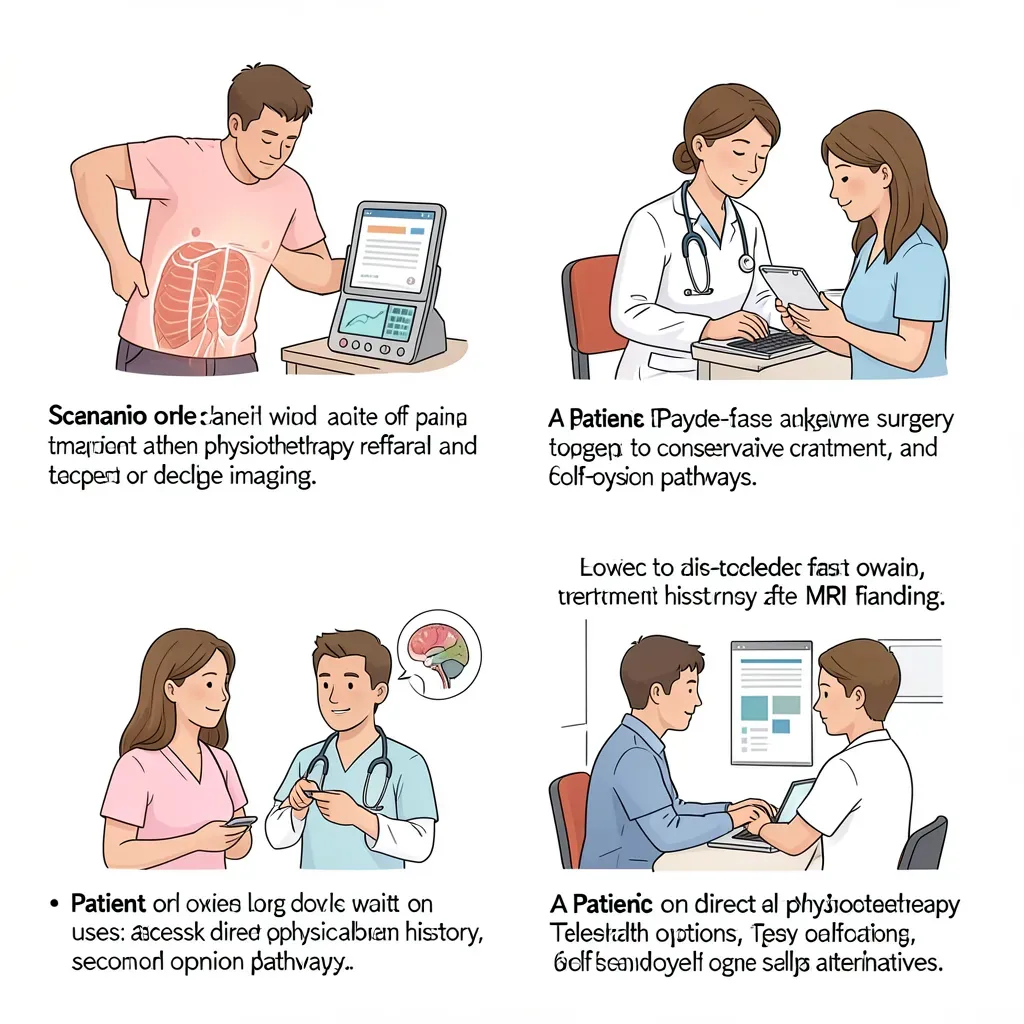
If your GP or emergency provider orders imaging for uncomplicated back pain (no red flags, no neurological symptoms) within the first four to six weeks of symptom onset, it is appropriate to ask why imaging is indicated at this stage. Major guidelines — NICE (UK), the American College of Physicians, and many others — explicitly recommend against early imaging for non-specific back pain. You are not being difficult by asking for the clinical rationale.
Red Flag Symptoms That Do Justify Early Imaging
The above critique of imaging overuse should not obscure the legitimate indications for early investigation. Imaging is appropriate and necessary when any of the following are present:
- Bowel or bladder dysfunction (possible cauda equina syndrome — this is an emergency)
- Saddle anesthesia (numbness in the perineal region)
- Significant progressive neurological deficit (worsening weakness, foot drop)
- History of cancer with new back pain
- Significant trauma (fall from height, motor vehicle accident)
- Unexplained systemic symptoms: fever, unexplained weight loss, night sweats
- Back pain that is completely unrelated to posture or movement (particularly pain that is worse at rest and at night)
- Age under 20 or over 50 with an atypical presentation
These red flags represent a small minority of back pain presentations. For the large majority of patients — those with mechanical, activity-related pain without neurological compromise or systemic features — early imaging adds cost and harm without benefit.
When Your GP Offers Only Medication
A common experience: you present to a GP with back pain. You receive a prescription for NSAIDs, muscle relaxants, or — in some healthcare systems — opioids, and a suggestion to rest. No physiotherapy referral. No rehabilitation plan. No discussion of exercise or activity.
This is not evidence-based practice. The major clinical guidelines for back pain universally recommend early physiotherapy referral, patient education, and maintenance of activity. Medication, where used, is an adjunct — not a primary treatment. GPs who offer medication alone are often constrained by system pressures (short appointment times, local referral bottlenecks, formulary incentives) rather than being deliberately wrong, but the outcome for the patient is the same.
Strategies for getting a physiotherapy referral from a GP who has offered only medication:
Ask directly. "Can you refer me to physiotherapy as well?" Most GPs will comply with a direct request. The barrier is often that they don't offer it first — not that they will refuse when asked.
Reference guidelines. "I've read that early physiotherapy is recommended for back pain — is that something you can arrange?" This is not adversarial. It invites the GP to proceed in line with guidelines they already know.
Be specific about what you want. "I want to understand why my back hurts and what exercises I should be doing" is a clearer request than a vague desire for a referral.
If self-referral is available, use it. In many countries and many insurance plans, physiotherapy can be accessed directly without a GP referral. If your system allows this, using it is faster and removes the GP as a gatekeeper.
In the United Kingdom, you can self-refer to NHS physiotherapy without a GP appointment in most areas. In Australia, you can access five Medicare-subsidized physiotherapy sessions through a chronic disease management plan. In the United States, many insurance plans allow direct access to physiotherapy within the network without prior authorization. Check your specific coverage — the referral requirement you may assume exists might not.
Telehealth Physiotherapy: A Practical Option
Telehealth physiotherapy — remote consultations with a physiotherapist via video call — expanded dramatically during the pandemic and has remained available in most markets. For back pain specifically, the evidence on telehealth physiotherapy is reasonably positive: exercise instruction, movement assessment, and education are deliverable remotely, and outcomes are not significantly inferior to in-person care for most non-surgical back pain presentations.
Telehealth is particularly useful for:
- Initial consultations when access to in-person care is limited
- Follow-up appointments where the primary content is exercise review and progression
- Patients in rural or remote areas
- Those with significant work or family commitments that make in-person appointments difficult to sustain
Telehealth has limitations: hands-on assessment of specific tissue tenderness or mobility is not possible, and complex presentations where manual assessment is clinically important are better managed in-person. For uncomplicated mechanical back pain, however, telehealth physiotherapy is a meaningful access improvement.
Self-Pay and International Options
In healthcare systems with long wait times or poor access to physiotherapy, self-pay options are worth understanding. A physiotherapy consultation in the UK, Australia, or Canada as a self-pay patient typically costs between £60-£120 per session. In the United States, a private physiotherapy session varies from $100-$250. Two or three targeted sessions with a skilled physiotherapist are often more valuable than indefinite waiting on a public system list.
For patients in the United States specifically, where insurance navigation can be complex, out-of-network physiotherapy with a cash price is sometimes more cost-effective than using insurance once deductibles and co-pays are factored in. Ask for the cash price before using insurance — it is sometimes lower.
Medical tourism for spine care is a more complex option that is increasingly used. Countries including Germany, the Netherlands, Spain, and Australia have strong evidence-based spine care traditions and significantly shorter wait times than the United States for some elective procedures. The cost differential for elective surgery can be substantial. This is most relevant for patients facing recommended elective procedures (disc surgery, decompression) who have the means and flexibility to travel. Thorough research into provider credentials, outcome data, and post-procedure follow-up is essential.
The International Comparison: What Other Systems Do Better
International comparison of back pain outcomes provides useful context for understanding what better care looks like. Several recurring features distinguish lower-spending, better-outcome systems:
Physiotherapy-first pathways. Countries including Denmark, the Netherlands, and New Zealand have systems where physiotherapy is the explicit first-line intervention for back pain, with imaging and specialist referral reserved for non-responders with clear indications. Surgery rates are substantially lower and outcomes are equivalent or better.
Education and self-management emphasis. Systems that invest in explaining back pain to patients — communicating that most back pain is not dangerous, that activity is beneficial, and that recovery is expected — produce better outcomes than those that communicate primarily through diagnoses and procedures.
Restriction of imaging. Guideline implementation that actually limits early imaging (through referral authorization requirements, GP education programs, and feedback mechanisms) produces lower downstream surgery rates without worse outcomes.
Integration of rehabilitation. Post-surgical rehabilitation is a standard expectation in most high-performing systems, not an optional add-on. The understanding that surgery addresses a structural problem but that rehabilitation addresses the functional recovery is embedded in the care pathway.
If you are preparing for any spine procedure — injection, surgery, or other intervention — ask your provider what the rehabilitation plan looks like afterward. A procedure without a defined rehabilitation plan attached to it is not a complete treatment. If the answer is "we'll see how you respond," that is insufficient. Ask specifically: who will supervise my rehabilitation, what does it consist of, and when does it begin?
Building an Effective Healthcare Team
The patient who navigates back pain most successfully tends to be the one who takes an active role in assembling and coordinating their care, rather than passively receiving whatever is offered. This involves:
Knowing your clinical picture. Understanding your diagnosis, the evidence base for your treatment options, and what outcomes are realistic allows you to have informed conversations with providers rather than simply deferring.
Communicating between providers. If you see a physiotherapist, a GP, and a physiatrist, they need to share information. Bring notes from each appointment. Ask for copies of any clinical letters or reports. Ensure that each provider knows what the others have recommended.
Setting treatment endpoints. Every treatment relationship should have a defined reassessment point. At 6-8 weeks, ask: am I making progress toward the goals we set? If not, what should change?
Knowing when to escalate. Escalation — requesting specialist referral, seeking imaging, consulting a surgeon — is appropriate when conservative treatment has been adequate and has not produced the expected response. Premature escalation bypasses the treatment most likely to help. Appropriate escalation at the right time accesses the intervention that is needed.
In Review
- The US back pain system is the most expensive in the world and produces among the worst outcomes — understanding why helps you navigate around it
- Imaging overuse is a primary driver of harm through nocebo labeling, incidental finding anxiety, and surgery funneling; early imaging is not indicated for uncomplicated back pain
- Red flags that justify early imaging include neurological compromise, cancer history, trauma, and systemic symptoms — these are a small minority of presentations
- When offered only medication, ask directly for physiotherapy referral; direct access to physiotherapy exists in many systems without a GP gatekeeper
- Telehealth physiotherapy is effective for most non-surgical back pain and meaningfully expands access
- Self-pay physiotherapy and international care options are practical alternatives when public system access is poor
- Countries with physiotherapy-first pathways, education emphasis, and imaging restriction have better back pain outcomes at lower cost
- An engaged, informed patient who actively assembles and coordinates their care achieves better outcomes than one who passively receives whatever is offered