Core Training Myths: What the Evidence Actually Supports
Challenging popular back pain advice — why crunches aren't inherently dangerous, why planks aren't magic, and what core training actually needs to achieve.
How the Core Became Mythology
Somewhere in the 1990s, back pain management underwent a cultural shift. Sit-ups were declared dangerous. The core became the answer to everything. Pilates studios and stability ball classes proliferated. Planks replaced crunches as the gold standard. Personal trainers began confidently explaining disc anatomy to clients.
Most of this narrative is partially true in specific contexts and wildly overgeneralized in practice. The research that generated these ideas — much of it from Stuart McGill's lab at the University of Waterloo — was rigorous and important. But the translation of that research into gym culture and clinical practice has produced a set of myths that often leave back pain patients doing the wrong things and avoiding the right ones.
This article examines what the evidence actually supports, corrects the most common misapplications, and offers practical principles for core training that are actually grounded in spine biomechanics.
Myth 1: Sit-Ups Are Dangerous
The sit-up became widely condemned after research demonstrated that it imposes higher spinal compressive loads than the modified curl-up and involves repeated lumbar flexion, which can stress the intervertebral disc. This finding is real and applicable — for people with disc pathology, repeated lumbar flexion under load is not appropriate.
The problem is that "disc pathology" applies to a specific subset of back pain patients, not all of them. For the general population without current disc injury, the sit-up is not inherently dangerous. Militaries around the world have used sit-ups in fitness testing for decades without evidence that the exercise itself causes widespread disc injury in people who do not have pre-existing disc pathology.
The McGill curl-up — modified to maintain lumbar lordosis throughout — was not designed because sit-ups are universally dangerous. It was designed as a safer alternative for people already dealing with disc problems, or as a more spine-sparing option for high-volume core training. The distinction matters: a healthy athlete doing sit-ups is not at meaningful risk. A person with a confirmed L4-5 disc herniation doing high-volume sit-ups is applying repeated flexion load to a compromised structure, which is a different situation entirely.
The research condemning sit-ups was largely conducted using cadaveric spines and in vivo biomechanical studies of people already identified as having back pain. Applying those findings universally to healthy populations and treating all trunk flexion exercises as dangerous represents a significant overreach of the original research.
Myth 2: Planks Are the Safe, Superior Core Exercise
The plank became the sit-up's replacement in popular culture. It is presented as spine-neutral, functional, and superior for back health. In a rehabilitation context, specifically for patients learning to tolerate load in a neutral spine position, the plank has genuine value. But it is not magic, and the idea that anyone doing planks is protecting their spine is not supported by the evidence.
Several problems arise with how planks are applied. First, an extended plank with a sagging lower back is not a spine-neutral exercise — it is a prolonged lumbar extension exercise, which loads the posterior elements and can aggravate facet joint pain and stenosis. Proper plank mechanics require that the spine remain genuinely neutral, which means the pelvis is not anteriorly tilted and the lumbar spine is not hyperextended. Many people have no idea whether they are sagging during a plank because they cannot feel it.
Second, the plank primarily trains isometric anterior core endurance. This is valuable — McGill's research clearly shows that lumbar spine stability is largely achieved through co-contraction of trunk muscles maintaining stiffness around the joint, which is an endurance quality. But isometric anterior endurance is one component of core function, not the whole picture. The lateral stabilizers (quadratus lumborum, obliques), the rotary stabilizers, and the muscles that transfer load between the upper and lower extremities are all important and are not meaningfully trained by front planks alone.
Third, the plank does not translate automatically to functional movement. A person who can plank for three minutes but cannot maintain a neutral spine during a loaded hip hinge has good plank endurance and poor functional core control. The goal of core training is not impressive plank times — it is the ability to maintain spinal stability during the specific movements that load your spine in daily life.
Myth 3: Drawing In the Abdomen Protects the Spine
For years, the dominant clinical instruction for back pain patients was to draw in — to pull the navel toward the spine — before and during exercise. This came from research suggesting that the transversus abdominis, the deepest abdominal muscle, fires in anticipation of limb movements in healthy people and that this anticipatory firing is delayed in back pain patients.
The conclusion drawn was that training the transversus abdominis through drawing-in maneuvers would restore this anticipatory firing and protect the spine. Drawing in became a standard instruction in Pilates, physiotherapy, and gym settings.
McGill's subsequent research challenged this model substantially. His work demonstrated that maximum spinal stability is achieved through co-contraction of all trunk muscles — not isolated activation of the transversus abdominis. Drawing in the abdomen actually reduces intra-abdominal pressure and reduces overall trunk stiffness compared to a moderate abdominal brace. When a spine is under load, stiffness is protective. Drawing in reduces stiffness.
The current evidence supports abdominal bracing — creating moderate tension across all the trunk muscles simultaneously, as if bracing for a punch — rather than drawing in. This produces greater spinal stiffness, better load transfer between the upper and lower body, and more stable mechanics during loaded movements.
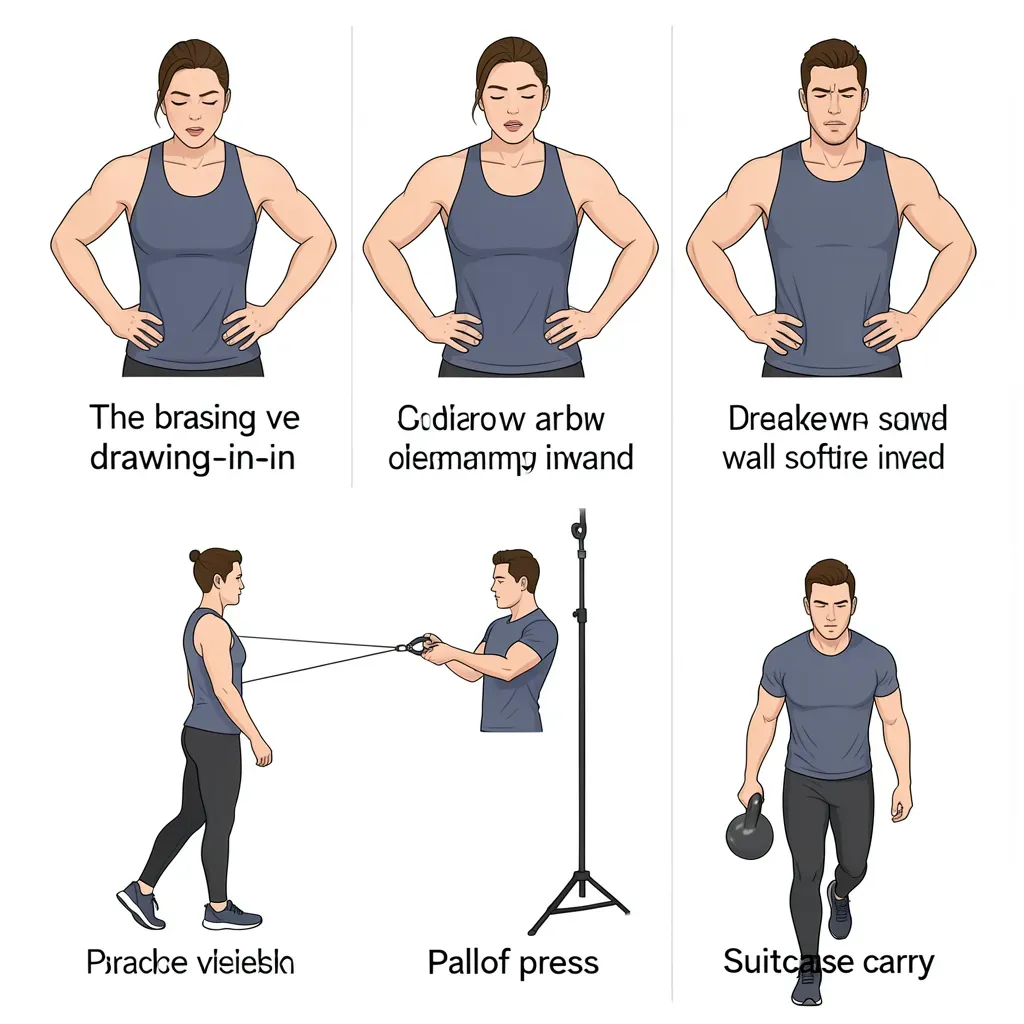
To practice bracing versus drawing in, try this: place your hands on your sides at waist level and cough. You will feel the muscular wall harden and expand outward. That outward tension is the brace. Now draw your navel toward your spine. You will feel the wall pull inward and soften slightly. The brace is what you want during loaded movement; the draw-in reduces the mechanical protection you are trying to create.
What McGill's Research Actually Says
Stuart McGill's contribution to back pain management is genuinely significant, but it has been heavily distorted in translation to clinical practice and gym culture. Here is what the research actually supports:
On stability versus strength: The spine requires stability — controlled stiffness — to tolerate load safely. This is different from strength in the conventional sense. The muscles of the trunk work primarily to prevent motion, not to produce it. Training them for endurance and stiffness is more relevant to back pain than training them for maximal strength output.
On the Big Three: The modified curl-up, side bridge, and bird-dog were identified as exercises that train the required muscles with minimal spinal load. They are valuable, particularly for people in pain or in early rehabilitation. They are not the only exercises with value for the back, and progressing beyond them is appropriate and necessary for recovery.
On individual assessment: McGill's clinical writing consistently emphasizes that there is no universal spine exercise prescription. Whether a patient benefits from flexion-based or extension-based exercise depends entirely on their diagnosis, their directional preferences, and their provocation patterns. The blanket condemnation of flexion exercises that has emerged from his research is not actually what the research says — it says flexion is problematic for specific patients with specific pathologies.
On loading: Healthy, progressive loading is what builds spinal resilience. The goal of rehabilitation is not to find the safest, most minimal exercises and stay there permanently. It is to progressively restore normal loading capacity so that the spine can tolerate the demands of a full life.
Myth 4: Core Stability Training Is Enough
The stability training model — Big Three exercises, planks, drawing in — became the dominant paradigm for back pain management in the early 2000s. It was an improvement over the previous model (rest, then general exercise). But subsequent research has shown that the specific content of the exercise program matters less than the act of engaging in structured, progressive movement.
Several large randomized controlled trials comparing motor control exercise (stability training) to general exercise, yoga, Pilates, and even aerobic training have found broadly similar outcomes across modalities for non-specific low back pain. This is not an argument against stability training — it is an argument against the idea that stability training is uniquely effective and that other forms of loading should be avoided.
What the evidence supports is a model where:
- Early rehabilitation uses low-load stability training to establish pain-free movement patterns and rebuild movement confidence
- Progressive loading is introduced as the patient improves, with increasing demand on both stability and strength
- Patients eventually return to the full range of physical activities that are meaningful to them — including loaded strength training, sport, and high-intensity activities
Remaining in a permanent stability training program of modified curl-ups and planks is not the goal. It is the beginning.
Patients who have been doing stability exercises for months or years without meaningful improvement are not usually doing the wrong exercises — they are not progressing. The spine adapts to the demands placed on it. If those demands never increase, the spine never becomes more resilient. Progressive overload applies to back rehabilitation just as it applies to any other system in the body.
Plank Endurance Versus Core Strength: What to Train
McGill's research measured spine endurance using timed holds (the extensor endurance test, flexor endurance test, and side bridge endurance test). The ratios between these measures — not the absolute values — were associated with back health. Someone who can hold a side bridge for 30 seconds on each side is more concerning than someone who can hold them for 60 seconds, if their flexor test is 120 seconds and their lateral test is 30 seconds. Imbalance is the issue.
This means that plank duration is not the meaningful metric — symmetry and proportion are. Training until the plank becomes a three-minute feat of endurance while ignoring the lateral and rotary planes of stability is building an unbalanced system.
Practical core training principles for progression beyond the stability baseline:
- Add anti-rotation: Pallof press variations challenge the rotary stabilizers with progressive load
- Add lateral stability under load: Suitcase carries (walking with a heavy load in one hand) are among the most functional lateral stability exercises available
- Add loaded hip hinge: The deadlift and its variations are core exercises — the spine stabilizes against significant load during every rep
- Add thoracic load transfer: Rows, carries, and overhead pressing all demand that the core transfer force between the lower and upper body, which is its primary real-world function
Practical Core Training Principles
Drawing from what the evidence actually supports, a rational core training approach for back pain patients looks like this:
Foundation: Train stability and endurance in all planes — not just flexion. Use the modified curl-up, side bridge, and bird-dog as the starting point, not the permanent endpoint.
Brace, don't draw in: Use a moderate abdominal brace during all loaded movements. Cue this before every set, every rep.
Progress load: As pain allows and movement quality improves, introduce progressive loading. The spine becomes more resilient by being loaded progressively within its tolerance — not by being permanently protected from load.
Assess symmetry: Test whether your lateral and rotary stability are proportional to your anterior stability. The most common asymmetry is strong anterior chain, weak lateral chain.
Integrate with movement: The goal of core training is spine stability during movement, not during plank holds. Practice your core exercises in positions and patterns that transfer to the movements that actually challenge your back in life.
In Review
- Sit-ups are not inherently dangerous for people without active disc pathology — the condemnation was based on studies of symptomatic populations and has been overgeneralized
- Planks are valuable for building isometric anterior core endurance but are not spine-neutral if performed with lumbar hyperextension, and plank duration is not the meaningful training metric
- Abdominal bracing — co-contracting all trunk muscles simultaneously — produces greater spinal stiffness and is more protective than the draw-in maneuver
- McGill's research supports individualized assessment and progressive loading, not universal avoidance of trunk flexion or permanent residence in a low-load stability program
- The distinction between stability and strength is real: the trunk muscles primarily prevent motion rather than produce it, and training for endurance and stiffness is the appropriate target
- Stability training alone is not superior to general exercise for non-specific low back pain — the evidence supports progressive loading across multiple modalities
- Symmetry between anterior, lateral, and rotary core endurance matters more than absolute plank duration
- The practical goal of core training is spine stability during the specific loaded movements that challenge your back in daily life, not impressive performance on isolated stability tests