Tennis and Back Pain: Managing Rotational Load
Tennis places unique rotational demands on the lumbar spine — the biomechanics of the serve, groundstrokes, and how to modify technique and training during recovery.
Rotation Is the Issue
Almost every other common sport places the spine under compression or sustained flexion. Tennis does something different: it demands high-velocity rotation, often combined with lateral bending and extension, repeated hundreds of times per session. The lumbar spine is not designed to be the primary rotator in this movement — most rotation in the kinetic chain should come from the thoracic spine, hips, and shoulders — but when those segments are stiff, the lumbar spine takes the slack and pays the price.
This is not an argument against tennis. It is the framing that allows you to play intelligently. Understanding where the rotational demand originates and how technique, conditioning, and modification can redistribute it away from the vulnerable lumbar segments is the practical knowledge that makes long-term participation possible.
Groundstrokes: The Lumbar Rotation Problem
The modern topspin forehand is one of the highest-demand movements for the lumbar spine in any racket sport. The mechanics are well understood: the player loads into hip and knee flexion on the backswing, rotates aggressively through the trunk into the swing, and finishes with the racket high and the torso fully rotated forward. Done correctly, the pelvis and hips generate this rotation while the lumbar spine is maintained in a relatively neutral position. Done at fatigue, with shortened preparation, or with inadequate hip mobility, the lumbar spine becomes the primary rotator — and it rotates under load.
The two-handed backhand is somewhat more protective than the one-handed backhand from a lumbar perspective, because the bilateral grip limits the range of rotation available and distributes load more symmetrically. The one-handed backhand requires significant trunk rotation and lateral flexion, particularly when stretched wide for a running ball, and this combination — rotation plus lateral bending plus extension — is the movement pattern most consistently associated with disc and facet irritation.
Research on lumbar rotation in tennis has found that elite players generate significantly more rotation through the thoracic spine and hips than recreational players, who compensate with higher lumbar rotation. This is a trainable difference, not an inherent one. Improving thoracic mobility and hip rotation capacity directly reduces the load transferred to the lumbar spine during groundstrokes.
The Serve: Hyperextension and Spondylolysis Risk
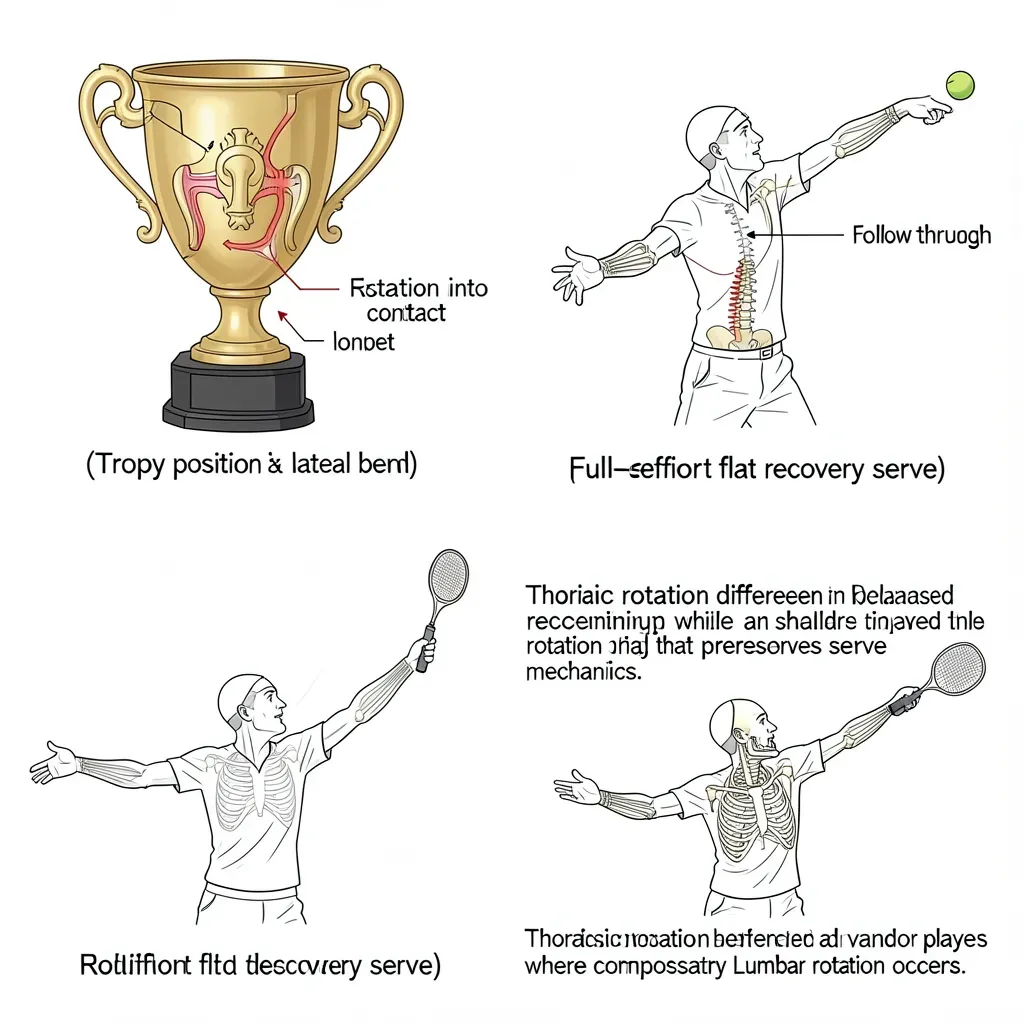
The tennis serve is biomechanically the most demanding movement for the lumbar spine in the sport. The serve loading sequence — trophy position (lumbar extension and side-bend at maximum), rotation into the ball, explosive arm extension — creates a repeated combination of extension, rotation, and lateral flexion that directly compresses the pars interarticularis, the bony isthmus between the superior and inferior articular processes of the lumbar vertebra.
Spondylolysis — a stress fracture of the pars interarticularis — is significantly overrepresented in racket sport athletes compared to the general population. It is most common at L5, occurs more frequently on the dominant side, and is causally linked to the trophy-position load in the serve and the corresponding position in overhead smashes. In young tennis players and in adults who began playing in childhood, imaging findings of pars stress reaction or established spondylolysis are common — and commonly asymptomatic until a high-volume training period, a growth spurt, or a change in surface or intensity tips the system into symptomatic range.
This matters practically for anyone experiencing low back pain that is worse with extension, that is worse with the serve but tolerable with groundstrokes, or that is associated with a previous history of frequent serving. Spondylolysis is not the end of a tennis career — it is a condition that responds to load management, appropriate rehabilitation, and technique modification — but it requires identification.
If your back pain is predominantly provoked by the service action and extension-based movements, and if you have played competitive tennis since adolescence, spondylolysis or spondylolisthesis should be considered in any clinical evaluation. This is a diagnosis that plain X-ray frequently misses — CT scan or MRI with specific pars protocol imaging is the appropriate investigation. Do not accept a normal X-ray as a definitive ruling out of pars pathology.
One-Sided Loading and Asymmetrical Development
Tennis is among the most asymmetrical sports in existence. A right-handed player generates most of their power from a right-dominant rotation pattern, extends their right shoulder above and behind the head hundreds of times per session on serves, and builds hypertrophy preferentially in the dominant-side forearm, shoulder, and trunk rotator musculature. This is visible at the population level: competitive tennis players consistently demonstrate measurable asymmetries in thoracic curvature, shoulder height, and lumbar paraspinal muscle volume.
These asymmetries matter because they create predictable loading imbalances. The dominant-side obliques, QL, and erector spinae work harder than the non-dominant side. Over years of training without countermeasures, this produces:
- Tighter hip flexors and internal rotators on the dominant side
- Reduced thoracic rotation in the non-dominant direction
- QL and erector asymmetry that can perpetuate a subtle lateral pelvic shift
- Shoulder elevation on the dominant side that alters the cervicothoracic mechanics
None of these adaptations are inevitable. They are the predictable result of high-volume, single-direction training without counterbalancing. A structured conditioning program that includes non-dominant side training, thoracic rotation in both directions, bilateral hip mobility work, and deliberate off-court balancing exercises prevents most of them.
Modifications During Recovery
The hierarchy of tennis-specific risk, from highest to lowest, is approximately: flat serve, topspin serve, overhead smash, topspin forehand, one-handed topspin backhand, slice backhand, forehand chip/underspin, two-handed backhand, groundstroke rallies with shortened swing.
This hierarchy has direct implications for what you modify during recovery. Volleys, drop shots, and slice groundstrokes — particularly the slice backhand — are genuinely lower-risk movements for the lumbar spine. They involve less trunk rotation, less extension load, and far less velocity. A player recovering from an acute flare can often maintain rally-based skill work, working on ball placement, footwork, and tactical patterns, using predominantly slice groundstrokes and volleys, without driving symptoms.
The serve is typically the last thing to return. A modified serve — reduced power, no trophy position hyperextension, flat to kick trajectory without aggressive wrist snap — is an appropriate early return option. Hitting serves at 50-60% intensity while maintaining good hip and shoulder rotation will preserve the kinetic chain pattern without the lumbar extension load that drives most serve-related injury.
During recovery, use practice matches or hitting sessions on a short court (service box to service box). This format keeps the ball low and slow, eliminates the serve entirely, develops touch and net skill, and maintains the social and tactical enjoyment of the game. Most intermediate players find that short-court hitting is both safe during back pain rehabilitation and genuinely useful for their overall game.
Warm-Up: Non-Negotiable for Rotation
The lumbar spine's capacity to tolerate rotational load is strongly influenced by tissue temperature and the degree to which the supporting musculature is pre-activated. Cold tissue is stiffer, absorbs less force, and has lower tolerance for the rapid loading of groundstrokes. The electromyographic recruitment of core stabilizers during the first few minutes of rotational activity is measurably lower than after 10-15 minutes of progressive warm-up.
This is not theoretical — it is a consistent clinical observation that a disproportionate number of acute lumbar events in tennis players occur in the first ten to fifteen minutes of play, particularly when that play begins with serving or hard groundstrokes without preparation.
A functional tennis warm-up for the recovering player includes:
Cardiovascular preparation (5 minutes): Light jogging around the court, or light cycling. The goal is tissue temperature, not fitness. If your body feels significantly warmer, it is working.
Hip mobility (3-4 minutes): Hip circles, lateral lunges, leg swings in both the sagittal and frontal planes. This is not stretching for flexibility — it is movement to increase synovial fluid distribution and activate the muscle spindle system.
Thoracic rotation (2-3 minutes): Seated or standing thoracic rotations through full available range. Not forced, not aggressive — smooth, progressive circles that rehearse the movement pattern before it is loaded.
Progressive groundstroke preparation: Mini-tennis (close range) before baseline rallies. Baseline rallies before full-swing groundstrokes. Groundstrokes before serves. Each step adds velocity and load progressively.
This 10-15 minute sequence is not optional when you have a history of back pain. The cost of skipping it is reliably higher than the time it takes.
Training Off Court: Addressing the Root Causes
The most durable protection against recurring tennis-related back pain is not technique modification — though that helps — it is building the physical capacities that allow good technique to persist through fatigue and pressure.
The relevant capacities are:
Thoracic mobility. If thoracic rotation is limited, lumbar rotation compensates. Regular thoracic rotation exercises — quadruped rotations, open-book stretches, rotation in various positions — reduce lumbar load during every forehand and serve for the rest of your career. This is a long-term investment with a guaranteed return.
Hip internal rotation. The ability to rotate through the hip into the follow-through on groundstrokes is a significant determinant of whether the lumbar spine gets involved in trunk rotation. Restricted hip internal rotation is common in tennis players and consistently linked to higher lumbar load.
Core endurance. Not core strength — core endurance. The McGill research distinguishes these explicitly: a spine that can maintain stiffness under sustained or repeated load is protected differently than one that can simply exert force. Side plank holds, Pallof presses, and anti-rotation exercises build the endurance quality that matters for extended sets and matches.
Shoulder mobility. Restricted shoulder elevation on the dominant side forces the lumbar spine to extend more in the trophy position to achieve overhead reach. Addressing posterior shoulder capsule tightness — common in overhead athletes — reduces the extension demand at the low back.
In Review
- Tennis places high rotational demand on the lumbar spine; when thoracic and hip mobility are adequate, most of this rotation bypasses the lumbar segments
- The serve trophy position creates a direct extension-rotation-lateral bend combination that is the primary mechanism for pars interarticularis stress fracture (spondylolysis)
- Spondylolysis is common in tennis players and frequently missed on plain X-ray; request appropriate imaging if extension-based pain is prominent
- Groundstroke modification during recovery should prioritize slice shots and two-handed backhands over topspin forehands; short-court practice is a practical safe alternative
- One-sided training creates predictable asymmetric loading — counterbalancing exercises and bilateral work prevent chronic imbalances
- Warm-up is biomechanically justified and clinically important: most acute lumbar events in tennis occur in the first 15 minutes of cold-start play
- Thoracic mobility, hip internal rotation, core endurance, and shoulder mobility are the off-court capacities that protect the lumbar spine during play
- The serve returns last in any recovery program — modified serve before full-effort flat serve