Fear Avoidance & Back Pain
How fear of movement perpetuates chronic back pain, the fear-avoidance model, and how to break the cycle.
The Fear That Hurts More Than Movement
You tweaked your back lifting something. It was genuinely painful. So you started moving carefully — avoiding bending, bracing before you sit down, skipping the gym "just in case." That caution made sense in the first week or two. The problem is when weeks become months and the caution becomes a way of life.
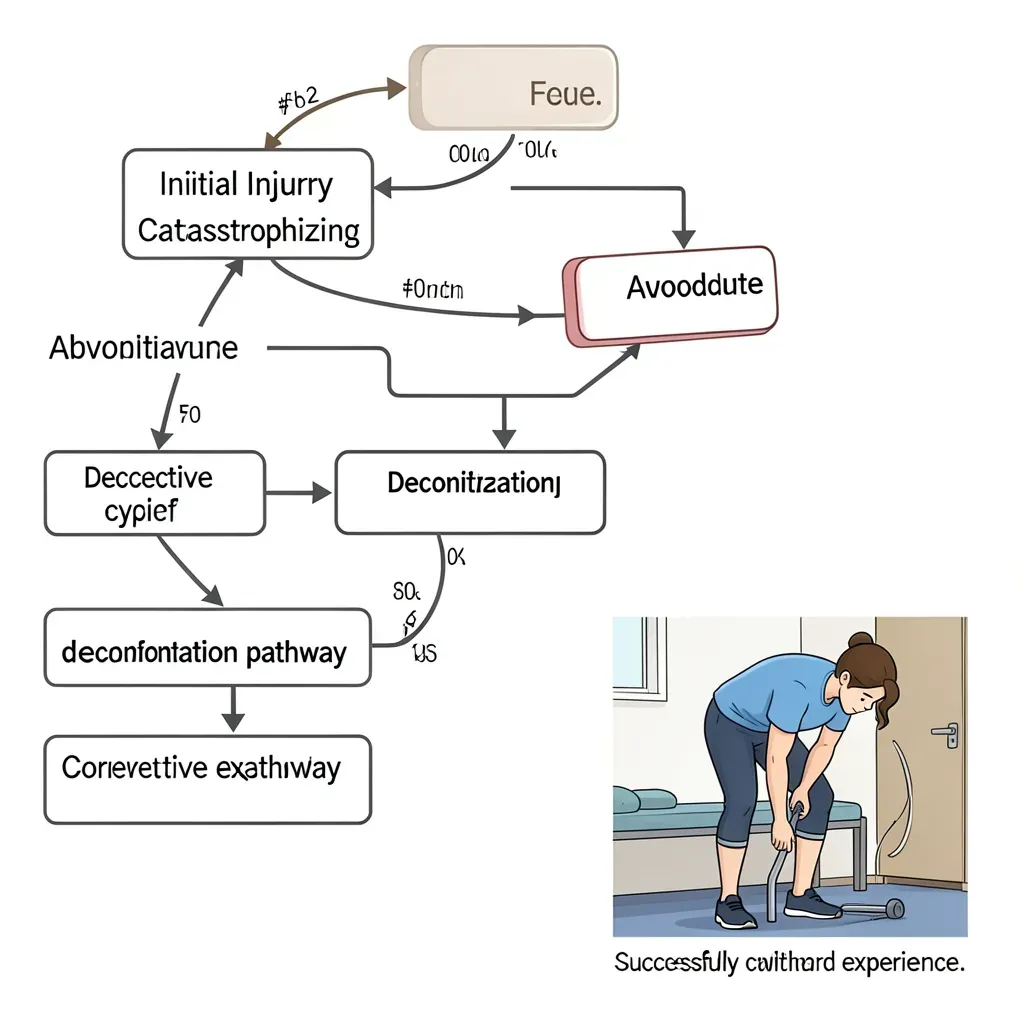
This is the fear-avoidance cycle, first described systematically by researchers Vlaeyen and Linton in 2000, and it is now one of the most well-validated models in chronic pain research. The basic path looks like this: an injury or painful episode leads to pain catastrophizing (interpreting pain as maximally threatening), which produces fear of movement and re-injury, which drives avoidance behavior and hypervigilance to any bodily sensation that might signal danger, which causes deconditioning, disability, and often depression — all of which amplify pain sensitivity, feeding the cycle further.
The striking research finding is this: pain-related fear predicts long-term disability better than pain intensity itself. How much you fear movement matters more than how much you hurt right now. That is both alarming and, once you understand it, genuinely hopeful.
Kinesiophobia: Fear of Movement as a Measurable Phenomenon
Researchers have given a name to pathological fear of movement: kinesiophobia. It is measured clinically with the Tampa Scale of Kinesiophobia (TSK), a 17-item questionnaire assessing beliefs like "Pain lets me know when to stop exercising so I don't injure myself" and "I'm afraid I might injure myself if I exercise."
High TSK scores reliably predict who will still be disabled months after a back pain episode, independent of actual tissue damage. This is not a personality flaw. It is a learned response — often taught inadvertently by healthcare providers, imaging reports, and cultural messages about the fragility of the spine.
Diagnostic language shapes fear. Phrases like "your spine looks like that of an 80-year-old," "bone-on-bone," or "degenerating discs" create a mental image of a crumbling structure that cannot tolerate load. The research is clear: these findings are common in pain-free adults, and they correlate poorly with symptoms. Words from authority figures become load-bearing walls in your pain architecture.
Why Avoidance Makes Sense — and Why It Backfires
In the short term, avoidance is rational. If bending forward caused sharp pain, not bending forward is protective. The nervous system rewards this behavior with temporary relief.
But avoidance has compounding costs. Muscles weaken and shorten through disuse. The cardiovascular system deconditions, making any activity harder. The nervous system, receiving constant signals that movement equals danger, lowers its alarm threshold further — a process called central sensitization. Attention narrows toward threat: you notice every twinge, every tightness, every sensation in your back that you would have ignored before the injury. This attention bias is not hypochondria; it is the nervous system doing what nervous systems do when they believe a region of the body is in danger.
The activities you stop doing are worth naming specifically. Most people with chronic back pain can list them without thinking hard: they stopped playing with children on the floor, stopped hiking, stopped having sex in certain positions, stopped lifting anything meaningful at the gym, stopped sitting through a movie without fidgeting anxiously. These are not trivial losses. They are the texture of a full life, and their absence accumulates into depression and identity erosion.
The Confrontation Pathway
The alternative to the avoidance pathway is confrontation — not reckless loading, but systematic, evidence-informed re-engagement with feared movements. The most rigorously tested approach is in vivo graded exposure: identifying the movements and activities you fear, ranking them by fear intensity, and deliberately exposing yourself to them in a controlled, progressive sequence.
Research comparing graded exposure to education alone shows exposure is significantly more effective for reducing disability in people with high fear. Education helps — understanding that your spine is robust, that pain does not equal damage, that movement is medicine — but understanding alone rarely overcomes a deeply conditioned fear response. The brain learns safety through experience, not information.
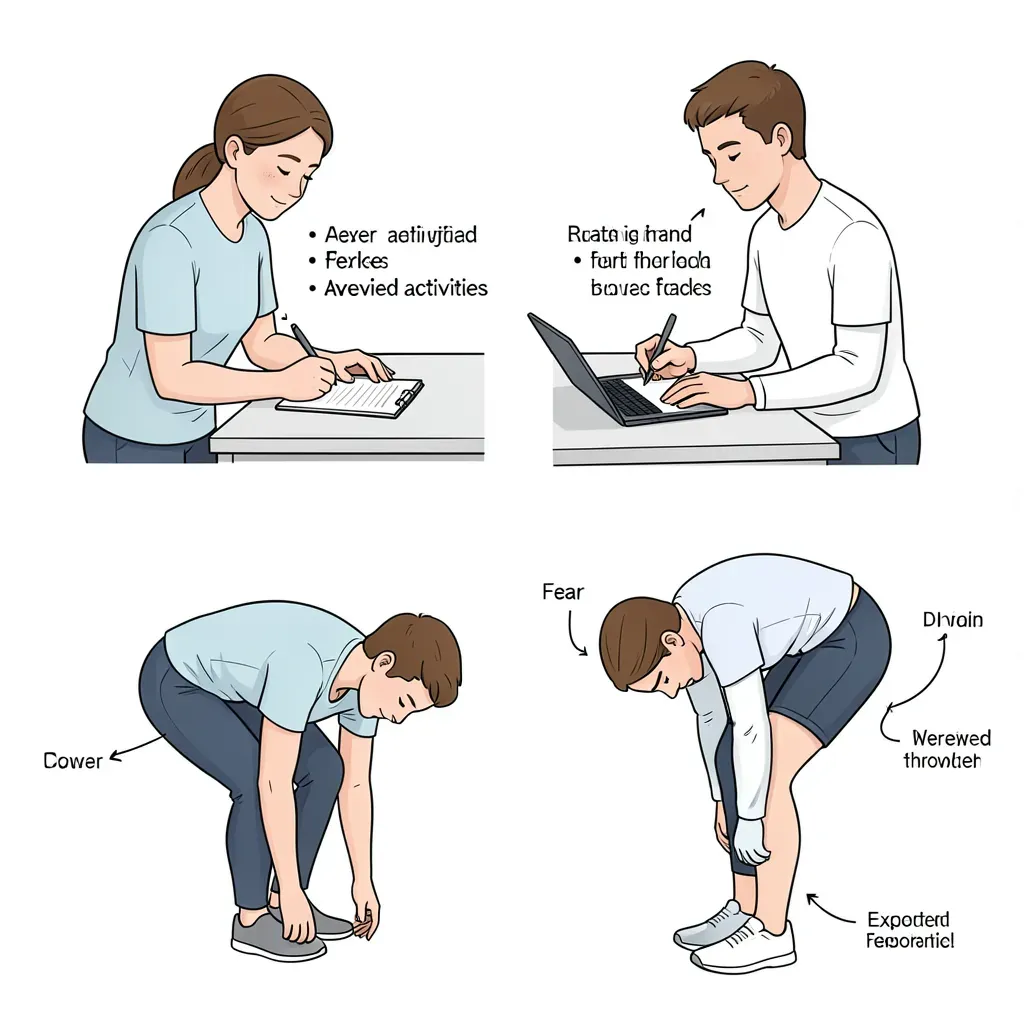
To identify your own avoidance behaviors, ask yourself: What activities have I stopped doing entirely since my back pain began? What movements do I protect around, brace for, or perform very slowly and carefully even when pain is low? What do I avoid "just in case"? Writing a concrete list is the first step in graded exposure — you cannot dismantle a fear hierarchy you have not mapped.
The Role of Safety Behaviors
An important subtlety in the fear-avoidance model is the role of safety behaviors — the things you do while performing a feared activity to prevent the feared outcome. Bracing your core hard before every movement. Bending your knees even for a piece of paper. Never lifting anything heavier than a cup. Moving with glacial slowness.
Safety behaviors feel protective but they maintain fear. They prevent you from getting the information your nervous system needs: that the movement, performed normally, does not produce catastrophe. Graded exposure therefore involves gradually removing safety behaviors alongside the gradual increase in feared activities. This is harder than it sounds, but it is essential.
Breaking the Cycle: Where to Start
You do not need a therapist to begin. Start by listing five activities you have significantly reduced or stopped because of back pain fear. Rate each one from 0 (no fear) to 100 (maximum fear). Pick the one rated around 20-30 — something that feels uncomfortable but not terrifying.
Do it. Repeatedly. Notice that nothing catastrophic happens. Notice that pain, if it occurs, diminishes and does not signal injury. Then move to the next item on your list.
This is not about ignoring pain. It is about learning, through direct experience, that your back is more capable than your fear has told you.
In Review
- The fear-avoidance model explains how pain-related fear, not just pain intensity, drives long-term disability
- Kinesiophobia (fear of movement) is measurable and predicts outcomes better than imaging findings
- Avoidance is rational short-term but causes deconditioning, sensitization, and disability long-term
- Diagnostic language like "degenerating" or "bone-on-bone" creates fear that is often disproportionate to the actual structural reality
- In vivo graded exposure — systematically confronting feared movements — is more effective than education alone
- Safety behaviors (bracing, moving slowly) maintain fear and need to be progressively reduced
- The first step is identifying and listing the activities and movements you have been avoiding