The Elimination Diet Protocol for Chronic Pain
A structured, evidence-based elimination protocol for identifying personal dietary triggers of inflammation — not a fad diet, but a systematic investigation.
Why Elimination, Not Just "Eating Healthy"
Generic anti-inflammatory dietary advice — eat more vegetables, reduce sugar, avoid processed food — is valid but imprecise. It operates on population-level averages and treats all patients as biologically identical. The problem is that inflammatory responses to food are individual. A food that drives systemic inflammation in one person may be completely benign in another. The elimination diet protocol exists to resolve this individual variability in a systematic, evidence-grounded way.
This is not a fad diet or a weight loss program. It is an investigative protocol: a structured 3-phase process designed to identify your personal dietary triggers through controlled removal and careful reintroduction. The methodology is borrowed from clinical allergy medicine and applied to the subtler, slower-moving terrain of chronic inflammation and pain amplification. Clinicians who work with conditions like autoimmune disease, irritable bowel syndrome, fibromyalgia, and chronic musculoskeletal pain have used versions of this protocol for decades with documented success.
The distinction between IgE-mediated food allergy (classic allergy medicine) and IgG-mediated or non-immune food intolerance is important here. True allergies produce rapid, measurable immune responses detectable on skin prick or RAST testing. Food intolerances and inflammatory food responses are often delayed (12–72 hours after exposure), lower in amplitude, and often completely missed by standard allergy testing — which is why the elimination-reintroduction method remains clinically superior to blood panels for identifying dietary triggers of chronic symptoms.
Phase 1: Baseline Tracking (2 Weeks)
Before eliminating anything, establish your baseline. This phase requires two weeks of symptom tracking while eating your normal diet. Its purpose is threefold: it establishes what "your normal" looks like before any intervention, it frequently reveals correlations between specific foods and pain flares that were previously invisible because they were too embedded in daily habit, and it gives you a comparison point for evaluating whether the elimination phase actually produces change.
What to track daily:
- Pain level at waking (0–10), midday (0–10), and evening (0–10)
- Sleep quality (subjective rating, hours, number of awakenings)
- Energy level
- Digestive symptoms (bloating, changes in bowel habits)
- Notable stiffness duration on waking
- Everything you eat and drink, including portion approximations
The tracking method matters less than the consistency. A simple notebook works. An app works. The goal is a complete record you can review across the two-week period for patterns.
Common patterns that baseline tracking reveals: weekend pain spikes after habitual social eating or drinking; pain increases 1–2 days after gluten-heavy meals; bloating that precedes pain flares; consistent poor sleep nights following specific food combinations. These patterns are invisible without a written record because human memory is not designed to track multi-day delayed cause-effect relationships.
Phase 2: Elimination (4 Weeks)
After establishing your baseline, spend four weeks removing the most common dietary inflammatory triggers. The list below covers the categories with the strongest evidence for immune reactivity and inflammatory signaling — it goes beyond the familiar advice to just cut sugar and seed oils.
The core elimination categories:
Gluten — wheat, barley, rye, and cross-contaminated oats. Gluten's link to inflammation extends beyond celiac disease. Non-celiac gluten sensitivity (NCGS) is recognized as a distinct entity involving intestinal permeability changes, systemic cytokine elevation, and joint pain even in the absence of celiac-specific antibodies. Read ingredient labels carefully: gluten appears in soy sauce, many seasonings, processed meats, soups, and sauces.
Dairy — all cow's milk products including butter, cheese, yogurt, and whey protein. Casein (milk protein) is one of the most common delayed inflammatory triggers. The mechanism involves intestinal permeability and immune activation, distinct from lactose intolerance (which is about enzyme deficiency, not immune response). Sheep and goat dairy may be tolerated by dairy-sensitive individuals and can be tested during reintroduction.
Eggs — a common food sensitivity trigger, particularly egg whites (albumin is the most immunoreactive protein). Egg sensitivity often presents as low-level systemic inflammation rather than acute allergic response.
Nightshades — tomatoes, peppers (including spices), eggplant, potatoes (not sweet potatoes). Nightshades contain alkaloids (solanine, capsaicin, chaconine) that may increase intestinal permeability and are reported triggers in a subset of patients with inflammatory arthritis and chronic musculoskeletal pain. The evidence here is less robust than for gluten and dairy, but the category is worth eliminating systematically because of how commonly it appears as a clinical trigger.
Refined sugar and high-fructose corn syrup — drives insulin spikes, promotes advanced glycation end products (AGEs), and increases inflammatory cytokine production. Unlike the immune-mediated triggers above, this effect is relatively consistent across individuals.
Industrial seed oils — soybean, corn, canola, sunflower, cottonseed, and safflower oil in their standard (not high-oleic) forms. These are high in omega-6 linoleic acid, which competitively displaces omega-3 from cell membranes and shifts the prostaglandin balance toward pro-inflammatory eicosanoids.
Alcohol — already covered in chapter 104, but essential to include here as it disrupts intestinal barrier integrity and impairs inflammatory resolution.
During the elimination phase, eat from this unproblematic base: vegetables (excluding nightshades), fruits, legumes, rice, quinoa, sweet potatoes, wild-caught fish, chicken, turkey, grass-fed beef, olive oil, coconut oil, avocado, nuts (except peanuts, which are legumes), and seeds. This is not a nutrient-restricted diet — it is a trigger-excluded diet. Eating enough protein and total calories during this phase is important to avoid confounding fatigue.
What a Positive Response Looks Like
A positive response to the elimination protocol does not mean zero pain. It means a measurable, consistent improvement in your tracked metrics relative to baseline. The most reliable signals are:
- Morning stiffness duration shortens
- Waking pain score is consistently lower (compare week 3–4 of elimination vs. your baseline average)
- Sleep quality improves
- Energy on waking increases
- Digestive symptoms resolve
- The overall pain trajectory during the day becomes less severe
What makes interpretation tricky: the elimination phase often involves a brief worsening in the first 1–2 weeks, particularly with gluten and dairy removal. This is sometimes related to microbiome disruption, withdrawal-like effects (some foods have opioid-receptor-binding properties in their partially digested peptide forms — gluten morphin and casomorphin), or the psychological adjustment to dietary change. If you feel worse in weeks one and two but significantly better by weeks three and four, that trajectory is itself informative.
If you notice no measurable change after four weeks of strict elimination, one of two things is likely: dietary triggers are not a major contributor to your inflammatory load (possible — not all chronic pain has a significant dietary component), or you were unknowingly still consuming one of the trigger categories (cross-contamination with gluten is the most common culprit).
Phase 3: Reintroduction (One Category at a Time)
Reintroduction is where the diagnostic value of the protocol is realized. It is also where most people make the critical mistake of reintroducing too many foods too quickly.
The protocol: after completing four weeks of elimination, reintroduce one food category at a time, in isolation, with a three-day monitoring period between each introduction.
Reintroduction procedure for each category:
- Day 1: consume a moderate serving of the test food at two meals
- Days 2–3: eat your elimination-phase base diet with no new foods; track symptoms carefully
- Day 4: if no reaction was detected, move to the next category. If a reaction occurred, allow symptoms to fully resolve (return to baseline) before testing the next category
The key principle: a delayed inflammatory reaction can appear 24–72 hours after consumption, not immediately. A reaction you attribute to dinner may actually be from a food you ate at lunch two days prior. The three-day gap exists to capture this delayed window.
Recommended reintroduction sequence (start with categories most likely to be tolerated; end with the highest-risk):
- Gluten-free grains (oats, if not already included)
- Eggs (start with cooked yolk only, then introduce whites)
- Nightshades (start with cooked tomato, then peppers, then eggplant)
- Dairy (start with fermented forms — plain yogurt or kefir — then proceed to harder cheeses, then fluid milk)
- Gluten — save for last; reaction recovery takes longer
Common Mistakes
Starting reintroductions before completing four weeks of elimination: The baseline comparison is corrupted; you cannot distinguish improvement from natural variation.
Reintroducing multiple foods simultaneously: If you introduce dairy and gluten in the same week and have a reaction, you cannot determine which caused it. This invalidates the entire reintroduction phase.
Quitting during the week-one worsening: As noted above, early worsening is common and often precedes significant improvement.
Not tracking rigorously: Human memory selectively encodes experiences based on emotional salience. A mildly increased pain day two days after a reintroduction will not be remembered accurately without a written record.
Treating the elimination diet as permanent: A permanent, highly restricted diet that removes categories without confirmed reactivity is nutritionally unnecessary, socially difficult, and not supported by the evidence. The goal is to identify your specific triggers — not to eliminate all possibly reactive foods forever.
Confounding with other variables: Starting the elimination diet simultaneously with a new exercise program, a medication change, or a major life stressor makes it impossible to attribute symptom changes to dietary factors.
In Review
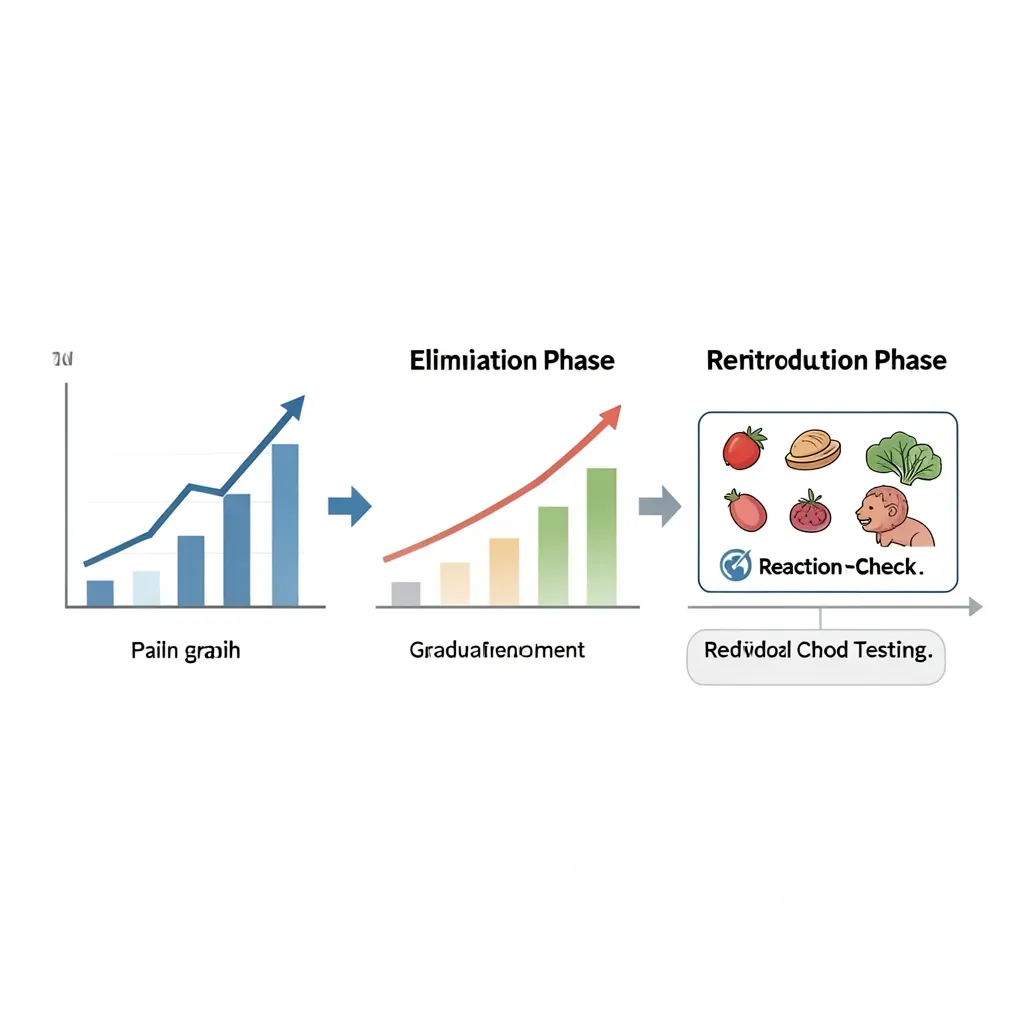
- The elimination diet protocol is a 3-phase investigation: 2 weeks baseline tracking, 4 weeks elimination, then systematic one-at-a-time reintroduction
- Core elimination categories: gluten, dairy, eggs, nightshades, refined sugar, industrial seed oils, alcohol
- Four weeks is the minimum elimination duration — inflammatory resolution from dietary change is measured in weeks, not days
- Morning stiffness duration and waking pain score are the most reliable markers for tracking improvement
- Reintroduction requires a three-day observation gap per food category to capture delayed (12–72 hour) inflammatory responses
- Never reintroduce multiple categories simultaneously — this eliminates the ability to identify which trigger is responsible
- A confirmed food reaction is not necessarily permanent — reactivity often decreases as gut health and systemic inflammation improve
- If four strict weeks produce no measurable change, dietary factors may not be a major driver of your specific pain — this is useful information too