Thoracic Mobility Program
Mobilising the upper back to reduce demands on the lumbar spine — the drills, progressions, and daily practice for thoracic extension and rotation.
Why Thoracic Mobility Is a Lumbar Spine Issue
The spine does not work in sections. When one region is stiff, adjacent regions compensate. The thoracic spine — the 12 vertebrae that form the upper and middle back — is the region most commonly neglected in back pain rehabilitation, and its restriction is a major underappreciated contributor to lumbar loading.
Here is the mechanics. The lumbar spine is built for flexion and extension. It has minimal rotation capacity — approximately 5-7 degrees per segment. The thoracic spine, by contrast, is built for rotation — each segment has 6-9 degrees of rotation capacity, giving the thoracic spine a total rotation range of 70-100 degrees. When the thoracic spine loses this rotation capacity through stiffness, every rotational task the body performs — reaching, twisting, driving, golf, tennis, carrying — borrows the missing range from the lumbar spine. At 5-7 degrees per lumbar segment, the lumbar spine is rapidly pushed to its rotational limits, dramatically increasing torsional disc load.
The most common cause of thoracic stiffness is the modern postural pattern: prolonged sitting with flexed thoracic spine, forward head position, and internally rotated shoulders. This pattern is reinforced by desk work, phone use, and anterior chest muscle tightness that pulls the thoracic spine into flexion and prevents the natural extension of the thoracic curve.
A simple thoracic extension assessment can be performed at home. Lie on your back on a firm surface. Observe whether the thoracic spine lies flat to the floor or whether there is a pronounced gap between the upper back and the floor. Significant kyphosis (rounded upper back) will produce a visible gap. This is a rough but useful indicator of thoracic extension restriction.
Thoracic Extension: The Foam Roller Protocol
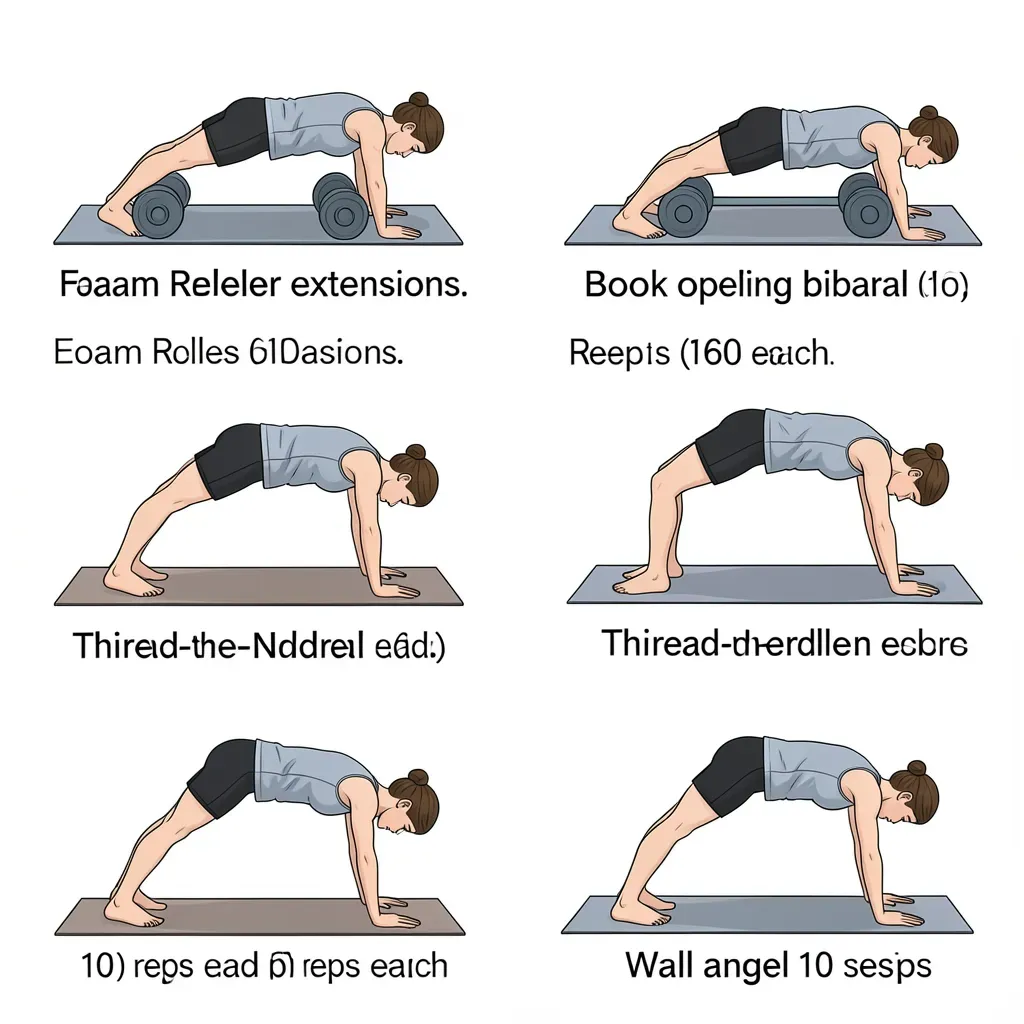
Foam roller thoracic extension is the most effective and accessible thoracic mobilisation technique. The roller acts as a fulcrum, allowing gravity to restore extension at each thoracic segment when the surrounding muscles relax.
Position the roller perpendicular to your spine and lie back over it. Identify the level — start at approximately T8 (mid-thoracic, roughly where the lower tips of the shoulder blades rest). Support your head in your hands or cross your arms over your chest. Allow the thoracic spine to extend over the roller for 30-60 seconds. Then shift the roller 2-3cm toward the head and repeat. Work systematically from T8 up to T4 (upper thoracic). Three to four positions is typically sufficient to cover the relevant range.
You should feel a comfortable release and extension sensation. If you feel sharp or localised pain, reduce the pressure (move the roller slightly away from the tender level) rather than forcing through it.
Thoracic Rotation: The Book Opening
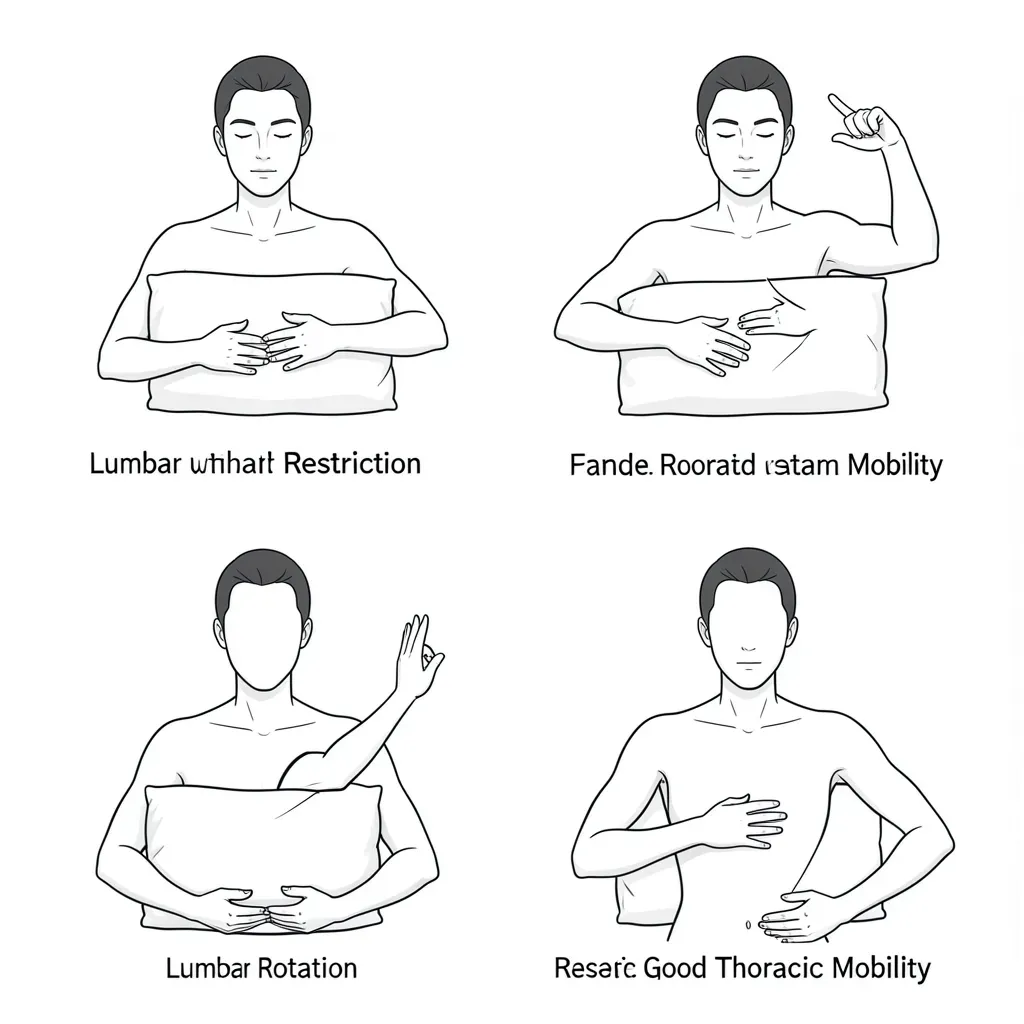
The book opening is the best isolated thoracic rotation drill available. It restricts lumbar rotation through the setup, ensuring that the rotation work occurs at the thoracic spine — where it is needed — rather than being borrowed from the lumbar spine.
Lie on your side with both knees stacked and a pillow under your top knee to prevent the lumbar spine from rotating. Your arms are extended in front of you, palms together. Keeping the lower hand still on the floor, slowly rotate the top arm upward and back (opening like a book), following the hand with your eyes. The thoracic spine rotates. The lumbar spine and hips stay still (the pillow prevents hip roll-through). Return and repeat. Perform 10 repetitions per side.
The range you achieve on day one is your baseline. With consistent practice, this range will improve measurably over 4-6 weeks. The book opening can be performed on any flat surface and requires no equipment.
Thoracic Rotation in Quadruped
The quadruped position (all fours) provides a stable base from which to train thoracic rotation with some loading. From all fours, place one hand behind your head, elbow pointing toward the floor. Rotate that elbow downward (closing) and then upward (opening) as far as possible without moving the pelvis or lower back. Perform 10 repetitions per side.
The quadruped position creates traction between adjacent thoracic vertebrae through the bilateral arm support, which often allows slightly more range of motion than the side-lying version. It is also a useful exercise for people who find side-lying positions uncomfortable.
Thread-the-needle: From all fours, slide one arm under the body and along the floor in the opposite direction — threading it through the space between the arm and the knee. Follow the movement with the head and thoracic spine rotating. Return. This is a gentle, flowing version of the rotation drill that many people find easier to perform with consistent mechanics than the more deliberate quadruped rotation.
Thoracic Extension Drills for the Desk Worker
For people who spend many hours at a desk, thoracic extension drills that can be performed in a chair are valuable for mid-session spine health management.
Seated thoracic rotation: Sit upright in a chair and cross your arms over your chest. Rotate as far as possible to one side, then the other, using the chair back as a gentle pivot point if needed. Perform 10 rotations per direction. This takes 60 seconds and can be performed every hour during a workday.
Wall angel: Stand with your back against a wall, feet about 10cm from the base. Press the entire spine — including the thoracic segment — against the wall. Raise the arms to 90 degrees (goalpost position) with elbows and backs of hands against the wall. Slowly raise the arms overhead while maintaining wall contact. This trains thoracic extension and scapular retraction simultaneously. Most people find wall contact above T6 difficult initially. Work within the available range and progress as mobility improves.
The thoracic-lumbar junction (T12-L1) is a transition zone where the highly mobile thoracic spine meets the less mobile lumbar spine. This junction is frequently stiff and is often a hidden source of lumbar-seeming pain. Include specific foam roller work at this level — position the roller just below the lower tips of the shoulder blades and allow extension there specifically.
Integration into Daily Life
Thoracic mobility work has the best return on investment when it is performed daily and positioned immediately before activities that require thoracic range — before exercise sessions with any rotational component, before extended periods of driving, before working at a computer after a gap.
The total time investment is 8-12 minutes. This is achievable as a morning routine, a before-work preparation, or a pre-exercise warm-up. The critical element is consistency over weeks, not intensity of any individual session.
In Review
- Thoracic rotation restriction forces the lumbar spine to compensate during every rotational task, significantly increasing torsional disc load — addressing thoracic mobility is direct lumbar spine protection
- The foam roller extension protocol (T4-T8, 30-60 seconds per level) is the most effective and accessible thoracic extension technique
- The book opening (side-lying with pillow under top knee) is the best isolated thoracic rotation drill — the pillow setup is essential to prevent lumbar substitution
- Thread-the-needle and quadruped rotation provide additional rotation input in positions that many people find more accessible
- The T12-L1 thoracic-lumbar junction requires specific attention — include foam roller work at this level
- Daily practice for 8-12 minutes produces meaningful improvement within 4-6 weeks; integrate immediately before activities with rotational demands for best transfer