Returning to Work
The evidence on work absence, return-to-work timing, and practical strategies for getting back — whether your job is sedentary or physical.
Work Is a Health Behavior
This is one of the most counterintuitive findings in back pain research, and one of the most important: staying off work longer does not improve back pain recovery — it typically worsens it. Work, including physically demanding work with appropriate modification, is generally beneficial for recovery.
This is not an argument for pushing through unbearable pain. It is the research-backed recognition that the biological, psychological, and social benefits of work — structure, identity, social connection, physical activity, sense of purpose and competence — are not incidental to recovery. They are part of it. And their absence accelerates the deconditioning, depression, and loss of function that prolong disability.
The Numbers on Work Absence
The relationship between work absence duration and return probability is stark and follows a predictable curve. At six weeks off work, most people with back pain do return. By six months off, the return rate drops to around 50 percent. By two years off, fewer than 20 percent return to the workforce. The longer absence continues, the more entrenched the disability becomes — through deconditioning, psychological change, loss of work routine and identity, and the gradual reorganization of life around not working.
This does not mean you should return to work while in agony and making your condition worse. It means that the decision to remain off work should not be driven by the goal of "getting better first" — because for most people, that is not how recovery works. Getting better and returning to work happen together, not sequentially.
A "fit note" (UK) or work restriction note in other countries should describe what you can do, not only what you cannot. Modified duties — changed tasks, reduced hours, different physical requirements — allow work participation during recovery. The evidence strongly supports early return with modification over full absence until recovery.
Why Prolonged Absence Is a Trap
Beyond the statistical reality, the mechanisms by which prolonged work absence maintains disability are well understood.
Physical deconditioning progresses rapidly. Cardiovascular fitness, muscle strength, and movement confidence all decline during bed rest or minimal activity. When the person who has been off work for six months attempts to return to a physically demanding job, the deconditioning alone makes the work painful — creating new pain from a different source (disuse) on top of the original problem.
The sick role — the social identity of being a person who is too unwell to work — becomes more entrenched over time. It carries real psychological and social costs: reduced sense of competence, changed expectations from family and employer, and a progressively more distant relationship with the work environment.
Compensation and legal proceedings create their own psychological terrain. Not dishonestly, but through entirely understandable mechanisms, sustained adversarial processes around injury claims are associated with poorer outcomes. The requirement to continuously prove disability to receive compensation means that demonstrating improvement carries social costs.
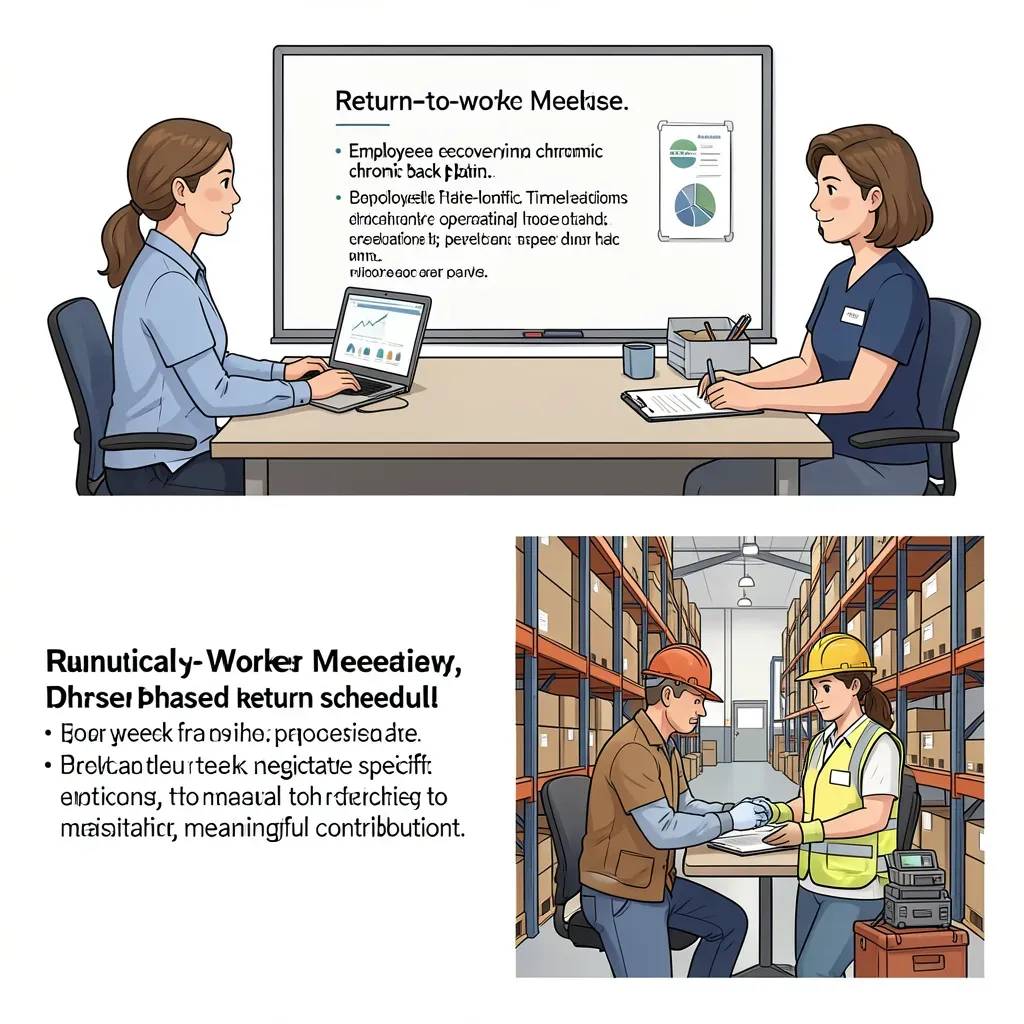
If you have been off work for more than three months with back pain, the return-to-work process requires more than just physical readiness. A structured, phased return — starting with reduced hours or modified duties and building over four to six weeks — is much more likely to succeed than attempting immediate full-time return after a long absence. Speak with your employer and occupational health service about designing a phased plan before your return date.
Modified Duties: How to Negotiate Them
Most workplaces are legally required (in most jurisdictions) to make reasonable adjustments for employees returning from musculoskeletal injury. The key is knowing what to ask for and how to frame the conversation.
For desk-based workers, common and reasonable modifications include:
- Sit-stand desk or regular standing breaks (every 30-45 minutes)
- Ergonomic chair and monitor positioning review
- Temporary reduction in meeting attendance for high-pain periods
- Flexible start time (stiffness is often worse in the morning)
- Permission to walk briefly when pain increases
For manual or physical workers:
- Reduction in maximum lift weight (specify in kilograms, not "light duties")
- No sustained bending or twisting for a defined initial period
- Reduced shift duration with planned increase over weeks
- Task rotation to avoid prolonged static postures
- Specific restriction on particular high-risk activities (e.g., overhead lifting) while maintaining other duties
Write these modifications down as specific requests. Vague requests ("light duties") are harder for employers to accommodate and easier to ignore.
Communicating with Your Employer
What to disclose is a common and legitimate concern. In most countries, you are not required to provide your employer with a specific diagnosis — your medical certificates typically state functional restrictions, not diagnosis. You can share as much or as little about the nature of your condition as you choose.
What is helpful to communicate: the specific activities that are currently restricted, the expected duration of restrictions, your motivation to return (employers want reassurance you want to be there), and your plan for progression (restrictions that reduce over time are more workable for employers than open-ended limitations).
What is less helpful: framing your condition in terms of maximum severity or permanent uncertainty when that is not the full clinical picture. The narrative you present to your employer shapes their planning and expectations.
The Role of Occupational Health
Occupational health services — whether through your employer or independently accessed — are an under-used resource in back pain recovery. Occupational health professionals can:
- Conduct a workplace assessment to identify specific ergonomic and task risks
- Write a functional assessment that supports your modified duty request
- Mediate between you and your employer on realistic expectations
- Identify workplace factors (work demands, supervisor relationship, job satisfaction) that predict whether return will succeed
- Connect you with workplace rehabilitation programs where available
Research consistently shows that psychosocial workplace factors — particularly low job satisfaction, poor supervisor support, and high job demands — predict work disability as strongly as physical factors. If your workplace environment is a significant source of distress, this is worth addressing explicitly as part of your return plan.
For Physical Jobs: The Evidence on Load and Recovery
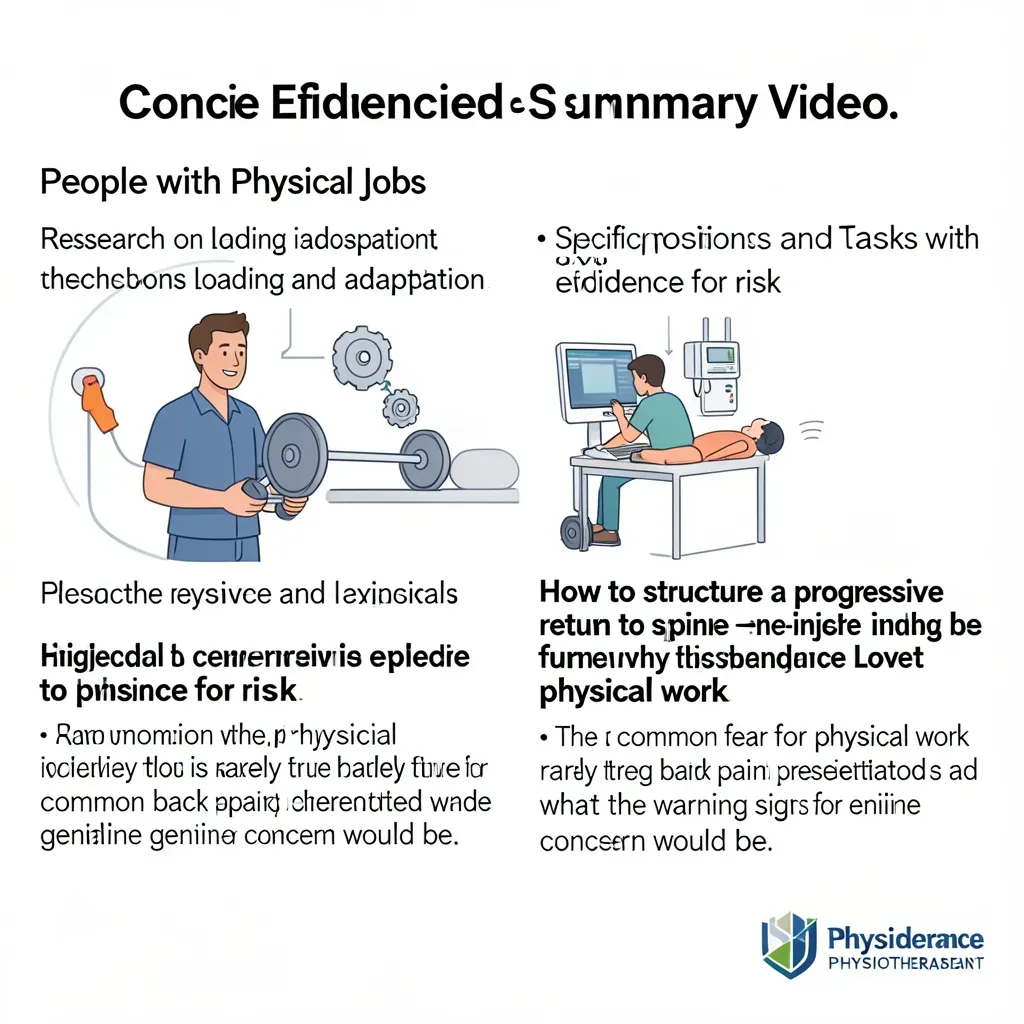
If your job is physically demanding, the question of what is safe to do is legitimate and deserves a direct answer. The evidence supports:
Movement and moderate loads are safe — the back responds to loading with adaptation, not damage, in most presentations. Fear-based complete restriction is counterproductive.
Prolonged static postures (sustained bending, sustained sitting, sustained static muscle contraction) are the higher-risk positions, more so than dynamic lifting with reasonable technique.
Progression matters more than starting point — begin with reduced frequency or duration of physically demanding tasks and build weekly. The 10% rule (increase total load by no more than 10% per week) provides a conservative, evidence-based framework.
Work is medicine. The structure, identity, social contact, and physical activity that work provides are each independently beneficial for chronic pain recovery. The goal of the return-to-work process is not to endure work despite being unwell — it is to use the return to work as part of an active recovery strategy.
In Review
- Early return to work with modification produces better outcomes than prolonged absence — the evidence is consistent and clear
- The probability of returning to work drops sharply with duration of absence: ~50% at 6 months, less than 20% at 2 years
- Prolonged absence causes deconditioning, entrenches the sick role, and removes the biological and psychological benefits of work
- Modified duties should specify concrete restrictions (lift limit in kg, hours, specific tasks) rather than vague "light work"
- In most jurisdictions, reasonable adjustments are legally required — know your rights and make specific requests
- Occupational health services can mediate, assess, and support the return process
- Psychosocial workplace factors (job satisfaction, supervisor support) predict return-to-work success as strongly as physical factors
- For physical jobs, progressive reloading is safe and adaptive — prolonged static postures are higher risk than dynamic movement