Acceptance & Commitment Therapy
ACT principles for chronic back pain — why acceptance is not resignation, and how values-based action changes the relationship with pain.
A Different Goal
Most chronic pain treatments share an implicit goal: reduce the pain. Physiotherapy, medication, injections, surgery — all are aimed at changing the signal. Even CBT often frames the target as reducing pain intensity or disability.
Acceptance and Commitment Therapy (ACT) proposes a different goal: increase psychological flexibility — the ability to live a rich, full, values-driven life even when pain is present.
This sounds like settling. It is not. It is a reorientation based on a clinical observation: for many people with chronic pain, the struggle against pain — the effort to eliminate it, suppress it, control it, or avoid it — consumes more life than the pain itself. ACT targets the struggle. When the struggle diminishes, life often expands in ways that also reduce pain — but pain reduction is a byproduct, not the primary aim.
RCT evidence shows ACT is as effective as CBT for chronic pain, with particular advantages in psychological flexibility, quality of life, and acceptance. For some patients — particularly those who have been fighting pain for many years without success — ACT's reorientation is more tractable than continuing to target pain reduction directly.
The Six Core Processes
ACT is built around six interrelated psychological processes that together comprise psychological flexibility.
Acceptance means allowing pain and difficult thoughts to be present without fighting them. Not liking them. Not wanting them. But not spending resources trying to eliminate them either. The counterintuitive finding is that accepting pain often reduces its emotional grip more effectively than trying to manage or suppress it.
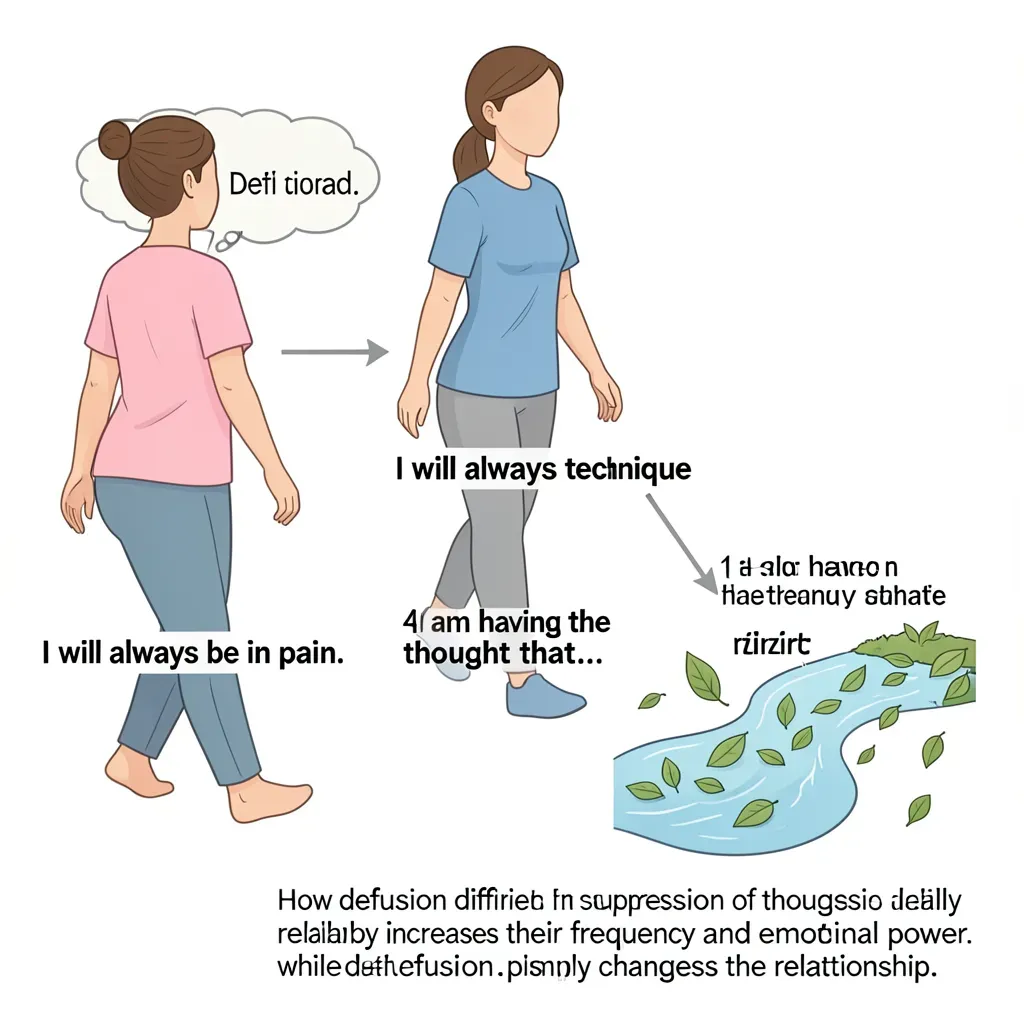
Cognitive defusion changes your relationship to your thoughts. The goal is to see thoughts as mental events — products of a pattern-matching brain — rather than facts. "I will never recover" becomes "I am having the thought that I will never recover." This slight distance is not trivial. It removes the automatic authority thoughts carry when they are fused with reality.
Present-moment awareness means engaging with what is actually happening right now rather than ruminating on past pain episodes or dreading future ones. Mindfulness practices are the training ground for this process.
Self-as-context is the ability to observe your experience from a stable vantage point — the "observer self" that notices thoughts, feelings, and sensations without being defined by them. This matters in chronic pain because many sufferers become identified with their pain: "I am a back pain patient" becomes the primary self-description, narrowing identity and amplifying suffering.
Values clarification is the heart of ACT. Values are not goals (achievable endpoints) but directions of travel — ongoing commitments to what matters. What kind of person do you want to be? What relationships, activities, and contributions matter most to you? In chronic pain, values often become dormant: "I'll get back to being a good parent / active person / professional when my pain is better." Values clarification asks: what does being those things look like today, with pain present?
Committed action means doing what matters — consistently, in service of your values — despite pain, not in the absence of it. This is not masochism. It is the recognition that waiting for pain to be gone before living often means waiting indefinitely.
ACT does not ask you to pretend to be positive about pain or to stop trying to get better. You can still pursue every reasonable treatment, work with your physiotherapist, take appropriate medication. ACT changes your relationship with the pain that remains in the meantime — which is often the majority of the suffering.
Acceptance vs. Resignation
This distinction is the most important in ACT and the most commonly misunderstood.
Resignation says: "My back will always hurt and there is nothing I can do, so I give up." It is passive, hopeless, and associated with depression.
Acceptance says: "Pain is present right now. I am not going to spend energy fighting this moment. I am going to engage with what matters anyway." It is active, values-directed, and coexists with continued pursuit of recovery.
A useful analogy: imagine you are lost in the wilderness. Acceptance means clearly acknowledging you are lost and stopping the exhausting behavior of refusing to believe it — not because being lost is fine, but because clear-eyed acceptance is the prerequisite for effective problem-solving. Struggling against the reality of being lost wastes the energy needed to find the way home.
The ACT "choice point" exercise: when pain is present and you are considering whether to engage with a valued activity or withdraw, ask yourself — is this choice moving toward your values or away from them? Not "will it hurt?" or "will I feel like it?" but "does this move me toward the life that matters to me?" This single question, applied consistently, is one of the most powerful tools in ACT.
Cognitive Defusion in Practice
Defusion techniques might seem strange at first. Common approaches include:
Naming the story: "There goes my 'I'm broken' story again." Recognizing recurrent thought patterns as familiar narratives rather than new revelations.
Thanking your mind: "Thanks, mind, for that thought about permanent disability." Acknowledges the thought is generated by a mind trying to protect you, without accepting it as truth.
Leaves on a stream: A mindfulness exercise where thoughts are placed on imaginary leaves floating past. They are observed but not grabbed. Pain-related thoughts float through rather than being seized and amplified.
None of these techniques deny the thought. They change its function — from a command that must be followed to a mental event that can be noticed and released.
Values Clarification: What Actually Matters
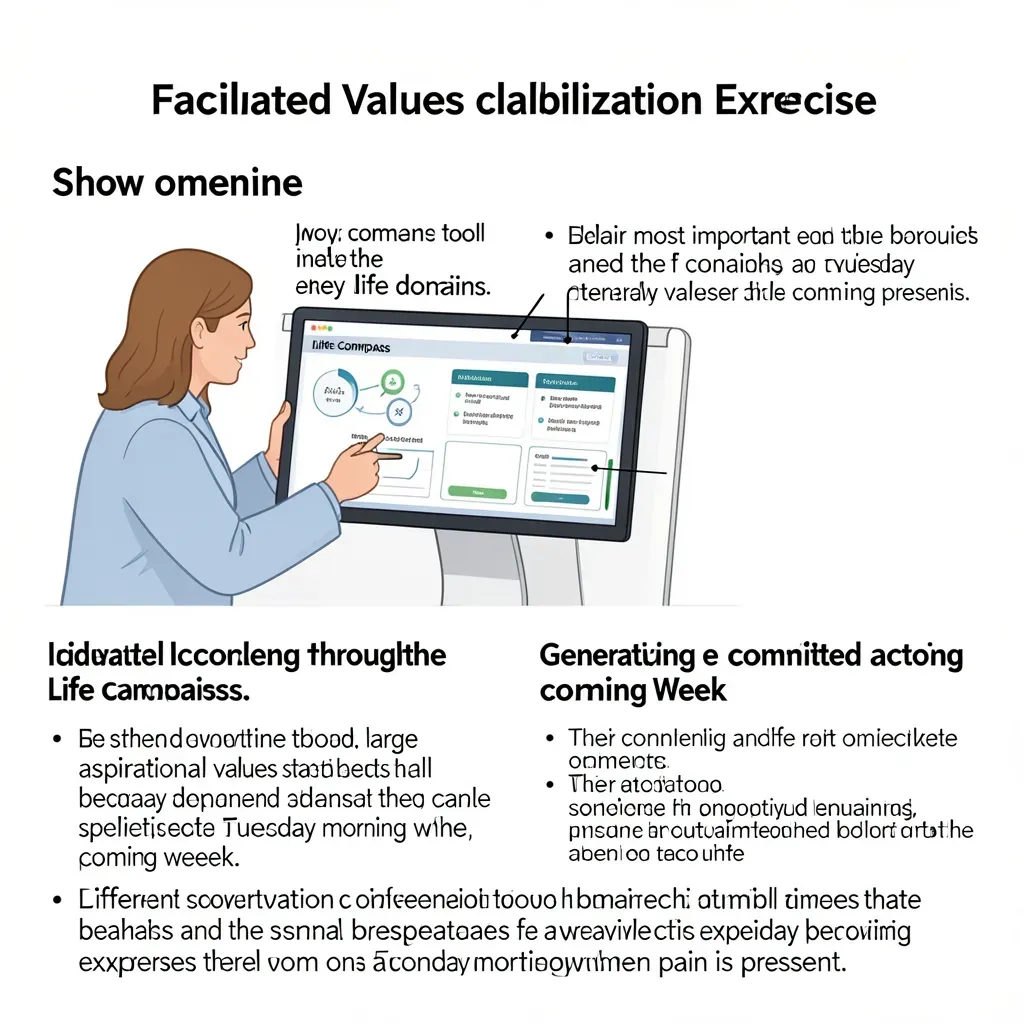
A values clarification exercise: pick three life domains that matter to you (relationships, work, health, recreation, community). For each domain, write: what kind of person do you want to be in this area? What would you be doing differently if pain were not the organizing principle of your life?
Then identify one small action in each domain you could take this week — not contingent on pain being low, but alongside whatever pain is present. This is committed action: the concrete expression of values through behavior.
The daily ACT practice is simple in structure: choose one values-consistent action per day regardless of pain level. Do it. Notice the impact on mood, sense of self, and relationship to pain. Repeat.
ACT involves sitting with discomfort — both physical and psychological — in ways that feel counterintuitive when your instinct is to reduce discomfort. If you have a history of trauma or significant depression, working with an ACT-trained therapist is strongly recommended rather than attempting self-directed ACT, as some acceptance processes can be destabilizing without appropriate support.
In Review
- ACT's goal is psychological flexibility — a full, values-driven life alongside pain — rather than pain elimination as the primary target
- The six core processes are acceptance, cognitive defusion, present-moment awareness, self-as-context, values clarification, and committed action
- Acceptance is not resignation — it is clear-eyed acknowledgment that allows effective action, not passive hopelessness
- Cognitive defusion changes the relationship to thoughts (from facts to mental events) without suppressing or arguing with them
- Values clarification identifies what matters most; committed action means doing those things despite pain, not after it resolves
- RCT evidence shows ACT is as effective as CBT for chronic pain, with particular benefits for psychological flexibility and quality of life
- The daily practice: choose one values-consistent action per day regardless of pain level