Housework & Cleaning
Vacuuming, mopping, making beds, and scrubbing — practical modifications for every common household task that loads the lumbar spine.
Housework Is Not Light Activity for a Recovering Spine
People with back pain are often advised to avoid heavy lifting and strenuous exercise, then sent home to do their own housework without a second thought. But vacuuming a medium-sized apartment, making three beds, and loading the washing machine represents a significant volume of lumbar flexion, rotation, and load-bearing movement.
The cumulative nature of housework is its defining biomechanical risk. None of the individual tasks is severe. Done repeatedly, in the same posture, over 60-90 minutes, they produce the same posterior disc loading as more obviously aggressive activities.
Vacuuming
Vacuuming is biomechanically complex. The typical technique combines: forward lean of the torso, reach with one arm, and a sweeping side-to-side stroke that introduces rotation. Over a moderate room, this pattern repeats 50-100 times.
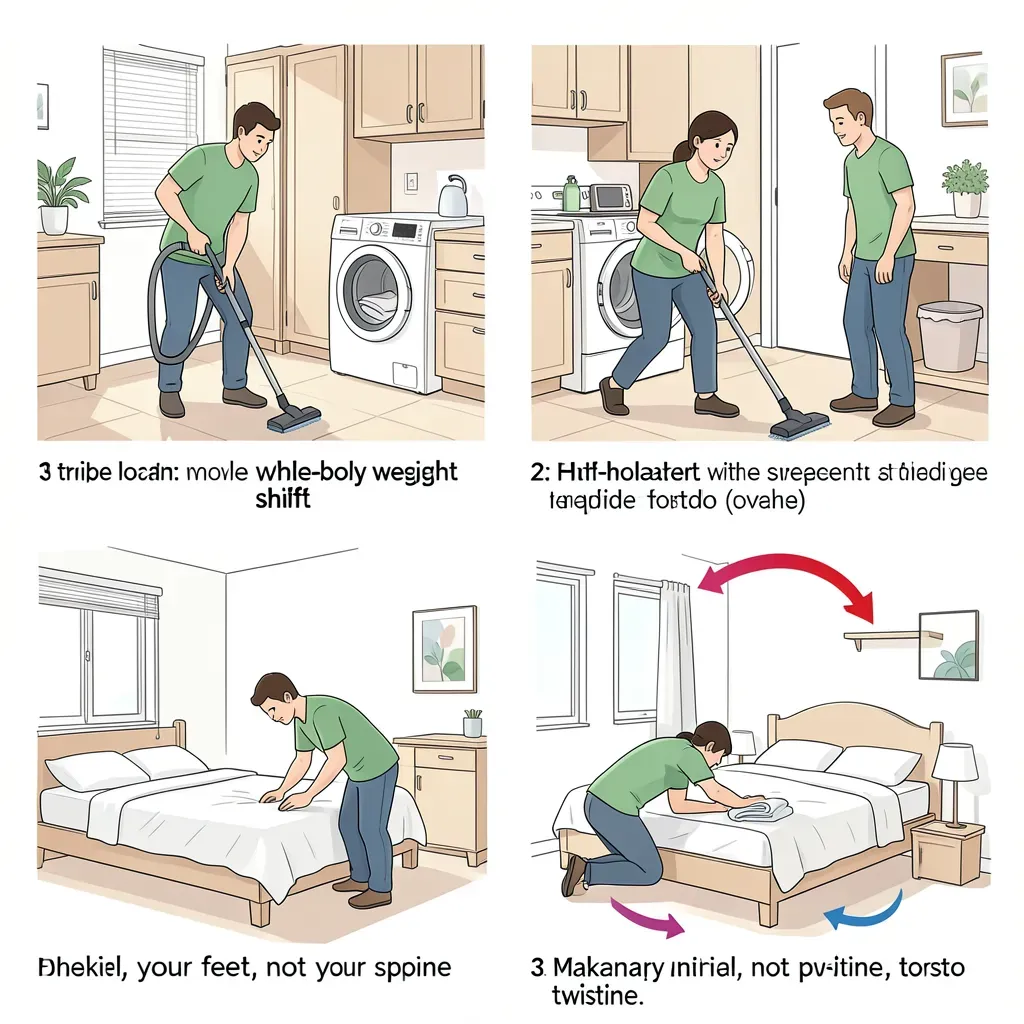
Stride stance: Place one foot forward and one foot back, with a moderate split stance. This allows your body to move forward and back with the vacuum using your legs rather than bending your back with each stroke. Think of it as walking while holding the vacuum — not standing still and reaching.
The reach problem: The main spinal load in vacuuming comes from reaching the vacuum forward to the end of the stroke. At full reach, your body is in partial forward lean with the arm extended. Keep the stride short — push and pull the vacuum over a shorter arc and take more steps forward, rather than a large arc with fewer steps.
Rotation: The sweeping left-right stroke is the second load source. Perform it by shifting your body weight side to side rather than twisting your torso. Your shoulders and hips move together — the spine does not rotate relative to the pelvis.
Cord management: Many vacuuming injuries are not from the technique but from the cord. Stepping over or stumbling on a vacuum cord in a bent position is a reliable acute injury mechanism. Keep the cord consistently to one side, behind you, and route it as you move so it is never in your path.
Robot vacuums as a medical device: For people in an acute flare, a robot vacuum is a legitimate spine management tool. Vacuuming is not a test of willpower.
Mopping
Mopping shares the same stride-stance and whole-body-sweep principles as vacuuming. The additional factors are water weight if using a bucket (see the carrying principle: bilateral handles, keep close to the body) and wet-floor slip risk.
Long-handled mops are significantly better than short-handled ones for tall people. A mop handle that keeps you upright is the most important selection criterion.
Making a Bed
Making a bed involves sustained bending over a surface at mid-thigh height — the worst working height for lumbar loading because it puts you in a partial forward lean throughout.
The kneeling method: Rather than standing and bending over the mattress edge repeatedly, kneel on the floor at each side of the bed and work from that position. This keeps your torso more upright relative to your work and transfers the load to your knees (a far more tolerant structure than the lumbar spine for this type of task).
Starting and ending tucks: The sheet tuck at the corners is a deep-reach, bent-over-the-mattress task. Kneel on the floor at the corner, reach under the mattress from a kneeling position rather than bending over the bed. Stand to move to the next corner.
Pillowcases: Pillowcases are often done with the pillow dangling low while you pull the case on — which means holding a weight at arm's length at low height. Prop the pillow against a wall or headboard at a height where you can work on it without reaching down.
If making beds triggers your back, start with the fitted sheet only and assess how you feel before continuing. The fitted sheet corners are the highest-load component. If that goes well, continue. If it provokes symptoms, stop and return later or ask for help. Bed-making is not a task that must be completed in a single session, and an unmade bed is not a medical problem.
Laundry: Front-Loading Washing Machines
Front-loading washing machines are the most consistently problematic appliance for back pain. The drum opens at approximately shin height, requiring deep forward bending to load and retrieve items, repeated for every piece of clothing.
Loading technique:
- Place the laundry basket on a low stool or chair to reduce the carry distance and height transition.
- Squat or half-kneel in front of the machine for loading. The alternative — bending at the waist for each item — produces 20-30 cumulative flexion loads for a standard wash load.
- For larger items (sheets, towels), stuff them in from a kneeling position in one or two movements rather than individual piece-by-piece loading.
Unloading: The same principles apply in reverse. Half-kneeling in front of the open drum, pulling items out rather than reaching deep in. The temptation to grab from a standing forward bend is high — items are wet, the drum is low, and it feels efficient. It is efficient. It is also how cumulative disc loading works.
Carrying the laundry basket: Full laundry baskets weigh 4-8 kg. Carry bilaterally at waist height. Place the basket on a surface to load rather than holding it with one arm while loading with the other — the asymmetric position is worse than the symmetric carry.
Laundry day concentrates all the high-risk laundry tasks into a single session: loading the machine, transferring wet laundry to the dryer or line, folding on a low surface, and putting items away (including low drawers). For someone in recovery, spreading these tasks across the day rather than completing all of them in one 45-minute session significantly reduces the cumulative flexion load.
Scrubbing Surfaces
Counter and stovetop level scrubbing: Standing at counter height and scrubbing is a relatively manageable posture as long as you maintain a neutral lower back. The shoulder and arm effort is forward, not requiring lumbar flexion.
Floor scrubbing: This is a kneeling task. Scrubbing a floor on your hands and knees is acceptable mechanically — the back is relatively neutral in the quadruped position. The transition to and from the floor (getting up and down) is the higher-risk moment. Use both hands on a stable surface to lower and raise yourself.
Toilet cleaning: Kneel on one knee beside the toilet rather than bending over it from standing. A long-handled toilet brush eliminates the need for forward reach and is one of the simplest tool upgrades available.
Shower and bath scrubbing: Scrubbing the inside of a shower from a standing position on a wet surface is risky for slip as well as posture. Use a long-handled brush where possible. For baths, kneel outside the bath rim rather than leaning over it.
The Rotation Rule
One consistent principle across all cleaning tasks: eliminate torso rotation under load. Rotation of the lumbar spine is tolerated well when the spine is in a neutral, unloaded state. Combined with forward flexion and carrying weight, it becomes the most reliable mechanism for posterior annular loading.
Whenever a cleaning task requires you to twist — vacuuming, raking debris into a dustpan, carrying a basket around a corner — move your feet instead of rotating your spine. The extra step is always the right answer.
In Review
- Vacuum in a stride stance, using your legs to advance rather than bending with each stroke. Keep the stroke arc short; take more steps.
- Use the kneeling method for making beds — work from the floor at each side rather than bending over the mattress edge.
- Squat or half-kneel at the front-loader washing machine for every item loaded or unloaded. The bend-per-item approach accumulates 20-30 flexion loads in a single wash cycle.
- Carry laundry baskets bilaterally at waist height. Spread laundry tasks across the day, not all in one session.
- Kneel beside the toilet; use a long-handled brush. Kneel outside the bath rim for scrubbing.
- The universal rule: move your feet instead of rotating your spine whenever a task requires turning.