Swimming Technique for Back Pain
Stroke-by-stroke technical breakdown — how to swim in a way that unloads rather than loads the spine.
Why Swimming Is Different
Water changes the mechanical environment of the spine in fundamental ways. Buoyancy offloads approximately 90% of body weight at shoulder depth. Spinal compressive loading during swimming is a fraction of any equivalent land-based activity. The horizontal body position eliminates the gravitational compression that accumulates across an upright day.
These properties make swimming the most spine-friendly aerobic activity available to most back pain patients. But "swimming is good for back pain" is a dangerous oversimplification. Stroke technique determines whether you are actually unloading the spine or continuously loading it in ways that maintain your injury. The details matter.
This chapter covers each stroke systematically — not as a swimming instruction manual but as a technical guide for how each stroke interacts with a spine in recovery.
Backstroke: The Safest Stroke
Backstroke is the spine's preferred stroke during recovery. The supine position (floating face-up) puts the lumbar spine in a gentle supported extension — roughly the opposite of the flexion posture that accumulates during sitting and forward bending. Buoyancy supports this position passively.
Key technique points for back pain patients:
Kick continuity. The flutter kick in backstroke serves two purposes: propulsion and hip stabilization. A continuous, low-amplitude kick maintains horizontal body position. When the kick lapses, the hips begin to sink, the lumbar spine flexes under the water's resistance, and the spine-sparing position is lost. Keep the kick active throughout.
Arm entry position. Arms should enter the water at approximately shoulder width — not significantly wider or narrower. Wider entry causes the body to rotate excessively around the long axis, which loads the lumbar spine in rotation. Narrower entry reduces propulsion and destabilizes the stroke. Shoulder-width entry maintains a balanced rotational demand.
Rotation and lumbar involvement. Backstroke involves rhythmic body rotation with each arm pull. This rotation should come from the thoracic spine and hips — the lumbar spine should remain relatively quiet. A common fault is rotating predominantly from the lumbar spine, which creates the same loading pattern as exercises specifically warned against in this guide.
Freestyle: Bilateral Breathing and High Elbows
Freestyle is the most common recreational and fitness stroke. It can be excellent for back pain patients or aggravating, depending almost entirely on two technique variables.
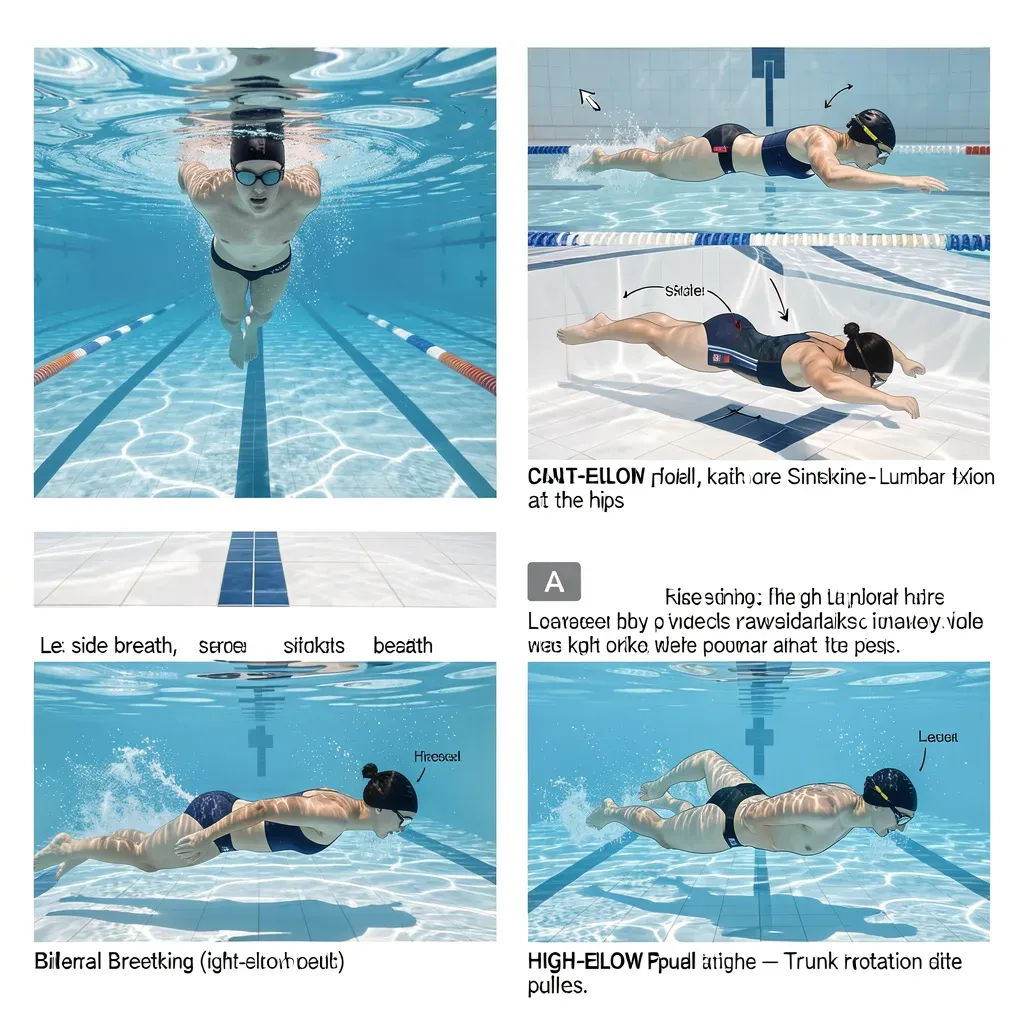
Bilateral breathing (every three strokes). Breathing to the same side every two strokes is the most common recreational pattern and creates significant rotational asymmetry across a swim session. Over a 1,500-meter swim, this asymmetry means hundreds of asymmetric trunk rotations. Bilateral breathing — alternating sides every three strokes — distributes rotational demand symmetrically across both sides of the spine.
If you are currently a one-sided breather and find bilateral breathing disorienting, practice it deliberately for several sessions. The short-term awkwardness is worth the long-term protective benefit.
High-elbow pull. The underwater pull phase is where propulsion is generated. A low-elbow pull (elbow dropping below the wrist) forces the trunk to rotate more to generate force. A high-elbow pull (elbow remaining near the surface, wrist below the elbow) allows the large muscles of the back and shoulder to drive the stroke without requiring compensatory trunk rotation. For any back pain patient, learning the high-elbow pull is not just a performance improvement — it is a spinal protection technique.
Two-beat kick. Competitive freestylers often use a six-beat kick (six kicks per two-arm stroke cycle). The two-beat kick (one kick per arm pull) reduces rotational demand on the trunk and is adequate for fitness swimming. It also reduces the total muscular work per lap, allowing longer sessions before fatigue sets in.
If you take nothing else from this chapter for freestyle, take these two: breathe bilaterally and keep the elbow high during the pull. These two changes address the most common ways recreational freestyle loading injures backs, and both are learnable in a single focused swim session.
Breaststroke: Managing the Glide Phase
Breaststroke is the most technically complex stroke from a spine-protection standpoint. The glide phase — the moment after the kick where the body is fully extended and streamlined — involves lumbar extension if performed with full range. For extension-sensitive conditions (facet syndrome, spondylolisthesis), this is the problem moment.
Modification for back pain: Maintain a slight abdominal brace throughout the glide phase rather than relaxing completely into extension. This does not eliminate the streamlined position — it simply prevents the lumbar spine from reaching end-range extension. The performance cost is minimal. The protective benefit is significant.
The whip kick. The breaststroke kick is mechanically demanding on the knees, but also loads the lumbar spine. The final drive phase of the kick involves a hip extension component that can provoke extension-sensitive spines. Reducing kick amplitude — a narrower, less aggressive kick — reduces this demand without eliminating the stroke's propulsion.
Head position. The breaststroke head lift for the breath creates cervical extension. Pair this with the lumbar extension of the glide and you have simultaneous cervical and lumbar extension loading. Keep the head lift minimal — just enough to clear water for breathing.
Butterfly: Defer Until Full Recovery
Butterfly is the most lumbar-intensive stroke in swimming. The dolphin kick requires powerful lumbar spine extension and flexion through a full range of motion on every stroke cycle. The undulation that drives butterfly propulsion is essentially a repetitive spinal extension and flexion exercise performed against water resistance at speed.
This is not the context in which to perform that movement pattern during recovery. Defer butterfly until you are fully returned to sport, Big 3 targets are comfortably exceeded, and you are swimming regularly without symptoms in the other three strokes.
If a lane-mate or coach suggests butterfly as part of a fitness program during your recovery, decline. It is genuinely the wrong stroke for this phase. This is not excessive caution — butterfly is mechanically the one stroke that specifically loads the spine through the full range that recovery protocols are designed to protect.
Flip Turns: Replace With Open Turns
The flip turn requires rapid forward flexion as you approach the wall, followed by a forceful push-off in a compressed position. This combination — high-speed spinal flexion into a loaded extension — is one of the riskier mechanics in a swimming session for disc-related pain.
Open turns are the straightforward alternative: touch the wall with your hand, rotate to push off on your back or side, then resume the stroke. They are slower. They are also the modification you should be using throughout your recovery.
For backstroke specifically, you can push off the wall in full supine position and continue directly into the stroke — the entire turn sequence involves no spinal flexion at all.
Pool Walking: Technique Matters
Pool walking is often underestimated as a rehabilitation tool. Water resistance increases with velocity as the square of speed, meaning that walking quickly in waist-deep water provides a significant cardiovascular and muscular stimulus while gravity loading remains dramatically reduced.
Technique: Upright posture is essential. The temptation in water is to lean forward due to the resistance — resist this. Arms should swing naturally as they do in land walking. Walk at a pace that creates noticeable water resistance without requiring forward lean.
Depth progression: Chest-deep water reduces body weight by approximately 75%. Waist-deep reduces it by approximately 50%. Beginning chest-deep and gradually reducing depth over weeks is a structured progressive loading approach.
The Swim Warm-Up Protocol
Cold pool entry without warm-up is a common mistake. Muscles that are not warmed up have reduced force output and reduced proprioceptive accuracy — both relevant to stroke technique and injury risk.
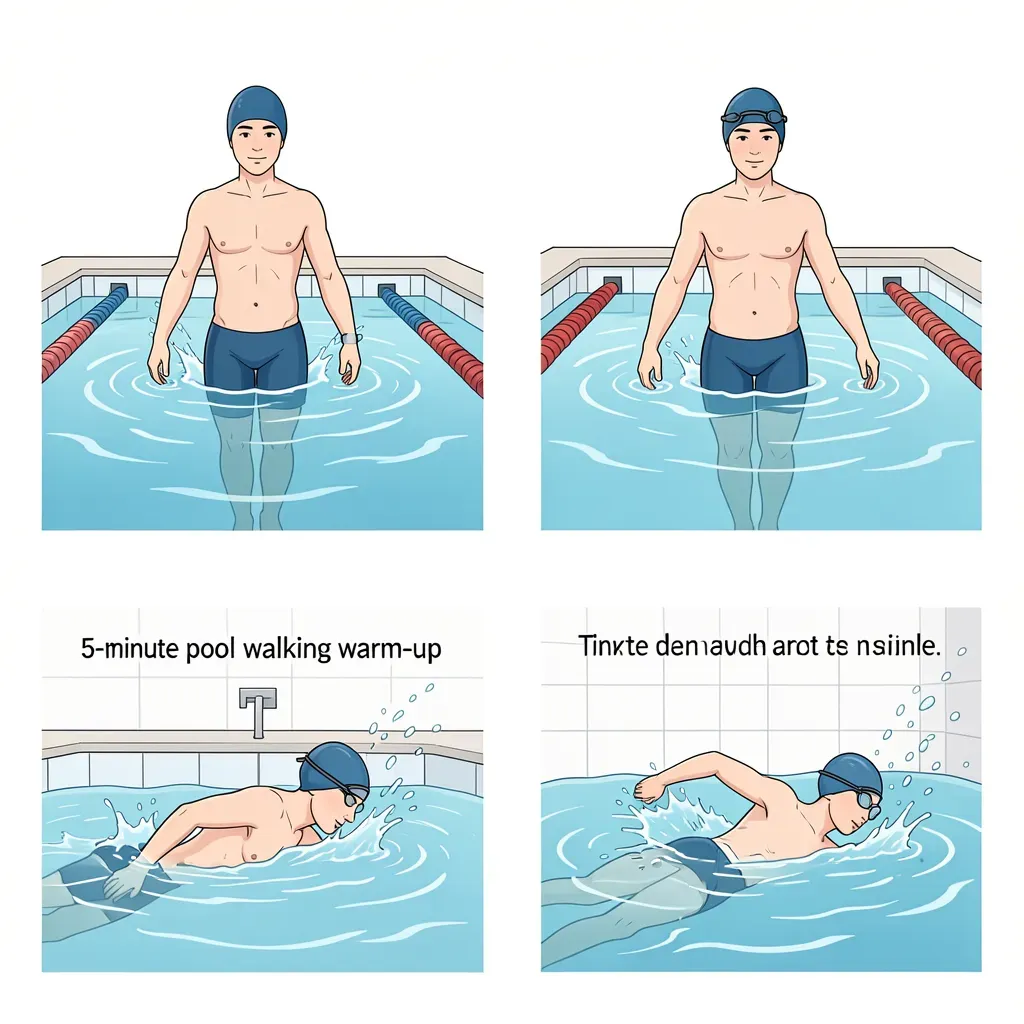
- 5 minutes of pool walking at moderate pace before any stroke swimming
- Backstroke for the first 2 laps regardless of your intended main stroke — the supine position is a natural warm-up for any freestyle or breaststroke session
- Gradual pace progression — first 300 meters at easy effort before swimming at workout pace
Water temperature is relevant. Cold water (below 80°F / 27°C) reduces muscle extensibility and can increase protective muscular tension in the lumbar region. Warm water pools (82–86°F / 28–30°C), common in rehabilitation facilities, provide therapeutic thermal benefit alongside the mechanical unloading of buoyancy. If you have access to a warmer pool, prefer it during early recovery.
In Review
- Buoyancy offloads up to 90% of body weight, making swimming the most spine-friendly aerobic option — but technique determines whether the spine is actually protected
- Backstroke is the safest stroke: supine position, continuous kick to maintain hip position, arms entering at shoulder width
- Freestyle: bilateral breathing every three strokes prevents rotational asymmetry; high-elbow pull reduces trunk rotation demand
- Breaststroke: maintain a slight abdominal brace during the glide phase to prevent end-range lumbar extension; reduce kick amplitude
- Butterfly should be deferred until full recovery — the dolphin kick undulation is essentially a repetitive spinal extension exercise
- Replace flip turns with open turns throughout recovery to eliminate the high-speed flexion-into-extension mechanics
- Pool walking at chest depth in warm water is an excellent early-rehabilitation tool; upright posture throughout
- Always begin with 5 minutes of pool walking and 2 backstroke warm-up laps before the main session
- Warm water pools (82–86°F) provide additional therapeutic benefit during early recovery phases